An articulated truck is a heavy-duty vehicle with two distinct sections—a tractor unit and a trailer—connected by a pivot joint that allows independent movement. This design delivers superior maneuverability and massive payload capacity, making these machines indispensable for industries that demand both muscle and precision.
This guide covers everything you need to know: precise definitions, mechanical systems, truck types, industry applications, key advantages, and practical buying considerations for articulated trucks.
TLDR: Key Takeaways About Articulated Trucks
- Articulated trucks use pivot-joint design for sharp turns while hauling 25-45+ ton loads
- Used in construction, mining, quarrying, and off-road logistics applications
- Exceptional maneuverability on uneven ground plus high capacity and stability
- Configurations include dump trucks, flatbeds, tankers, and refrigerated trailers
- Require Class A CDL licensing; available as new or used units from dealers
What is an Articulated Truck? Complete Definition
An articulated truck is a heavy commercial vehicle consisting of two distinct sections: a tractor unit (cab) and a trailer (semi-trailer). These sections connect via a fifth-wheel coupling or pivot joint.
This articulation point allows the trailer to move independently from the tractor, creating a flexible hinge that enables tight turning despite the vehicle's considerable length.
Regional Names and Terminology
This pivoting connection gives the vehicle its "articulated" name. Regional terminology varies significantly:
- United States: Semi-truck, tractor-trailer, 18-wheeler
- United Kingdom: Articulated lorry, artic
- Australia/Canada: Semi-trailer, Class 1 vehicle
Regardless of regional naming, the defining feature remains the same—a mechanical joint that lets the trailer follow a different path than the tractor during turns. This dramatically reduces the turning radius compared to rigid trucks, where the cab and cargo area form one fixed unit.
Articulated vs. Rigid Trucks:
Rigid trucks have the cab and cargo bed permanently attached to a single chassis, limiting maneuverability and maximum load capacity.
Articulated trucks separate these components, allowing for:
- Tighter turning circles despite longer overall length
- Higher payload capacity (typically 2-3x more than rigid equivalents)
- Ability to swap different trailer types on the same tractor
Standard Dimensions and Specifications:
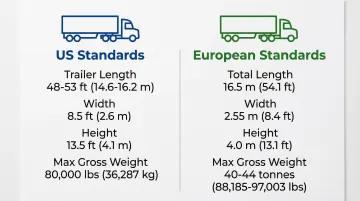
Typical articulated trucks operate within these dimensional and weight limits:
| Specification | US Standard | European Standard |
|---|---|---|
| Trailer Length | 48-53 ft (14.6-16.2 m) | 16.5 m (total length) |
| Width | 8.5 ft (2.6 m) | 2.55 m (2.6 m for refrigerated) |
| Height | ~13.5 ft (4.1 m) | 4.0 m |
| Max Gross Weight | 80,000 lbs (Interstate) | 40-44 tonnes |
How Articulated Trucks Work: Mechanics and Engineering
Fifth-Wheel Coupling System
The fifth-wheel coupling creates the critical articulation point. A horseshoe-shaped coupling device mounted on the tractor locks onto a kingpin protruding from the trailer's underside.
Jaws within the fifth wheel secure the kingpin, creating a strong but pivoting connection that bears tremendous weight while allowing rotation.
SAE J2228 standards mandate kingpin replacement when diameter wear exceeds 0.125 inches (1/8") to prevent catastrophic decoupling during operation.
Hydraulic and Pneumatic Systems
Beyond the coupling, braking systems must coordinate power between separated units.
On-Highway Tractors use pneumatic (air) brake systems with compressed air actuating brakes across both tractor and trailer. Air lines connect the units, providing fail-safe stopping power for heavy loads at highway speeds.
Off-Highway Articulated Dump Trucks (ADTs) feature hydraulic wet multiple-disc brakes. These enclosed, oil-cooled systems resist contamination from mud and debris common in mining environments, maintaining consistent performance on steep grades up to 40%.
Articulation Mechanics and Turning
The pivot point allows the trailer to follow a different arc than the tractor during turns. This reduces the turning circle significantly.
The Cat 745 ADT has an inside turning radius of just 174 inches (4.4 m), far tighter than rigid trucks of comparable size.
Weight Distribution and Stability
Proper weight distribution is critical for safety and performance:
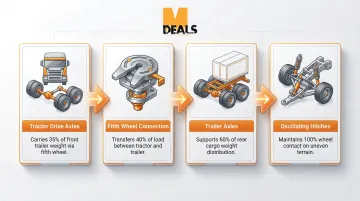
- Tractor drive axles carry front trailer weight via the fifth wheel
- Trailer axles support rear cargo weight
- ADTs use oscillating hitches for wheel contact on uneven terrain
- Improper loading affects braking, stability, and tire wear
Drivetrain and Power Delivery
On-Highway Tractors:
- Engine power: 400-605 HP (models like Peterbilt 579, Kenworth T680)
- Automated Manual Transmissions (AMTs) like Detroit DT12 maximize fuel efficiency
- Optimized for sustained highway speeds and moderate grades
Articulated Dump Trucks:
- Engine power: 479-523 HP (prioritizing torque over top speed)
- Planetary powershift transmissions handle high-torque off-road shifting
- 6x6 all-wheel drive configurations deliver power to all axles for maximum traction
Types and Specifications of Articulated Trucks
Articulated Dump Trucks (ADTs)
ADTs dominate off-road hauling applications where rigid trucks can't operate. These machines combine 6x6 all-wheel drive, oscillating suspension systems, and reinforced dump bodies to handle extreme terrain conditions.
| Model | Payload Capacity | Heaped Capacity | Engine Power |
|---|---|---|---|
| Cat 745 | 45.2 tons (41 tonnes) | 32.7 yd³ | 511 HP |
| John Deere 460 P-Tier | 46 tons (41.8 tonnes) | 32.9 yd³ | 481 HP |
| Volvo A45G | 45 tons (41 tonnes) | 32.8 yd³ | 479 HP |
| Bell B45E | 45 tons (41 tonnes) | 33.0 yd³ | 523 HP |
These payload capacities and power ratings make ADTs ideal for construction sites, mining operations, and quarries. They excel in locations with soft soil, steep grades, or rough haul roads where rigid trucks bog down or can't navigate safely.
Semi-Trailer Truck Configurations
Dry Van Trailers: Enclosed 53-foot units provide weather protection for general freight, making them the standard choice for long-haul logistics moving consumer goods and industrial products.
Flatbed Trailers: Open cargo decks accommodate oversized machinery, building materials, and irregular loads that won't fit in enclosed trailers. Side loading with cranes or forklifts eliminates the constraints of rear-door access.
Refrigerated Trailers (Reefers): Temperature-controlled units maintain specific ranges during transit, essential for food, pharmaceuticals, and other temperature-sensitive cargo. Insulated walls and active cooling systems protect product integrity across long distances.
Specialized Articulated Trucks
Lowboy Trailers:
- Low deck height for heavy equipment transport
- Haul excavators, bulldozers, and oversized machinery
- Accommodate tall loads while staying within height restrictions
Tanker Trucks:
- Transport liquids (fuel, chemicals, water) and gases
- Specialized baffles prevent liquid surge during braking
- Various compartment configurations for different products
Emerging Innovations
The articulated truck market is shifting toward electrification, connectivity, and automation as operators demand lower operating costs and improved safety.
Electric Power Systems
- Volvo FH Electric offers 300 km range with 490 kW power for regional haulage
- Freightliner eCascadia provides 155-230 mile range with 80% charge in 90 minutes
- Volvo CE introduced electric ADTs (A30/A40 Electric) with 4-4.5 hour runtime matching diesel performance
Telematics & Fleet Management
- Real-time monitoring of fuel consumption, idle time, and payload weight
- Over 60% of new ADTs now include standard telematics systems
- Optimize fleet efficiency and track maintenance needs proactively
Autonomous Operation
- Semi-autonomous operation in controlled environments like mines
- Advanced driver assistance systems (ADAS) for collision avoidance
- Remote monitoring and diagnostics capabilities
Key Applications and Industries Using Articulated Trucks
Construction Industry
Articulated trucks move earth, aggregates, debris, concrete, and building materials across large job sites with variable terrain. ADTs excel where ground conditions prevent rigid trucks from operating—muddy sites, steep grades, and confined spaces with limited turning room.
Common Construction Uses:
- Site preparation and earthmoving
- Aggregate and fill material transport
- Demolition debris removal
- Concrete and building material delivery
Mining and Quarrying
The global ADT market is valued at approximately $6.9 billion (2025), with infrastructure and mining driving 55% of demand. ADTs haul rock, ore, overburden, and minerals from extraction points to processing facilities over unpaved haul roads.
Mining Advantages:
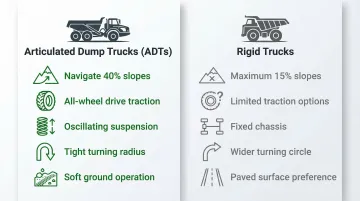
- Handle 40% grades versus ~15% for rigid trucks
- Maintain traction on loose, wet, or uneven surfaces
- Reduce cycle times with superior maneuverability in tight pits
Logistics and Freight Transport
Articulated trucks dominate long-haul freight operations across North America and globally. These vehicles move consumer goods, industrial products, and materials across highways between distribution centers, warehouses, and ports.
Key Transport Applications:
- Interstate and regional freight hauling
- Port-to-warehouse container delivery
- Cross-border commercial transport
- Time-sensitive bulk cargo movement
Specialized Applications
Beyond traditional construction and freight, articulated trucks serve specialized roles across multiple industries.
Waste Management:
- Roll-off containers and bulk waste transport
- Demolition site cleanup and material sorting
Agricultural Transport:
- Grain hauling from fields to storage facilities
- Livestock transport in specialized trailers
Forestry Operations:
- Log transport from harvest sites to mills
- Equipment mobilization in remote locations
Benefits and Advantages of Articulated Trucks
Superior Maneuverability
The articulated design allows dramatically tighter turning than rigid trucks of equivalent capacity. The John Deere 460 P-Tier achieves a 15-foot inside turning radius despite its 46-ton payload capacity.
This tight turning is essential for navigating construction sites and narrow mining roads.
Exceptional Payload Efficiency
Carrying 20-40+ tons in a single trip reduces the number of loads needed, lowering fuel costs and increasing productivity per operating hour.
Comparative testing shows the Volvo A30G consumes 11% less fuel than competitors while moving 2% more material, resulting in 8% lower cost per ton.
Productivity Impact:
- Fewer trips mean reduced cycle times
- Lower fuel consumption per ton moved
- Decreased wear on haul roads and equipment
Unmatched Terrain Versatility
All-wheel drive configurations, high ground clearance, and independent suspension on ADTs handle conditions that stop rigid trucks:
- Gradeability: ADTs navigate 40% slopes versus ~15% for rigid trucks
- Soft Ground: Oscillating hitches keep all wheels in contact on uneven terrain
- Traction Control: Systems like Cat AATC eliminate wheel slip automatically
Operational Flexibility
Beyond hauling capabilities, the ability to swap different trailer types on the same tractor allows carriers to adapt to changing cargo needs without purchasing entirely new vehicles.
A single tractor can pull:
- Dry vans for general freight
- Flatbeds for oversized equipment
- Tankers for liquid transport
- Refrigerated trailers for perishables
This versatility maximizes equipment use and return on investment.
Buying Considerations: New, Used, and Rental Options
New vs. Used Articulated Trucks
New Equipment:
- Cost: $300,000-$700,000 for ADTs; $120,000-$200,000 for on-highway tractors
- Advantages: Latest technology, full warranties, optimal fuel efficiency
- Financing: New unit financing is up 2.7%, indicating strong market confidence
Used Equipment:
- Cost: 40-60% savings compared to new; 2022 Volvo A45G units sold for $432,500-$520,000
- Advantages: Immediate availability, lower depreciation, proven track record
- Risks: Higher maintenance costs, unknown service history, potential wear issues
Rental and Leasing Options
While many buyers explore rental options for temporary needs, the used equipment market often provides better long-term value. For context on the broader market:
Short-Term Rentals:
- Ideal for specific projects with defined timelines
- Avoid capital expenditure for temporary needs
- Include maintenance and support from rental companies
Long-Term Leases:
- Preserve capital for other business investments
- Fixed monthly costs simplify budgeting
- Option to purchase at lease end
Rent-to-Own Programs:
- Build equity while using equipment
- Flexibility to return if project needs change
- Offered by equipment dealers and financing companies
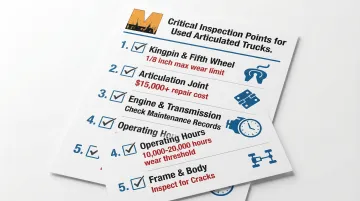
Critical Inspection Points for Used Trucks
When evaluating used articulated trucks, focus on these high-cost wear areas:
- Kingpin and Fifth Wheel: Replace kingpin if wear exceeds 1/8 inch per SAE J2228; inspect fifth-wheel jaws for cracks or excessive wear; check locking mechanism operation
- Articulation Joint (ADTs): Excessive play in hitch/hinge pins can cost $15,000+ to repair; test for movement when bucket is raised and lowered; inspect for leaking grease or damaged seals
- Engine and Transmission: Review maintenance records and oil analysis reports; check for unusual smoke, noise, or vibration; verify smooth shifting under load
- Operating Hours: Components show significant wear between 10,000-20,000 hours; 5,000 hours is considered low usage; compare hours to age for usage intensity assessment
- Frame and Body Integrity: Inspect for cracks, especially near stress points; check dump body for dents, corrosion, or structural damage; examine tire condition and wear patterns
Where to Find Articulated Trucks
Once you know what to look for in used equipment, finding the right truck becomes the next priority.
Authorized Dealers:
- Factory-backed support and warranties
- Certified pre-owned programs with inspections
- Financing options through manufacturer networks
Equipment Auctions:
- Competitive pricing on diverse inventory
- Experienced dealers like Mideast Equipment Supply provide comprehensive services from equipment location and inspection to export coordination, with a global network reaching Australia, the Middle East, and Central America
- Preview periods allow thorough inspection before bidding
Online Marketplaces:
- Broad selection from multiple sellers
- Detailed specifications and photos
- Direct seller contact for questions
Manufacturer Direct Sales:
- Custom configurations for specific needs
- Volume discounts for fleet purchases
- Comprehensive support packages
Financing Considerations
Typical Loan Terms:
- 3-7 year terms for new equipment
- 2-5 year terms for used equipment
- Down payments typically 10-20% of purchase price
Financing Sources:
- OEM financing arms (PACCAR Financial, Volvo Financial)
- Equipment-specific lenders with industry expertise
- Traditional banks and credit unions
- Lease programs with purchase options
Qualification Requirements:
- Business credit history and financial statements
- Down payment or trade-in equity
- Proof of insurance and business operations
Frequently Asked Questions
What is an articulated truck?
An articulated truck is a heavy commercial vehicle with two sections—a tractor and trailer—connected by a pivot joint. This design enables hauling heavy loads (25-45+ tons) with superior maneuverability compared to rigid trucks.
What is the difference between a truck and an articulated truck?
Regular rigid trucks have a fixed frame where the cab and cargo area form one unit. Articulated trucks feature a pivoting connection that allows the trailer to move independently, enabling tighter turns and 2-3x higher payload capacity.
What is another name for an articulated truck?
Common alternate names include articulated lorry (UK), semi-truck, tractor-trailer, 18-wheeler (US), and artic. Regional terminology varies, with "semi-trailer truck" used in Australia and Canada.
What license do you need to drive an articulated truck?
Most countries require a commercial driver's license with articulated vehicle endorsement: Class A in the US, Category CE in Europe/UK, or Class 1 in Canada. Requirements include written knowledge tests and practical driving examinations.
How much does an articulated truck cost?
New tractors range from $120,000-$200,000, with trailers adding $30,000-$80,000. Used combinations cost $50,000-$150,000, with equipment auctions often offering competitive pricing below retail rates.
What are the main advantages of articulated trucks over rigid trucks?
Key advantages include 2-3x greater payload capacity, tighter turning radius despite longer length, and ability to interchange trailers for different cargo. Superior weight distribution also improves stability and braking performance.