Introduction
Construction projects rely on specialized vehicles, each engineered for specific tasks—from excavating foundations and hauling materials to compacting soil and lifting workers to elevated work areas.
Choosing the right equipment directly impacts project efficiency, safety, timelines, and costs, whether you're building roads, clearing land, or constructing commercial buildings. The stakes are significant.
According to recent Bureau of Labor Statistics data, specific construction sectors like industrial building have achieved productivity gains of 45.7% in 2023, largely due to proper equipment selection and mechanization.
However, these gains only materialize when contractors match the right vehicle to their specific application and site conditions.
Key Takeaways
- Construction vehicles are specialized machines for excavating, hauling, lifting, compacting, and grading tasks
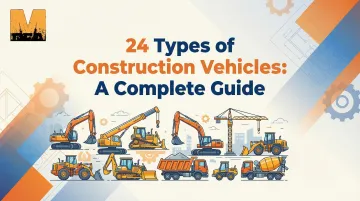
- The 24 main types fall into six categories: earthmoving equipment, material handling machines, construction trucks, roadwork equipment, aerial lifts, and specialized vehicles
- Select equipment based on project type, terrain, load requirements, and versatility needs
- Matching equipment to your application prevents oversizing, terrain damage, and compatibility issues
What Are Construction Vehicles?
Construction vehicles are heavy-duty machinery and trucks engineered to perform specific tasks on construction sites—from moving earth and materials to lifting workers and compacting surfaces. Unlike standard trucks, these machines feature specialized components that handle extreme loads, rough terrain, and demanding applications regular vehicles can't manage.
The variety is substantial—from compact skid steers at 2.8 tons to massive wheel loaders exceeding 266 tons. Each machine is designed to excel at specific tasks.
Key specialized components include:
- Undercarriage systems (tracks for stability, wheels for mobility)
- Hydraulic or mechanical power systems matched to workload
- Attachment capabilities transforming machines into multi-purpose tools
- Reinforced frames and components for extreme conditions
Why Construction Vehicles Matter in the Construction Industry
Mechanized systems like automated equipment can produce 4,000 units per hour compared to roughly 250 units in 8 hours of manual work—a 16-fold productivity increase. The right construction vehicles accomplish in hours what would take days or weeks with manual labor, directly impacting project profitability and timelines.
This productivity advantage becomes critical when you consider the alternative. Without appropriate equipment, projects face consequences that extend far beyond slower timelines:
- Project delays from inability to move materials at required pace
- Safety risks from manual handling of heavy loads
- Higher labor costs due to extended crew time on site
- Failure to meet specifications for precision grading and excavation depth
Large-scale earthmoving, heavy lifting, and precision grading work are not feasible without specialized machinery. The gap becomes especially pronounced on projects requiring deep excavation, mass material transport, or work on challenging terrain where manual methods would be prohibitively slow or dangerous.
24 Types of Construction Vehicles
Construction vehicles fall into six main categories based on their primary function, with each type excelling at specific applications. Some machines like backhoe loaders offer versatility across multiple tasks, while others like pile drivers focus on single specialized operations.
Knowing these categories helps you identify the right vehicle for your project faster, whether you're excavating, hauling materials, or grading surfaces. Below, we'll break down all 24 vehicle types organized by their core function.
Earthmoving Equipment
Earthmoving equipment is designed to excavate, move, push, and grade large quantities of soil, rock, and debris—forming the backbone of site preparation and land development projects. These machines handle the heavy lifting of transforming raw land into buildable sites.
Excavators
Excavators are tracked machines with rotating cabs, hydraulic arms (booms), and bucket attachments used for digging trenches, excavating foundations, demolition, and material handling. The 360-degree rotation lets operators dig and place material without repositioning the machine, significantly increasing efficiency.
Size ranges and capabilities:
- Mini excavators (1-6 tons): Digging depth 8-14 ft, ideal for residential work and confined spaces
- Mid-size excavators (7-15 tons): Digging depth 17-18 ft, suitable for commercial foundations and utility work
- Large excavators (20+ tons): Digging depth 20-25+ ft, essential for mining, large commercial projects, and deep excavation
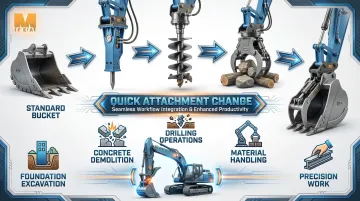
Excavators excel at projects requiring deep digging, precise excavation, or heavy lifting. They can be equipped with specialized attachments like hydraulic breakers for concrete demolition, augers for drilling holes, and grapples for material handling.
This versatility makes them among the most adaptable earthmoving machines available.
Bulldozers
Bulldozers are powerful tracked machines with front-mounted blades used to push large quantities of soil, clear land, level ground, and create access roads.
Their weight and traction make them ideal for moving material over short distances and working on steep grades where wheeled equipment would struggle.
Key specifications:
- Small dozers (e.g., Cat D4): Operating weight 13-14 tons, 130 hp, blade capacity 3.3-3.8 m³
- Large dozers (e.g., Cat D8): Operating weight 38-41 tons, 354 hp, blade capacity 10.3 m³
- Ground pressure: Standard models exert 5.9 PSI; Low Ground Pressure (LGP) models reduce this to 4.5 PSI for soft terrain
Bulldozers are ideal for land clearing, demolition debris removal, rough grading, and pushing materials on projects from site preparation to mining operations. Many models include rear-mounted rippers to break up compacted soil or rock before pushing.
Backhoe Loaders
Backhoe loaders are versatile machines combining a front loader bucket and rear excavator arm, making them capable of both digging and material loading. This dual functionality eliminates the need for multiple machines on small to medium projects.
Typical specifications:
- Operating weight: 6.3-11.7 tons
- Digging depth: 14 ft standard, up to 17-21 ft with extendable arms
- Loader capacity: 0.77-1.43 m³
- Travel speed: Up to 36-40 km/h on roads
Backhoes are best for small to medium projects requiring multiple functions—utility installation, trenching, backfilling, and light material transport—especially in confined urban spaces where their wheeled mobility and compact size provide advantages over larger tracked equipment.
Skid Steer Loaders
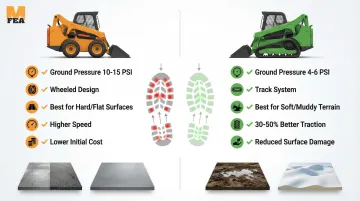
Skid steer loaders are compact, maneuverable machines with four wheels and front-mounted attachments, capable of tight-radius turns and working in confined spaces. Their unique steering system allows them to pivot within their own footprint, making them ideal for indoor work and crowded job sites.
Key characteristics:
- Operating weight: 2.8-4.7 tons
- Rated Operating Capacity: 1,750-4,000 lbs
- Ground pressure: 10-15 PSI (higher than tracked alternatives)
- Best terrain: Hard, flat surfaces like pavement or concrete
The versatility comes from dozens of available attachments including buckets, pallet forks, augers, trenchers, and snow blades, making skid steers suitable for landscaping, demolition, material handling, and snow removal. However, their high ground pressure (10-15 PSI) makes them unsuitable for soft or finished surfaces where they can cause significant damage.
Compact Track Loaders
Compact track loaders are similar to skid steers but with tracks instead of wheels, providing better traction on soft, muddy, sandy, or uneven terrain.
The track system distributes weight over a larger surface area, reducing ground pressure by 60-70% compared to wheeled skid steers.
Advantages over skid steers:
- Ground pressure: 4-6 PSI (compared to 10-15 PSI for wheeled units)
- Traction: 30-50% better traction in soft conditions
- Operating capacity: 2,125-5,750 lbs
- Operating weight: 3.2-6.2 tons
Compact track loaders are preferred over wheeled skid steers for projects on loose soil, wet conditions, or where minimizing ground disturbance is important—such as landscaping on finished lawns, working in muddy conditions, or grading sensitive terrain.
Wheel Loaders
Wheel loaders are large machines with front-mounted buckets used to scoop and transport materials like soil, gravel, sand, and debris around construction sites. Their size and power make them essential for high-volume material handling operations.
Size ranges:
- Compact models: Bucket capacity 0.7-2.0 m³, tipping load 2,470-5,710 kg
- Large models: Bucket capacity up to 40+ m³, operating weight exceeding 266 tons, power output 1,715 kW
Wheel loaders are ideal for loading trucks, stockpiling materials, and moving large volumes quickly on projects from road construction to mining and quarrying. Their articulated steering provides excellent maneuverability despite their size, and high travel speeds allow them to cover large sites efficiently.
Motor Graders
Motor graders are large machines with long, adjustable blades used to create smooth, level surfaces for road construction, site preparation, and maintaining haul roads. The blade can be positioned at various angles and depths to achieve precise grade control.
Specifications:
- Operating weight: 18-22 tons
- Power: 185-300 hp
- Blade length: 12-14 ft
- Blade pull force: 31,066-49,500 lbs
Graders are essential for projects requiring precise grade control and are commonly used in road building, airport runway construction, and large-scale site development. Many modern graders include GPS-guided grade control systems that automatically adjust blade position to match design elevations.
Material Handling Equipment
Material handling equipment is designed to lift, move, and position materials and loads rather than excavate or grade. These machines are essential for vertical material transport and placement on construction sites.
Cranes
Cranes are lifting machines with booms and cables designed to hoist and move heavy materials vertically and horizontally. Different crane types serve different project requirements:
Common crane configurations:
- Mobile cranes: Truck-mounted units for general construction, offering flexibility to move between job sites
- Tower cranes: Fixed installations essential for high-rise building projects, providing maximum lift height
- Crawler cranes: Tracked units for heavy lifting on soft ground or rough terrain
OSHA 29 CFR 1926 Subpart CC requires certification for operators of cranes with capacity exceeding 2,000 lbs. These machines typically come with certified operators rather than as standalone rentals due to specialized skill and safety requirements.
Telehandlers
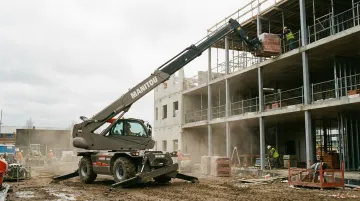
For jobs requiring both lift height and horizontal reach, telehandlers bridge the gap between forklifts and cranes. These forklift-crane hybrids feature telescoping booms that extend forward and upward, placing loads at height and reaching over obstacles.
Key features:
- Lift capacity: 2,500-12,000+ lbs
- Lift height: Up to 56 ft or more
- Multiple steering modes: Two-wheel, four-wheel, and crab steering
- Rough-terrain tires for outdoor construction sites
Common applications include placing palletized materials, framing lumber, and roofing materials where standard forklifts cannot reach.
The telescoping boom delivers both vertical lift and horizontal reach, making these machines invaluable for placing materials on upper floors or over obstacles.
Forklifts
For ground-level material handling, forklifts remain the workhorse of construction sites. These machines use front-mounted forks to lift and move palletized materials vertically over short distances, available in two main configurations:
Configuration options:
- Warehouse models: Cushion tires for smooth indoor surfaces, lower ground clearance
- Rough-terrain models: Pneumatic tires for outdoor construction and lumber yards, higher ground clearance and more robust suspension
These machines excel at unloading delivery trucks and moving materials around job sites. While generally excluded from OSHA crane certification requirements, forklifts configured with winches or hooks for hoisting suspended loads fall under different regulatory requirements.
Construction Trucks
Construction trucks are vehicles designed to transport materials, equipment, and mixed concrete to and around job sites. Unlike material handlers that primarily lift and position, construction trucks focus on hauling capacity and mobility.
Articulated Dump Trucks
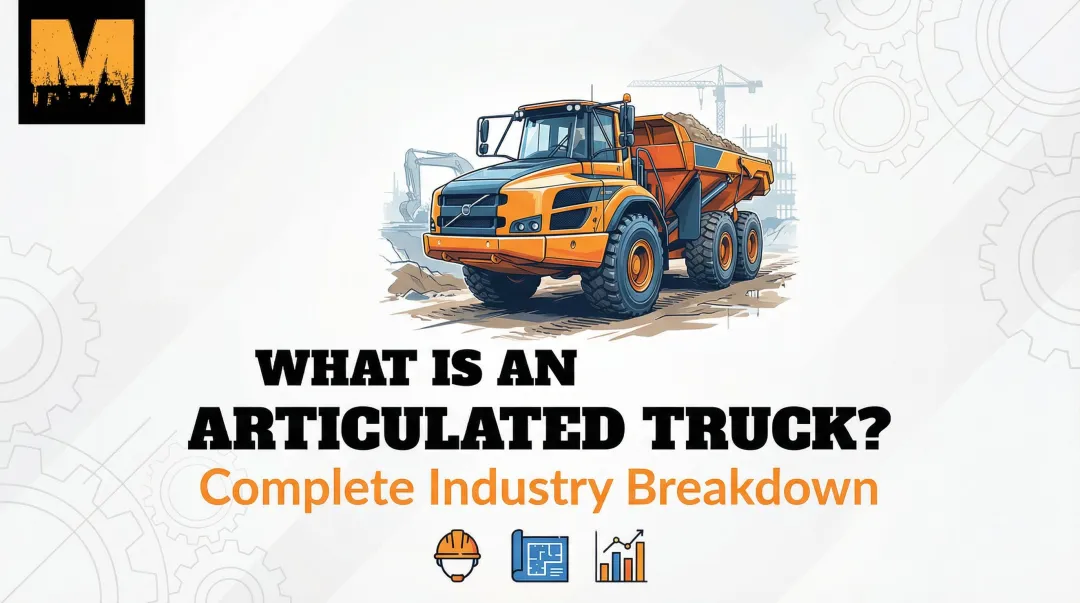
Articulated dump trucks (ADTs) are off-road haulers with a pivot point between the cab and dump body, giving them excellent maneuverability on rough terrain.
The articulation allows the front and rear sections to move independently, maintaining wheel contact on uneven ground.
Technical advantages:
- Payload capacity: 26.5-61 tons
- Heaped capacity: 19.6-43.9 cubic yards
- All-wheel drive (6x6 configuration) for maximum traction
- Oscillation capability maintains wheel contact on rough terrain
These capabilities make ADTs ideal for large earthmoving projects, mining, and quarrying where materials must travel over unimproved haul roads and steep grades that would stop standard dump trucks.
Their superior traction in soft, muddy conditions makes them essential for projects without maintained haul roads.
Standard Dump Trucks
Standard dump trucks feature hydraulic dump beds that transport and unload loose materials like soil, gravel, sand, and demolition debris. These on-road workhorses handle paved surfaces and maintained site roads, not rough terrain.
Typical specifications:
- Payload: 10-30 cubic yards depending on body and axle configuration
- Terrain: On-road or maintained site roads only
- Applications: Hauling materials between sites or to disposal facilities
Standard dump trucks are suitable for projects with road access and are commonly used for hauling materials on public highways. They cost less to operate than ADTs but lack the off-road capability needed for unmaintained haul roads or soft ground conditions.
Concrete Mixer Trucks
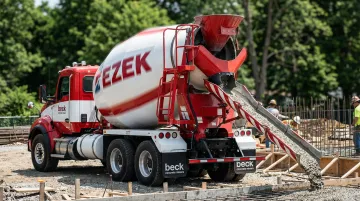
Concrete mixer trucks have rotating drums that continuously mix cement, water, and aggregates during transport to keep concrete workable until it reaches the pour site. The rotation prevents the concrete from setting prematurely and maintains consistent mixture quality.
Specifications:
- Water capacity: 7.8-17.4 cubic yards (5.95-13.30 m³)
- Geometric drum volume: Up to 26.7 cubic yards (20.45 m³)
- Onboard water tanks for mix adjustment
- Rotating drum prevents segregation and premature setting
These trucks are essential for any project requiring fresh concrete for foundations, slabs, columns, or roadwork. The continuous mixing during transport ensures the concrete arrives at the job site with the proper consistency and workability for placement.
Water Trucks
Water trucks are tanker vehicles equipped with spray systems used for dust suppression and soil compaction on construction sites. They distribute water evenly across work areas through front, rear, and side spray bars.
Water trucks are particularly important in hot, dry climates and on projects where dust control is required for safety, environmental compliance, or compaction effectiveness. Proper moisture content is critical for achieving specified compaction densities in soil work.
Roadwork and Compaction Equipment
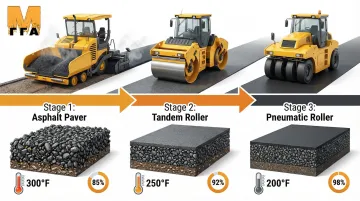
Roadwork and compaction equipment consists of specialized machines for building and maintaining roads, parking lots, and other paved surfaces. These machines work together in sequence to create durable, smooth pavement.
Asphalt Pavers
Asphalt pavers receive hot asphalt mix and lay it in uniform layers for road construction, parking lots, and pathways. The paver's screed system spreads and initially compacts the asphalt to the specified thickness and width.
Capabilities:
- Paving width: 0.25-18 m (mini to highway class)
- Laydown rate: Up to 1,100 tons/hour for large highway pavers
- Automatic grade control systems maintain elevation accuracy
Compaction equipment follows to achieve proper density and smoothness. Modern pavers include sophisticated controls for maintaining consistent mat thickness and temperature.
Road Rollers (Tandem Rollers)
Road rollers feature two steel drums (front and back) that compact freshly laid asphalt without leaving tire marks. The smooth steel drums provide uniform compaction across the entire width.
Key specifications:
- Operating weight: 1.5-20+ tons
- Vibration frequency: 40-67 Hz (2,400-4,020 vibrations per minute)
- Vibration amplitude: 0.2-0.8+ mm
These machines are essential for achieving proper asphalt density and smooth finished surfaces. The vibration system increases compaction effectiveness by reducing internal friction in the asphalt mix.
Soil Compactors
Soil compactors use heavy drums to compress soil and create stable bases for foundations, roads, and structures. Drum type must match soil type.
Drum types and applications:
- Smooth drum rollers: Best for granular soils like sand and gravel
- Padfoot rollers: Designed for cohesive soils like clay and silt, with protruding feet that knead and compress the soil
Operating weights range from 5-26 tons with drum widths of 1.37-2.44 m. Proper compaction prevents settlement and ensures long-term structural stability.
Pneumatic Rollers
Pneumatic rollers use rubber tires rather than steel drums, providing kneading action that's particularly effective for asphalt compaction. Tire pressure adjusts to optimize compaction for various materials.
Specifications:
- Operating weight: Up to 28 tons
- Multiple tires (typically 7-11) distribute weight
- Tire pressure adjustable for different materials
These rollers achieve proper density and seal the surface in asphalt finishing. The kneading action works aggregate particles together, creating a tight, durable mat.
Cold Planers (Milling Machines)
Cold planers use rotating drums with cutting teeth to remove and grind existing asphalt or concrete surfaces. The milled material can be recycled and reused in new pavement mixes.
Capabilities:
- Milling width: 0.35-2.5+ m
- Milling depth: Up to 330-350 mm in a single pass
- Applications: Road rehabilitation and surface preparation
Road rehabilitation projects rely on cold planers to prepare surfaces for new pavement. They create a uniform, textured surface that bonds well with new asphalt overlays.
Trenchers
Trenchers feature chains or wheels equipped with cutting teeth designed to dig narrow, precise trenches for utility lines, cables, and pipes. They create cleaner, narrower cuts than excavators.
Specifications:
- Digging depth: Up to 18 ft
- Trench width: Up to 4 ft
- Power: 185-600 hp for large track trenchers
For utility trenching, trenchers outperform excavators by creating narrower cuts requiring less backfill. This reduces both material costs and labor time. Dealers like Mideast Equipment Supply maintain inventories of used roadwork equipment, including compaction and trenching machines for construction and roadwork companies.
Aerial Lifts and Access Equipment
Aerial lifts safely elevate workers and tools for construction, maintenance, painting, and electrical work. They provide stable platforms with safety features like guardrails and emergency lowering systems.
Scissor Lifts
Scissor lifts use crossed supports (scissors mechanism) to raise platforms vertically. The platform remains level throughout its travel range, providing stable work areas for multiple workers.
Key features:
- Working height: 18-70 ft
- Platform capacity: 500-2,750 lbs (heavy-duty rough-terrain models)
- Power options: Electric (indoor use) or diesel (outdoor construction)
- Vertical lift only (no horizontal reach)
These lifts excel at indoor and outdoor tasks requiring vertical access. Electric models work best indoors on smooth surfaces, while rough-terrain models handle outdoor construction sites.
When jobs require reaching over obstacles or around structures, articulating boom lifts offer greater flexibility.
Boom Lifts (Articulating)
Articulating boom lifts feature multiple boom sections that bend and maneuver around obstacles to reach difficult areas. The bending points (articulation) enable "up-and-over" access.
Specifications:
- Working height: Up to 150+ ft
- Horizontal reach: Up to 63 ft
- Platform capacity: Typically 500-1,000 lbs
- Multiple boom sections for obstacle navigation
Articulating booms are best for outdoor construction work requiring both vertical and horizontal reach, especially when obstacles prevent straight-line access to the work area.
For maximum reach without the need to navigate around obstacles, telescopic boom lifts offer a simpler, more direct solution.
Boom Lifts (Telescopic)
Telescopic boom lifts use a single-piece extending boom that provides maximum vertical and horizontal reach without bending points.
Maximum capabilities:
- Working height: Up to 185 ft
- Horizontal reach: Up to 80 ft
- Straight boom design for maximum extension
- Platform capacity: 500-1,000 lbs
Telescopic booms are ideal for tasks requiring maximum height and reach, such as bridge work, building facade maintenance, and tree trimming where the work area is accessible in a straight line from the machine position.
Specialized Construction Vehicles
Some construction projects require equipment beyond standard excavators and loaders. Specialized vehicles handle niche applications like deep foundation work, where general-purpose machines simply can't reach the required depths or apply the necessary force. These machines represent significant investments but prove essential for specific project types.
Pile Drivers
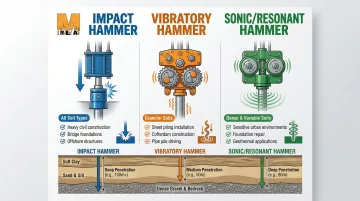
Pile drivers use impact force or vibration to drive support piles into the ground for foundations of bridges, piers, and structures built on soft soil. Different pile driving methods suit different soil conditions:
Pile driver types:
- Impact hammers (diesel/hydraulic) — Heavy ram strikes pile top, suitable for all soil types including stiff clay
- Vibratory hammers — Counter-rotating weights create vibration to loosen granular soil, best for sheet piles and extraction
- Sonic/resonant hammers — High-frequency oscillation resonates the pile for fast penetration in suitable soils
Pile drivers are essential for projects requiring deep foundation support where standard excavation can't reach stable bearing strata.
They're commonly used for bridge foundations, waterfront structures, and buildings on weak soils.
How to Choose the Right Construction Vehicle
Selecting the right construction vehicle depends on matching the machine's capabilities to your specific project requirements, site conditions, and budget. A systematic approach prevents costly mistakes and ensures optimal productivity.
Identify your primary task requirements: Determine whether you need excavation, material transport, lifting, compacting, grading, or multiple functions. This narrows your equipment category.
For example, if you need to dig trenches and load trucks, a backhoe loader provides both functions in one machine, while dedicated excavation requires a full-size excavator.
Assess site conditions and access: Consider terrain type (paved versus rough), space constraints, and ground conditions. Compact track loaders with 4-6 PSI ground pressure are essential for soft or wet terrain, while wheeled skid steers (10-15 PSI) work better on hard surfaces. Tight urban sites may require compact equipment, while open sites can accommodate full-size machines with better productivity.
Evaluate load and capacity needs: Calculate these requirements before selecting equipment:
- Weight and volume of materials you'll handle
- Digging depths and lift heights required
- Hauling distances and terrain conditions
- Safety margin above minimum rated capacity
For excavators, tipping stability (75% of tipping load) and hydraulic capacity (87%) limit lift performance.
Consider acquisition method: Decide whether to buy, rent, or source through auctions based on project duration and frequency of use.
Renting works best for short-term or infrequent needs, while purchasing provides better value for high-utilization scenarios. Equipment auctions through dealers like Mideast Equipment Supply offer quality used equipment at competitive prices, with financing options available to match your budget.
Beyond the equipment itself, verify operator qualifications. Your team needs appropriate training and certifications for specialized machines. Cranes exceeding 2,000 lbs capacity require OSHA-mandated operator certification, while forklifts and aerial lifts have separate training requirements. Consider ease of operation for less experienced crews when selecting between similar equipment types.
Common Mistakes When Selecting Construction Vehicles
Choosing Oversized Equipment for the Application
Using larger machines than necessary increases fuel costs, purchase prices, and transportation expenses. Large compact track loaders (3,500+ lbs capacity) consume 20-30% more fuel than appropriately sized units, adding $25,000-$45,000 annually in unnecessary operating costs per machine.
Oversized equipment may also struggle with site access or cause excessive ground disturbance on finished surfaces.
Ignoring Terrain and Ground Conditions
Selecting wheeled equipment for soft or muddy sites leads to equipment getting stuck and project delays. Conversely, using tracked equipment on finished concrete or asphalt surfaces accelerates undercarriage wear.
Ground pressure mismatches can increase surface damage by 60-75% compared to properly matched equipment.
Overlooking Attachment Compatibility and Versatility
Buying equipment without verifying it can use the attachments your project requires wastes money and time. High-flow hydraulic attachments like mulchers or cold planers require machines with adequate GPM (gallons per minute) and PSI specifications.
Missing opportunities to use versatile machines that can perform multiple tasks increases equipment costs unnecessarily.
Conclusion
Construction vehicles are specialized tools, with the 24 types covered representing the core equipment categories used across residential, commercial, industrial, and infrastructure projects. From mini excavators for residential foundations to articulated dump trucks for mass earthmoving, each vehicle type brings specific capabilities designed to excel at particular applications.
Understanding each vehicle type's strengths, limitations, and ideal applications helps with better project planning, more accurate budgeting, and improved productivity and safety outcomes.
Proper equipment selection prevents common mistakes like oversizing, terrain mismatches, and attachment incompatibility that can cost tens of thousands of dollars annually.
Whether you're buying or sourcing equipment through auctions with dealers like Mideast Equipment Supply, matching the right vehicle to your specific project requirements is essential for success.
Taking time to assess your tasks, site conditions, and capacity needs ensures you select equipment that maximizes productivity while controlling costs. Working with experienced dealers who maintain global networks and understand equipment logistics can help you find the right used units at competitive prices.
Frequently Asked Questions
What's the difference between an excavator and a backhoe?
Excavators are larger tracked machines with 360-degree rotation and 8-20+ ft digging depth, ideal for heavy excavation. Backhoes are smaller wheeled units combining a front loader and rear excavator (180-degree swing, 14 ft depth), best for utility work requiring mobility between sites.
When should I choose a skid steer versus a compact track loader?
Choose skid steers for hard, flat surfaces where their wheeled design provides speed and maneuverability. Select compact track loaders for soft, muddy, or uneven terrain where their 4-6 PSI ground pressure (vs. 10-15 PSI for skid steers) prevents surface damage and getting stuck.
What size excavator do I need for a residential foundation?
Mini to mid-size excavators (3-6 tons) are ideal, providing 8-14 ft digging depth for most residential basements. These sizes balance compact access and minimal lawn damage with sufficient excavation power.
Should I buy or rent construction equipment?
Rent for short-term or infrequent needs to avoid maintenance costs. Buy for high-utilization scenarios where ownership provides long-term value. Equipment auctions like those at Mideast Equipment Supply offer quality used machines at below-retail prices with financing available.
What type of dump truck is best for off-road construction sites?
Articulated dump trucks (ADTs) are best for off-road sites, with all-wheel drive (6x6) and articulation that maintains traction on rough terrain, steep grades, and soft ground. They're essential for unmaintained haul roads and muddy conditions where standard dump trucks would get stuck.
Do I need special certifications to operate construction vehicles?
Requirements vary by location and equipment type. OSHA requires certification for crane operators (over 2,000 lbs capacity), aerial lifts, and forklifts. Other equipment typically requires employer-provided training. Always verify local regulations before operation.