

But here's the problem: the 2026 Caterpillar pickup truck doesn't exist. The viral images are AI-generated fabrications, and no official announcement has ever been made.
This article cuts through the hype to reveal the truth behind the rumored 2026 Caterpillar pickup. You'll learn how to identify AI-generated vehicle hoaxes, why Caterpillar is unlikely to build a consumer truck, and which real heavy-duty pickups actually deliver the capability these fake specs promise.
TLDR:
- Caterpillar has not announced or confirmed any 2026 pickup truck—the viral images are AI-generated
- Digital forensics reveal clear fabrication markers including garbled text and impossible design elements
- Rumored specs (500 HP, $65,000 starting price) are entirely unverified and speculative
- Caterpillar exited the on-highway truck market in 2016, citing insufficient market opportunity
- Real alternatives like Ford Super Duty and Ram HD offer verified heavy-duty capability with established dealer networks
Is the 2026 Caterpillar Pickup Truck Real?
No. Caterpillar Inc. has not announced, confirmed, or released any consumer pickup truck as of 2026.
A review of Caterpillar's official press releases reveals zero mentions of a pickup truck launch, concept vehicle, or automotive partnership.
The company's most recent automotive-related announcement was their exit from the on-highway vocational truck market in 2016.
The AI-Generated Evidence
Automotive journalism outlets including The Drive investigated the viral images and identified them as AI-generated fabrications.
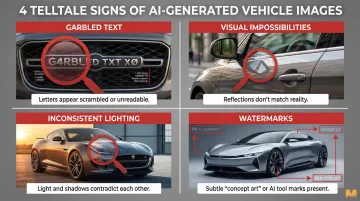
Digital forensics experts found clear signs of AI manipulation:
- Garbled text and logos - Badges feature nonsensical or unreadable text, a common AI generation flaw
- Visual impossibilities - Mirrored panels and symmetry issues that violate physical design principles
- Concept art watermarks - These images carry watermarks from "Garagem Master," a site known for AI-generated automotive concepts
- Inconsistent lighting - Reflections and shadows that don't match across different elements
How the Hoax Spread
Understanding how this fabrication gained traction reveals the mechanics of modern misinformation. The rumor followed a predictable viral pattern:
- April 2024: Garagem Master posts AI-generated concept images of a "2025 Caterpillar Pickup"
- May 2024: TikTok accounts repost images as "leaks," generating millions of views
- September 2024: Content aggregators syndicate speculative articles, adding false credibility
- Present: The hoax persists despite multiple debunking investigations

Unlike real vehicle launches—which feature camouflaged prototypes, patent filings, and EPA certification documents—no such evidence exists for a Caterpillar pickup.
Why This Matters for Buyers
This hoax has real business consequences beyond internet curiosity.
Construction professionals delaying equipment purchases while waiting for a nonexistent truck lose valuable time and productivity. Understanding how to verify automotive news protects you from making business decisions based on fiction.
When evaluating actual equipment purchases—whether trucks, construction machinery, or specialized tools—work with established dealers who can provide documented specifications, inspection reports, and verified inventory.
Rumored Specifications (Unverified and Speculative)
Online speculation about a Caterpillar pickup has generated detailed specification lists across social media and clickbait sites. These numbers sound impressive—but they have no basis in reality.
Here's what the rumors claim and why you shouldn't believe them:
Alleged Powertrain Options:
- 500 HP diesel with 1,000 lb-ft torque
- 450 HP hybrid with 600 lb-ft torque and 40-mile electric range
- 600 HP electric with 850 lb-ft torque
Claimed Performance:
- 0-60 mph in 5.5 seconds (diesel) or 4 seconds (electric)
- Towing capacity exceeding 30,000 lbs
- Payload capacity over 7,000 lbs
Supposed Advanced Features:
- Thermal management system for extreme conditions
- Regenerative braking on hybrid/electric models
- Level 2+ autonomous driving capability
- 360-degree camera system
- Multiple 120-volt bed outlets
- Integrated hidden winch
- Split horizontal tailgate
- Built-in step rails
Why These Specs Can't Be Trusted
None of these specifications appear in verifiable sources. Real vehicle development leaves a clear paper trail that's completely absent here:
- No Caterpillar engineering documentation
- No investor reports or earnings call mentions
- No EPA certification database entries
- No NHTSA safety testing records
- No patent filings for truck-specific technology
- No supplier contracts or manufacturing announcements
Legitimate truck launches involve months of documented testing and regulatory filings. The figures circulating online exist exclusively on clickbait websites and social media—not in any official technical data sheets.
Design and Exterior Features
The AI-generated images show a vehicle with classic pickup proportions wrapped in signature Caterpillar yellow. The design borrows visual cues from CAT's heavy equipment lineup:
- Bold front grilles resembling excavator intake vents
- Industrial styling with exposed fasteners and reinforced panels
- High ground clearance suggesting serious off-road capability
Design Philosophy vs. Reality
The rendered design takes a more conventional approach than the Tesla Cybertruck's angular aesthetic, featuring:
- Traditional pickup truck silhouette with separate cab and bed
- Prominent Caterpillar branding and yellow livery
- Aggressive wheel arches accommodating large off-road tires
- Industrial-grade bumpers with integrated recovery points
- High ground clearance suggesting serious approach and departure angles
While these design elements look convincing individually, closer inspection reveals the AI origin.
The Inconsistency Problem
Different AI-generated versions show contradictory design elements—proof these aren't photographs of a real vehicle:
- Badges and trim pieces appear in different locations across images
- Panel gaps and body lines don't align consistently
- Lighting signatures change between renderings
- Proportions shift subtly, indicating separate generation sessions
Actual product photography maintains perfect consistency because it captures a physical object. AI-generated images lack this constraint, creating each rendering independently without a real-world reference point.
Interior and Technology
Speculation about the interior suggests a cabin combining rugged functionality with advanced tech features:
- Seating for five or six passengers in a spacious cab layout
- Heads-up display projecting critical information onto the windshield
- Leather and industrial-grade plastics throughout the cabin
- AI-powered voice commands using natural language processing
- Load-adaptive suspension that adjusts automatically to cargo weight
- Automatic crash detection with satellite emergency response
These claims remain unverified. Real automotive interiors require years of ergonomic testing, safety certification, and supplier coordination.
That documentation is completely missing here.
Pricing and Market Positioning
Rumors suggest a starting price of $65,000, with fully-equipped models reaching $90,000. This places the hypothetical truck in premium territory—well above standard work trucks but below luxury off-road models.
The speculated pricing would position a Caterpillar truck in the premium heavy-duty segment alongside established competitors:
| Vehicle | Starting Price (USD) | Target Market |
|---|---|---|
| Ford F-150 (work truck) | $38,810 | General contractors, fleet buyers |
| Ram 2500 Tradesman | $45,300 | Heavy-duty work applications |
| Ram 3500 Tradesman | $46,595 | Maximum towing and payload |
| Tesla Cybertruck | $39,900+ | Tech-forward buyers, EV enthusiasts |
| Rumored CAT Truck | $65,000-$90,000 | Construction professionals (theoretical) |
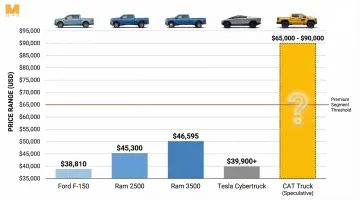
The rumored pricing would target construction professionals, contractors, and heavy equipment operators who value Caterpillar's reputation for durability.
However, established competitors already serve this market with verified products, comprehensive warranties, and nationwide service networks. At this price point, buyers would expect:
- Towing capacity exceeding 15,000 lbs
- Heavy-duty suspension for off-road job sites
- Commercial-grade interior materials built for daily abuse
- Advanced telematics for fleet management
- Extended powertrain warranties (5+ years)
For construction companies evaluating truck purchases, proven models from Ford, Ram, and GMC offer immediate availability, established service infrastructure, and known performance metrics—advantages a theoretical CAT truck would need years to match.
Why Caterpillar Might (or Might Not) Build a Pickup Truck
The Business Case For
Caterpillar's brand strength in durability and reliability could theoretically translate well to pickup trucks. The company's reputation for building equipment that operates in extreme conditions for decades creates natural appeal among buyers prioritizing longevity over luxury.
Other equipment manufacturers have entered automotive markets with varying success. Mahindra & Mahindra successfully transitioned from tractors to consumer vehicles globally, though their U.S. pickup entry faced significant regulatory hurdles.
The Challenges Against
The case against Caterpillar building a consumer pickup is far stronger than the case for it. History provides a clear example of why.
Historical Precedent: The International Harvester Scout
The International Harvester Scout (1960-1980) serves as a cautionary tale. Despite being a capable SUV that competed well with Jeep and Ford Bronco, it ultimately failed commercially due to a critical mismatch: IH sold Scouts through their agricultural and heavy truck dealer network, which was designed for rural farm equipment sales, not suburban consumer vehicles.
Service experiences at tractor dealerships didn't meet consumer expectations. Dealers lacked the training, parts inventory, and customer service infrastructure for consumer automotive sales. The lesson: a great product fails without the right distribution and service network.
Caterpillar's 2016 Market Exit
Caterpillar manufactured on-highway vocational trucks (the CT660 model) from 2011-2016 in partnership with Navistar.
On February 26, 2016, Caterpillar announced it would end production, stating there was "not a sufficient market opportunity to justify the investment required" to remain competitive. The company determined that developing a complete portfolio would require "significant additional investment" that didn't align with strategic priorities.
This was for commercial vocational trucks—a market closer to Caterpillar's core competency than consumer pickups.
The Dealer Network Problem
Caterpillar faces the same dealer network challenge that doomed International Harvester. Their network is optimized for industrial heavy equipment, not consumer vehicles.
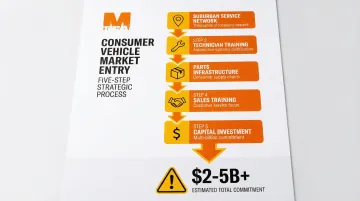
Establishing a network capable of servicing consumer pickups would require:
- Thousands of new service locations in suburban areas
- Retraining technicians for automotive systems
- Different parts inventory and supply chains
- Consumer-focused sales and customer service training
- Massive capital investment comparable to Tesla or Rivian's network buildout
This infrastructure would cost billions—a poor use of capital for a company that already determined the on-highway truck market wasn't worth pursuing. The dealer network barrier alone makes a consumer pickup highly unlikely.
What to Do If You're Interested in This Concept
If the idea of a Caterpillar-branded pickup appeals to you, here's what you should actually do:
Wait for Official Announcements
Monitor Caterpillar's official website and authorized dealer communications. If the company ever decides to enter the consumer pickup market, they'll announce it through proper channels—not through viral social media posts.
Explore Authentic Caterpillar Equipment
If you need Caterpillar's legendary durability for actual construction work, focus on their existing heavy equipment lineup.
For verified Caterpillar equipment, dealers like Mideast Equipment Auctions provide access to genuine excavators, dozers, wheel loaders, and construction machinery through their auction platform. They serve buyers across the United States and internationally with proper documentation and service support.
Consider Real Heavy-Duty Alternatives
If you need a pickup truck now rather than waiting for a concept that may never materialize, these verified alternatives offer heavy-duty capability with established support networks:
| Model | Max Towing | Max Payload | Key Work Features |
|---|---|---|---|
| Ford Super Duty F-250/350 | 37,000 lbs | 8,000 lbs | Pro Power Onboard, factory upfitter switches, integrated tailgate steps |
| Ram 2500/3500 HD | 37,090 lbs | 7,680 lbs | Auto-level air suspension, 50-gallon fuel tank, integrated trailer hardware |
| Chevrolet Silverado HD | 36,000 lbs | 7,234 lbs | Multi-Flex tailgate, transparent trailer view, Duramax diesel |
These trucks offer verified specifications, comprehensive warranties, and thousands of service locations nationwide—advantages a hypothetical new entrant couldn't match for years.
Frequently Asked Questions
Is there a real Caterpillar pickup truck?
No. Caterpillar has not announced or confirmed any 2026 pickup truck. The circulating images are AI-generated concepts with no basis in reality, and the company has made no official statements about entering the consumer pickup market.
How much does a Caterpillar pickup truck cost?
Since no official truck exists, pricing is purely speculative. Rumors suggest $65,000-$90,000, but these figures have no official source and should not be considered reliable for any planning purposes.
Where can I buy a Caterpillar pickup truck?
The truck is not available for purchase anywhere because it doesn't exist. Watch Caterpillar's official website and authorized dealer network for any future announcements, though none are expected based on the company's strategic direction.
Has Caterpillar made vehicles before?
Yes, but not consumer pickups. Caterpillar manufactured the CT660 vocational truck (2011-2016) for commercial applications. Production ended because the market opportunity didn't justify continued investment.
What trucks are similar to what a Caterpillar pickup would offer?
For durability and heavy-duty capability, consider Ford Super Duty (F-250/F-350), Ram 2500/3500 HD, or Chevrolet Silverado HD. These work-focused trucks prioritize towing capacity, payload, and longevity.
How can I tell if Caterpillar news is real or fake?
Verify through official channels: check Caterpillar's press releases, consult authorized dealers, and look for coverage in established automotive outlets. Be skeptical of AI-generated images showing garbled text or inconsistent design elements.
The Bottom Line
The 2026 Caterpillar pickup truck is a compelling fiction—nothing more. While the concept appeals to construction professionals who respect the CAT brand, no evidence supports its existence. Caterpillar's 2016 exit from the on-highway truck market and the massive investment required to build a consumer vehicle distribution network make a pickup truck entry extremely unlikely.
If you need heavy-duty capability today, focus on proven alternatives from Ford, Ram, and Chevrolet. If you need authentic Caterpillar construction equipment, dealers like Mideast Equipment Supply specialize in sourcing quality used heavy machinery for contractors and construction companies. And if you encounter viral vehicle rumors in the future, verify through official channels before believing the hype.