

This guide covers the maintenance strategies that protect your equipment investment—from preventive and predictive approaches to scheduling best practices and cost considerations. You'll learn how to identify warning signs before failures occur, understand what proper maintenance should cost, and implement a structured program that extends asset lifespan while minimizing expensive emergency repairs.
Key Takeaways
- Proper maintenance cuts unplanned downtime by 50% while extending equipment life 20-40%
- Combine four maintenance approaches: scheduled preventive, sensor-driven predictive, reactive corrective, and major overhauls
- Plan to spend 2-5% of replacement value annually on maintenance
- Aim for 80/20 split: proactive maintenance over reactive repairs
- Watch for performance changes, unusual noises, visible wear, and increased fuel consumption as early failure indicators
Why Equipment Maintenance Matters
Equipment maintenance directly impacts your bottom line—it's a strategic investment, not an expense you can defer. The financial case becomes clear when you examine the cost multipliers of reactive repairs.
Cost Impact: Preventive vs. Reactive Maintenance
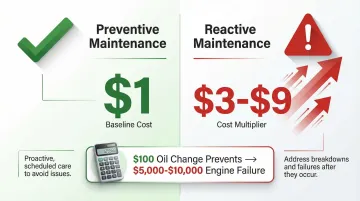
Reactive maintenance costs 3 to 9 times more than preventive maintenance. Emergency repairs carry premiums of 300-500% over planned service due to expedited parts shipping, overtime labor rates, and emergency service fees.
A simple $100 oil change can prevent catastrophic engine failure costing $5,000 to $10,000.
The mathematics are straightforward: every $1 of deferred routine maintenance generates $4 to $7 in downstream costs. One documented case study shows a contractor who attempted to save $45,000 by extending service intervals suffered a $2.3 million loss—a 4,200% negative return on the attempted savings.
Equipment Lifespan and Replacement Cycle Benefits
Proper preventive maintenance extends heavy equipment life by 20-40%. Well-maintained assets last 50-60% longer than neglected counterparts. For commercial trucks, longevity-focused maintenance can push vehicle life from an average of 650,000 miles to over 1.1 million miles.
This extension delays capital replacement costs and maximizes return on your original equipment investment.
A $200,000 excavator that lasts 15 years instead of 10 years effectively reduces your annual capital cost by 33%.
Downtime Reduction and Productivity Gains
Scheduled maintenance during off-hours prevents the unplanned downtime that cripples productivity. While planned maintenance might take equipment offline for 4-8 hours during a weekend, unplanned failures can halt operations for days while waiting for diagnosis, parts procurement, and repairs.
Industry data shows that implementing structured maintenance programs reduces unplanned downtime by 50%, directly translating to increased equipment availability and project completion rates.
Safety, Compliance, and Liability Protection
Beyond productivity, proper maintenance protects your team and your business from liability. OSHA mandates specific inspection intervals for construction equipment:
- Cranes and derricks require visual inspection prior to each shift (29 CFR 1926.1412)
- Powered industrial trucks must be examined at least daily before use
- Non-compliance results in citations, fines, and increased liability exposure
Equipment failures that result in worker injuries expose companies to OSHA citations, workers' compensation claims, and potential litigation. Documented maintenance programs demonstrate due diligence in accident investigations.
Resale Value Preservation
Maintenance history significantly impacts secondary market value. Excavators with complete maintenance records sell for an average of 15% more than those without documentation.
When dealers like Mideast Equipment Supply assess used machines, documented service history is a primary factor in determining fair market value. Well-maintained equipment with verified records commands premium prices because buyers have confidence in the machine's condition and remaining useful life.
Types of Equipment Maintenance
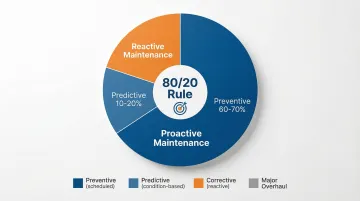
Effective maintenance programs combine multiple strategies based on equipment criticality, usage patterns, and operational requirements. World-class organizations target an 80% preventive and 20% reactive maintenance ratio.
Preventive (Scheduled) Maintenance
Preventive maintenance consists of time-based or usage-based routine service performed before failures occur. This proactive approach forms the foundation of any effective maintenance program.
Typical tasks include:
- Scheduled inspections and visual checks
- Lubrication of pivot points and moving components
- Filter changes (oil, fuel, air, hydraulic)
- Fluid analysis and replacement
- Belt and hose replacements
- Calibration checks and adjustments
Ideal use cases:
- High-value assets where downtime is costly
- Safety-critical equipment that poses risks if it fails
- Machinery with predictable wear patterns and established service intervals
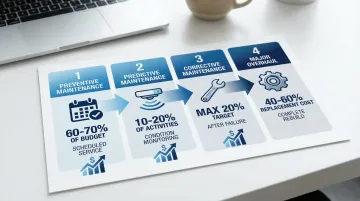
Budget impact: Preventive maintenance typically represents 60-70% of your maintenance budget. It requires consistent investment, but the payoff is substantial.
Preventive work costs 3-4 times less than reactive repairs. Plus, you get predictable scheduling that minimizes operational disruption.
Predictive (Condition-Based) Maintenance
Unlike scheduled preventive work, predictive maintenance uses real-time data and equipment condition monitoring. You perform service only when indicators show it's actually needed, not on fixed schedules regardless of condition.
Monitoring methods include:
- Vibration analysis to detect bearing wear and imbalance
- Thermal imaging to identify overheating components
- Oil analysis to detect contamination and component wear
- Ultrasonic testing for leak detection
- IoT sensors for continuous condition monitoring
Most valuable for: Critical assets where failure is extremely costly, equipment with variable operating conditions, and high-value machinery where the monitoring investment is justified by downtime prevention.
Investment and returns: Predictive maintenance requires higher upfront investment in monitoring technology and data analysis capabilities.
The payoff is substantial. It delivers an average ROI of 250% by reducing maintenance costs by 40% and eliminating up to 70% of breakdowns.
Corrective (Reactive) Maintenance
Corrective maintenance addresses repairs after equipment fails or shows clear signs of problems. Sometimes it's unavoidable.
But this approach should represent the smallest portion of your maintenance activities.
Key risks include:
- Unplanned downtime that disrupts project schedules
- Secondary damage to connected systems and components
- Safety hazards from unexpected equipment failure
- Higher labor costs due to overtime and emergency service rates
When it's acceptable: For non-critical equipment where downtime doesn't halt operations, low-cost items where repair cost approaches replacement cost, and redundant systems where backup equipment maintains productivity.
The cost reality: Reactive maintenance typically costs 3-4 times more than preventive approaches.
Target no more than 20% of total maintenance activities as reactive. This keeps costs efficient and operations reliable.
Major Overhaul and Refurbishment Maintenance
Major overhauls are the most intensive maintenance approach. They involve complete disassembly, inspection, and replacement of worn components to restore equipment to like-new operating condition.
When it's required:
- At specific usage milestones (typically every 10,000-15,000 hours)
- When multiple systems show wear simultaneously
- Before warranty expiration to address covered components
- When equipment has substantial remaining useful life
Typical scope includes:
- Complete engine rebuilds with new pistons, rings, and bearings
- Transmission overhauls and clutch replacements
- Hydraulic system component replacement
- Structural repairs and frame reinforcement
Making the financial decision: Major overhauls typically cost 40-60% of replacement value.
They make sense when equipment has 30-50% of useful life remaining and the overhaul will extend service life by several thousand additional hours.
How to Check If Equipment Needs Maintenance
Recognizing early warning indicators prevents major breakdowns and allows you to schedule maintenance proactively rather than reactively. Catching problems early saves time, money, and keeps your equipment running when you need it most.
Performance Degradation and Output Changes
Equipment rarely fails suddenly—performance typically declines gradually before complete failure occurs. These changes in baseline performance signal developing problems:
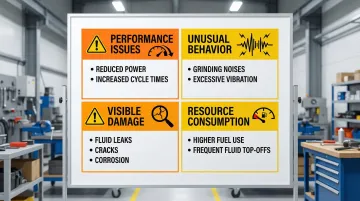
- Reduced power, speed, or lifting capacity compared to baseline
- Inconsistent operation or difficulty completing routine tasks
- Increased cycle times or reduced productivity metrics
- Difficulty starting or unusual warm-up requirements
Unusual Sounds, Vibrations, or Operating Behavior
Your equipment communicates its condition through sounds and behavior. Operators often detect problems before diagnostic systems register faults:
- Abnormal noises: grinding, squealing, knocking, hissing, or rattling
- Excessive vibration or shaking during operation
- Jerky or erratic movements instead of smooth operation
- Unexpected shutdowns, stalling, or system error messages
Visible Wear, Damage, or Warning Indicators
Physical inspections catch problems sensors miss. Look for these warning signs:
Fluid and Structural Issues:
- Leaking fluids (oil, coolant, hydraulic fluid)
- Visible cracks in structural components or welds
- Worn components showing metal-to-metal contact
- Rust, corrosion, or loose connections
System Warnings:
- Dashboard warning lights or error codes
- Excessive exhaust smoke or unusual exhaust color
- Overheating indicators or abnormal operating temperatures
Increased Resource Consumption and Recurring Issues
Changes in consumption patterns often indicate developing problems.
Track these consumption patterns:
- Higher than normal fuel, oil, or hydraulic fluid consumption
- More frequent need to top off fluids between service intervals
- Repeated minor issues that keep reoccurring despite temporary fixes
- Increasing frequency of operator complaints or service calls
Equipment Maintenance Schedule Guidelines
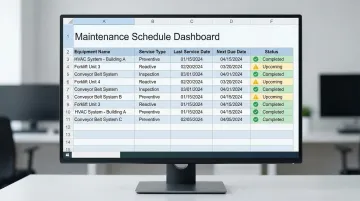
Optimal maintenance schedules vary by equipment type, usage intensity, operating environment, and manufacturer specifications. Use manufacturer recommendations as your baseline, then adjust based on actual operating conditions.
Maintenance Frequency Framework
| Interval | Duration | Typical Tasks | Time Required |
|---|---|---|---|
| Daily/Per-Use | Before each shift | Visual inspections, fluid level checks, safety system tests, cleaning, basic lubrication | 5-15 minutes |
| Weekly/Every 50 Hours | Once per week | Detailed inspections, filter checks, tire pressure, battery condition, brake tests | 30-60 minutes |
| Monthly/Every 250 Hours | Every 250 operating hours | Oil changes, filter replacements, detailed system inspections, calibration checks, minor adjustments | 2-4 hours |
| Quarterly-Annual/Every 500-2000 Hours | Major service intervals | Comprehensive inspections, system overhauls, manufacturer-specified maintenance | 4-8+ hours |
Critical Scheduling Considerations
High-usage vs. low-usage scenarios: Equipment operating 8+ hours daily needs more frequent service than occasional-use machinery. Base intervals on operating hours, not calendar time.
Harsh operating conditions: Equipment working in dust, extreme temperatures, heavy loads, or corrosive environments requires more aggressive maintenance schedules.
OEMs explicitly state that severe conditions demand more frequent service than standard intervals.
Manufacturer recommendations: Always start with OEM guidelines as your baseline. These intervals are engineered based on component design life and testing data.
Documentation benefits:
- Track maintenance activities to identify patterns and predict future needs
- Optimize scheduling based on actual equipment performance
- Support warranty claims with detailed service records
- Enhance resale value with complete maintenance history
Conclusion
Equipment maintenance is a strategic necessity that directly impacts profitability, safety, and operational reliability.
The data is unambiguous: proactive maintenance costs 3-4 times less than reactive repairs, extends equipment lifespan by 20-40%, and reduces unplanned downtime by half.
Apply the 80/20 rule to your maintenance program—aim for 80% proactive maintenance (preventive plus predictive) and only 20% reactive repairs to maximize equipment value and minimize total cost of ownership. This ratio represents the difference between controlling your maintenance costs and letting equipment failures control your operations.
Starting with this balanced approach protects your equipment investment and ensures assets maintain their value whether you operate them for decades or eventually upgrade.
When the time comes to sell or trade equipment, documented maintenance history significantly impacts market value. At Mideast Equipment Supply, we've seen firsthand how well-maintained machines with complete service records command premium prices in the used equipment market—often 15-25% higher than comparable units without documentation.
Frequently Asked Questions
How often should construction equipment be maintained?
Heavy construction equipment typically needs service every 250-500 operating hours, with daily pre-use inspections. Base intervals on usage hours rather than calendar time, adjusting for your specific operating conditions.
What is the average cost of equipment maintenance?
Budget 2-5% of equipment replacement value annually for maintenance. For a $200,000 excavator, that's $4,000-$10,000 per year, depending on age and usage intensity.
What happens if you skip regular equipment maintenance?
Skipping maintenance leads to 3-4x higher repair costs, unexpected downtime costing hundreds per hour, and 30-50% shorter equipment lifespan. You'll also face safety risks, voided warranties, and reduced resale value.
What is the difference between preventive and predictive maintenance?
Preventive maintenance follows fixed schedules regardless of condition (every 250 hours, for example), while predictive maintenance uses real-time data from sensors and monitoring to perform maintenance only when equipment condition indicates it's actually needed.
How do you create an equipment maintenance schedule?
Start with manufacturer recommendations and track usage hours systematically. Document all maintenance activities, then adjust schedules based on actual equipment performance and operating conditions using maintenance management software.
Does regular maintenance really extend equipment lifespan?
Yes. Properly maintained equipment lasts 20-40% longer than neglected assets, with documented maintenance history showing clear correlation between consistent service intervals and equipment longevity across all equipment types.