Introduction
A contractor evaluating a heavy-duty pickup for his construction business and a logistics company registering a fleet of vans face the same question: Does this qualify as a commercial vehicle? That classification determines licensing requirements, insurance premiums, and federal compliance obligations—before the vehicle ever leaves the lot.
Understanding what legally constitutes a "commercial vehicle" is a financial and operational necessity. Misclassify a vehicle and you risk fines, insurance gaps, or a failed DOT roadside inspection—consequences that can halt operations and cost far more than proper compliance ever would.
This article breaks down the definition of commercial vehicles, the eight weight classifications that determine regulatory thresholds, the major vehicle types used across industries, and the federal and state regulations that govern them—including CDL requirements, USDOT registration, and hours-of-service rules.
Key Takeaways
- Commercial vehicles transport goods or passengers for business, classified by GVWR, passenger capacity, or cargo type
- Federal threshold: 10,001 lbs GVWR triggers safety regulations; 26,001 lbs requires a CDL
- Cargo vans, box trucks, semi-trailers, dump trucks, and specialized units like concrete mixers each serve distinct commercial roles
- Regulations cover CDL licensing, USDOT numbers, hours-of-service limits, and ELD mandates
- State rules differ from federal standards; Texas, for example, sets a higher 26,001 lb threshold for intrastate operations
What Qualifies as a Commercial Vehicle?
A commercial vehicle is any motor vehicle used primarily for business purposes—transporting goods, passengers, or materials—rather than personal use. The term covers a broad spectrum, from a plumber's cargo van to an 18-wheeler hauling freight across state lines.
Key factors that trigger commercial designation:
- Vehicle registered or titled to a business entity
- Used for revenue-generating activity (delivery, hauling, passenger transport)
- Exceeds specific weight or passenger capacity thresholds set by federal or state law
Federal CMV Criteria (FMCSA)
The Federal Motor Carrier Safety Administration (FMCSA) defines a Commercial Motor Vehicle (CMV) under 49 CFR 390.5 as any vehicle operating in interstate commerce that meets any one of these criteria:
- GVWR of 10,001 lbs or more (including combination vehicles where truck + trailer weight rating exceeds 10,001 lbs)
- Designed to carry 9+ passengers for compensation or 16+ passengers without compensation
- Transports hazardous materials requiring federal placarding
Important Nuances
Three points trip up operators and fleet managers most often:
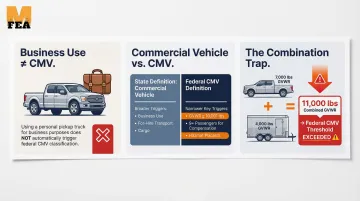
- Ownership doesn't determine CMV status. A sole proprietor using a personal pickup truck for business may face commercial insurance or registration requirements, but the truck only becomes a federal CMV if it meets the weight, passenger, or hazmat criteria above.
- "Commercial vehicle" vs. CMV: "Commercial vehicle" covers any business-use vehicle for state registration and insurance purposes. The narrower CMV designation applies specifically to interstate operations and triggers federal safety regulations: medical cards, logbooks, USDOT numbers, and hours-of-service limits.
- The combination trap: A pickup with a 7,000 lb GVWR towing a trailer rated at 4,000 lbs reaches a combined GVWR of 11,000 lbs. That clears the 10,001 lb threshold and triggers CMV status in interstate commerce, even though neither vehicle qualifies on its own.
Major Types of Commercial Vehicles
Commercial vehicles span a wide range of sizes, configurations, and applications. Here's how they break down by duty level and typical use:
Light-Duty Commercial Vehicles (Class 1–3)
Cargo vans, work vans, and pickup trucks form the backbone of trade and last-mile delivery. Common examples include the Ford Transit, Ram 1500, and heavy-duty models like the Ford F-350.
- GVWR range: 0–14,000 lbs
- Typical applications: Plumbing, electrical work, last-mile delivery, landscaping
Medium-Duty Commercial Trucks (Class 4–6)
Box trucks, flatbed trucks, and utility trucks handle local delivery, moving services, and construction. Common models include the Ford F-550, Freightliner M2 106, and Isuzu NPR.
- GVWR range: 14,001–26,000 lbs
- Typical applications: Furniture delivery, HVAC installation, municipal services, tow trucks
- Licensing note: More stringent inspection requirements apply; operators may need a CDL depending on configuration
Heavy-Duty Trucks and Semi-Trailers (Class 7–8)
This is the most heavily regulated category. Tractor-trailers, tanker trucks, and long-haul freight vehicles — including the Freightliner Cascadia, Kenworth T680, and Peterbilt 579 — fall here.
- GVWR range: 26,001 lbs and above
- Typical applications: Interstate freight, refrigerated transport, fuel delivery, heavy equipment hauling
- Licensing requirement: Class A or Class B CDL required; full FMCSA oversight applies, including ELD mandates and hours-of-service rules
Specialized Commercial Vehicles
Dump trucks, cement mixers, crane trucks, and refrigerated trucks serve construction, infrastructure, and perishable goods transport. Examples include ready-mix concrete trucks, articulated dump trucks, and mobile cranes.
- Common in: Road construction, site development, cold-chain logistics
Passenger-Carrying Commercial Vehicles
Buses, coaches, and shuttle vans designed to carry 9 or more passengers for compensation are classified as CMVs regardless of weight. This includes school buses, transit buses, and charter coaches.
Heavy Construction Equipment
Excavators, loaders, and bulldozers may fall under commercial vehicle regulations during transport — a key consideration for contractors and equipment buyers.
- Trigger point: The truck-and-trailer combination used for hauling must meet CMV requirements if operating in interstate commerce
- Common scenario: A contractor sourcing a used excavator through an auction house like Mideast Equipment Auctions needs to confirm the hauling setup meets CMV standards before crossing state lines.
Commercial Vehicle Weight Classifications
The U.S. Department of Transportation classifies commercial trucks into eight weight classes based on Gross Vehicle Weight Rating (GVWR)—the maximum safe operating weight of a vehicle including cargo, passengers, and fuel. Manufacturers assign this rating, and it drives licensing, registration, and compliance decisions for operators nationwide.
The Eight Truck Weight Classes
| Class | GVWR Range | Duty Level | Example Vehicles |
|---|---|---|---|
| Class 1 | 0–6,000 lbs | Light Duty | Ford Ranger, Toyota Tacoma |
| Class 2 | 6,001–10,000 lbs | Light Duty | Ford F-150, Ram 1500, Chevy Silverado 1500 |
| Class 3 | 10,001–14,000 lbs | Medium Duty | Ford F-350, Ram 3500, Isuzu NPR |
| Class 4 | 14,001–16,000 lbs | Medium Duty | Ford F-450 (Chassis Cab), Isuzu NPR-HD |
| Class 5 | 16,001–19,500 lbs | Medium Duty | Ford F-550, Ram 5500, Isuzu NRR |
| Class 6 | 19,501–26,000 lbs | Medium Duty | Ford F-650, Freightliner M2 106 |
| Class 7 | 26,001–33,000 lbs | Heavy Duty | Ford F-750, Hino 338, Freightliner M2 |
| Class 8 | 33,001+ lbs | Heavy Duty | Freightliner Cascadia, Kenworth T680, Peterbilt 579 |
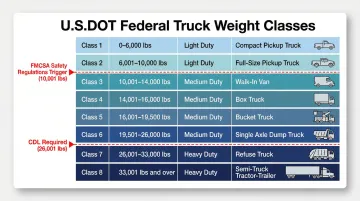
Weight class alone doesn't tell the whole story—certain GVWR thresholds trigger specific federal requirements that apply regardless of how the vehicle is used.
Critical Regulatory Thresholds
10,001 lbs (Class 3 and above): Vehicles at or above this GVWR operating in interstate commerce are subject to FMCSA safety regulations, including medical certification, USDOT number registration, and hours-of-service limits.
26,001 lbs (Class 7 and above): Vehicles at or above this weight always require a Commercial Driver's License (CDL), regardless of use or ownership. There are no exceptions—cross this weight and a CDL is mandatory.
Single Vehicle vs. Combination Vehicle Weight
A pickup truck alone may not qualify as a CMV, but when towing a trailer, the combined GVWR determines classification:
- Truck GVWR: 7,000 lbs
- Trailer GVWR: 4,000 lbs
- Combined GVWR: 11,000 lbs → Triggers CMV status in interstate commerce
If the combination exceeds 26,000 lbs and the trailer exceeds 10,000 lbs, a Class A CDL is required.
How Commercial Vehicles Are Used Across Industries
Construction and Infrastructure
Dump trucks, flatbed trucks, concrete mixers, and crane trucks are essential for moving materials, equipment, and crews across job sites. Whether it's a road paving operation or a high-rise build, these vehicles keep project logistics on schedule.
Contractors sourcing equipment through dealers like Mideast Equipment Auctions need to account for transport regulations when hauling heavy machinery between sites. The company stocks excavators, wheel loaders, and articulated dump trucks — all of which require proper permitting and route planning to move legally.
Freight and Logistics
This sector moves goods across the full supply chain — from manufacturing hubs to warehouses to retail locations. Common vehicle types include:
- Semi-trailers and Class 8 tractor-trailers for long-haul freight
- Refrigerated trucks for temperature-sensitive cargo
- Box trucks for last-mile and regional deliveries
Class 8 operators fall under FMCSA oversight. Drivers must log hours via Electronic Logging Devices (ELDs) and comply with federally mandated rest periods.
Passenger Transport and Public Services
School buses, transit buses, and charter coaches fall under commercial classification due to passenger capacity. Specialized vehicles like ambulances and fire apparatus also qualify, subject to unique regulatory exemptions for emergency operations.
Federal and State Regulations for Commercial Vehicles
FMCSA Regulatory Authority
The Federal Motor Carrier Safety Administration sets national standards for CMVs operating in interstate commerce, covering licensing, vehicle inspection, hours of service, and cargo securement (49 U.S.C. § 31136).
CDL Requirements
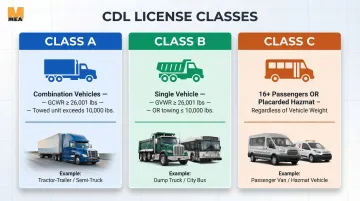
Drivers operating Class B (26,001–33,000 lbs) or Class A (combination vehicles over 26,001 lbs) vehicles must hold a Commercial Driver's License (CDL).
- Class A: Combination vehicles with GCWR ≥ 26,001 lbs, where the towed unit exceeds 10,000 lbs (e.g., semi-truck with trailer)
- Class B: Single vehicle with GVWR ≥ 26,001 lbs, or towing a vehicle ≤ 10,000 lbs (e.g., dump truck, box truck)
- Class C: Vehicles designed to carry 16+ passengers or transporting placarded hazmat, regardless of weight
USDOT Number and Operating Authority
Two federal identifiers apply to most commercial carriers:
- USDOT Number: Required for any company operating a CMV in interstate commerce. Also required by 39 states — including Texas — for intrastate operations.
- MC Number (Operating Authority): Required for for-hire carriers transporting passengers or federally regulated commodities across state lines. Private carriers hauling their own goods generally do not need one.
Hours-of-Service (HOS) Rules
CMV drivers in interstate commerce must follow federally mandated driving limits:
- 11-hour driving limit after 10 consecutive hours off duty
- 14-hour on-duty window (no driving beyond the 14th hour after coming on duty)
- 30-minute break required after 8 cumulative hours of driving
- 60/70-hour limit over 7/8 consecutive days
Electronic Logging Devices (ELDs)
Drivers required to keep Records of Duty Status must use an ELD to automatically record driving time. Exemptions apply to:
- Short-haul drivers operating within 150 air miles who return to their starting point within 14 hours
- Vehicles with engines manufactured before model year 2000
State-Level Variations: Texas Example
State definitions don't always mirror federal thresholds — and that matters when determining which rules apply to your fleet. Texas, for example, defines an intrastate CMV as a vehicle with a GVWR over 26,000 lbs, designed to carry 15+ passengers, or used to haul hazardous materials. That's a higher bar than the federal 10,001 lb threshold, meaning some vehicles classified as CMVs federally fall outside Texas's intrastate regulations.
Always confirm your state's DMV or DOT thresholds directly — the gap between federal and state definitions can affect your licensing, registration, and compliance obligations.
Frequently Asked Questions
What is classed as a commercial vehicle?
A commercial vehicle is any motor vehicle used for business purposes, including those exceeding 10,001 lbs GVWR, carrying passengers for compensation, or transporting hazardous materials. State definitions vary — check your local DMV for specifics.
What does Texas consider a commercial vehicle?
Texas defines a CMV as a vehicle with a GVWR over 26,000 lbs, designed to carry 15+ passengers, or used to haul hazardous materials—higher than the federal 10,001 lb threshold for intrastate purposes.
What is the difference between a commercial motor vehicle (CMV) and a non-CMV?
A CMV meets FMCSA criteria (GVWR ≥ 10,001 lbs, passenger capacity, or hazmat use) and triggers federal regulations. A non-CMV falls below all those thresholds, such as a pickup truck under 10,001 lbs used for personal travel.
Do I need a CDL to drive a commercial vehicle?
CDL requirements depend on vehicle class and use. Class A and B vehicles (≥ 26,001 lbs) generally require a CDL, while some Class C vehicles (like vans carrying 16+ passengers) also require one. Personal pickup trucks do not.
Are pickup trucks considered commercial vehicles?
Whether a pickup counts as commercial depends on how it's titled and used. One titled to a business may be classified as commercial for insurance and registration purposes, but it only qualifies as a CMV under FMCSA rules if it meets weight or passenger thresholds.
What is the GVWR threshold that makes a vehicle commercial?
The federal FMCSA threshold is 10,001 lbs GVWR for CMV classification. Vehicles at or above 26,001 lbs are always commercial regardless of use, and state-level thresholds may differ.