Cat equipment shows up on virtually every job type — utility trenching, commercial foundations, highway infrastructure, mass earthmoving. That's not coincidence. Caterpillar holds roughly 15.9% of the global construction equipment market with $37.8 billion in total sales, making it the world's largest construction equipment manufacturer. Their excavator lineup spans the compact 315 all the way to the 395, with the 320, 323, 330, and 336 filling the mid-to-large range.
This guide covers five Cat excavators that consistently perform across real construction applications — with specs, selection guidance, and a framework for matching the right machine to your project scope.
Key Takeaways
- The Cat 336 is the #1 best-selling Cat excavator across both new and used markets — built for large infrastructure and mass earthmoving
- Ranked #2 in sales, the Cat 320 covers most general commercial construction needs efficiently
- The Cat 315 is the top compact option for urban sites and confined jobsites
- The Next Gen series (320, 323, 330, 335, 336) delivers 20–25% better fuel efficiency than earlier models — a key factor when buying used
- Used Cat 320, 330, and 336 excavators hold strong resale value and are widely available through dealer and auction channels
Why Cat Excavators Dominate Construction Projects
Caterpillar uses a straightforward numeric naming system: lower numbers mean smaller, lighter machines, higher numbers mean more weight, more power, and deeper dig capability. The 300 Series covers compact and small machines, while the 330–395 range represents large production-class equipment.
That structure matters for buyers. It means the 320 and 323 sit in adjacent weight classes with meaningful differences in hydraulic capacity, the 336 nearly doubles the flow rate of the 323, and the 349 doubles it again.
The global excavator market was valued at $75.85 billion in 2023 and is projected to reach $108.37 billion by 2030 — a CAGR of 5.0%. Within that expanding market, Cat has retained the #1 position by new financed equipment sales in the US, alongside strong international demand through dealer networks spanning every major construction market.
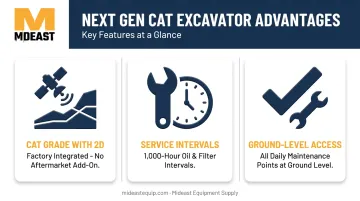
That market position reflects tangible engineering advantages. Every Next Gen Cat excavator includes features that directly reduce operating costs across the ownership cycle:
- Cat Grade with 2D comes factory-integrated — no aftermarket add-on required
- 1,000-hour oil/filter service intervals cut scheduled downtime compared to most competitors
- Ground-level access to all daily maintenance points reduces service time per inspection
Those cost advantages hold whether you're running one machine or a full fleet. The five models below were selected to reflect that range — covering size classes from compact utility to large production, each with a documented track record on commercial construction sites.
Best Cat Excavators for Construction Projects
These models were selected based on documented sales rankings, coverage across project size categories, hydraulic capability, and consistent contractor demand in new and used markets.
Cat 315
The Cat 315 occupies the small excavator class, built for contractors who need real digging capability in a compact footprint. It handles commercial site prep, utility trenching, and confined urban jobsites where a larger machine can't maneuver.
What sets it apart comes down to a few key upgrades over the 315F predecessor:
- Cab is 13% larger with a 60% increase in vertical visibility
- Maintenance costs run 30% lower than the prior model
- Every daily service point is accessible from ground level — no ladders required
- Ranks #3 best-selling Cat excavator overall
| Specification | Cat 315 |
|---|---|
| Operating Weight | 35,700 lb |
| Net Engine Power | 110 hp |
| Max Dig Depth | 19 ft 7 in |
Cat 320
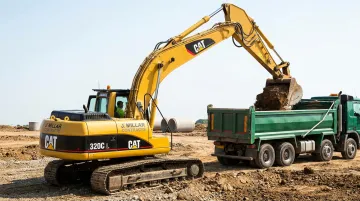
The Cat 320 is the fleet standard for mid-size excavation, deployed widely across commercial construction, road building, and pipe installation. It holds the #2 position in Cat excavator sales; the predecessor 320D series produced over 150,000 units globally.
The current generation delivers 20–25% lower fuel consumption than previous models, translating to 400–1,000 gallons saved per machine per year. Cat Grade with 2D, Cat Payload monitoring, and a smart electrohydraulic system are all standard. Its compact dimensions for a mid-size machine give it site access flexibility that larger machines can't match, and resale value in the used market remains consistently strong.
| Specification | Cat 320 |
|---|---|
| Operating Weight | 49,800 lb |
| Net Engine Power | 172 hp |
| Max Dig Depth | 22 ft |
Cat 323
The 323 steps up from the 320 in weight class and engine platform, moving from the C4.4 to the Cat C7.1. It's designed for contractors handling heavier commercial foundations, larger pipe work, and sustained truck loading cycles that demand higher production rates.
The 323 uses 25% less fuel than predecessor models and runs a full high-flow hydraulic system for heavier attachments. It cuts maintenance costs by up to 15%, with the hydraulic return filter running 3,000 hours before replacement. For fleet operators across regulated markets, it meets both U.S. EPA Tier 4 Final and EU Stage V emissions standards.
| Specification | Cat 323 |
|---|---|
| Operating Weight | 55,100 lb |
| Net Engine Power | 172 hp |
| Max Dig Depth | 22 ft 1 in |
Cat 330
The 330 sits at the transition between mid-size and large production equipment. You'll find it on large commercial builds, major trenching operations, and bulk material handling applications that need consistent cycle times over long shifts.
Its hydraulic system supports larger buckets and heavier tool attachments — hydraulic hammers, shears, and compactors that compact machines can't run effectively. Swing torque and bucket breakout force exceed the 323 class by a meaningful margin, which shows up in cycle times on high-volume loading work. The updated cab includes operator comfort features that reduce fatigue on long production days. Among Mideast Equipment Supply's current inventory, the 330 series appears as a frequently stocked model, with units ranging from late-2000s to 2018 builds available in recent listings.
| Specification | Cat 330 |
|---|---|
| Operating Weight | 74,600 lb |
| Net Engine Power | 270 hp |
| Max Dig Depth | 24 ft 4 in |
Cat 336
The Cat 336 is the #1 best-selling Cat excavator across both new and used categories. For infrastructure projects, mass earthmoving, and heavy pipe installation, it's the machine contractors reach for first.
The digging force numbers back that reputation: 47,190 lbf bucket digging force, 32,480 lbf stick digging force, and max swing torque of 105,250 lbf-ft. At 81,100 lb with a 300 hp Cat C7.1 TTA engine, it sustains high utilization without the downtime that affects lighter machines.
The standard technology suite covers the full range of job-site needs:
- Cat Grade Assist and E-Fence for precision and safety
- Payload monitoring and Boom and Swing Assist
- People Detection as standard
- Auto Dig Boost and Auto Heavy Lift, each adding up to 8% more power on demand
| Specification | Cat 336 |
|---|---|
| Operating Weight | 81,100 lb |
| Net Engine Power | 300 hp |
| Max Dig Depth | 26 ft 1 in |
How to Match the Right Cat Excavator to Your Project
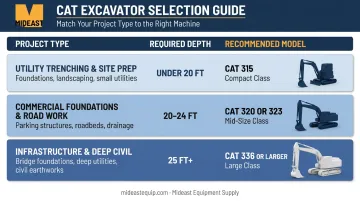
Getting the size class right is the single most important decision. Here's a practical framework:
Dig Depth First
| Project Type | Required Depth | Recommended Class |
|---|---|---|
| Utility trenching, site prep | Under 20 ft | Cat 315 (19'7" max) |
| Commercial foundations, road work | 20–24 ft | Cat 320 or 323 |
| Infrastructure, deep pipe, large civil | 25 ft+ | Cat 336 or larger |
Site Access and Ground Conditions
Choose compact models (315) when:
- Working on urban infill or confined commercial sites
- Overhead or lateral clearance is restricted
- Underground utilities limit swing radius
- Ground bearing capacity is low
Choose large tracked models (336) when:
- Operating on open, stable ground
- Production volume is the priority
- Long daily haul cycles demand consistent output
Attachment Compatibility
Not all Cat excavators support the same tool range:
- 315: Suited for light attachments: standard buckets, small thumbs, light compaction plates
- 320: Compatible with mid-duty attachments including smaller hydraulic hammers
- 323, 330, 336: Support high-flow hydraulics needed for full-size hammers, shears, pulverizers, and heavy compactors
New vs. Used: The Budget Question
For contractors scaling a fleet or managing capital costs, used Cat excavators deliver strong ROI. The 320, 330, and 336 hold their value better than most competitors, and supply through dealer and auction channels is consistent.
Mideast Equipment Supply sources verified used Cat excavators for buyers across the US and internationally. Services include:
- Inspection documentation on every unit
- Financing options through multiple lenders
- Full export support for international buyers
How We Chose the Best Cat Excavators
The five models here were evaluated on four factors:
- Sales performance — ranked by documented sales volume across new and used Cat excavator transactions in the North American market
- Size range coverage — ensuring the list spans from compact to large-class without gaps
- Hydraulic capability — confirming each model supports the attachment types used across its target applications
- Operator and maintenance feedback — extended service intervals, ground-level access, and cab ergonomics all factor into real-world operating costs
These criteria also shaped one firm recommendation: match the machine to the job, not to a preference for power. Oversizing is as costly as undersizing. A 336 on a confined utility project adds transport costs, fuel burn, and site access complications that a 320 handles cleanly. Choose based on daily production demand.
Conclusion
Caterpillar's excavator lineup covers every realistic construction application, from tight residential utility trenching to large-scale highway infrastructure. But the range of options means selection requires honest assessment of dig depth requirements, site access constraints, attachment needs, and production volume.
Don't default to the largest machine you can afford or whichever model happens to be common on nearby job sites. Evaluate fuel costs, maintenance intervals, parts availability, and resale value against what the project actually demands — not what looks impressive on paper.
Once you've identified the right model, sourcing a quality used machine is the next step. Mideast Equipment Supply stocks used Cat excavators across locations in Massachusetts, Connecticut, New York, Florida, and Utah, with direct sales, auction access, and financing options. For international buyers, the team handles everything from inspection through export. Contact Mideast Equipment Supply to check current availability or discuss which models fit your project requirements.
Frequently Asked Questions
What is the best Caterpillar excavator?
There's no universal answer. The Cat 336 leads in sales and suits large construction and infrastructure projects. The Cat 320 is the most versatile mid-size option for general commercial work. The Cat 315 is the preferred choice for compact, urban, or access-restricted sites. The right model depends on dig depth, site conditions, production requirements, and transport constraints.
What is the difference between CAT 320 and CAT 330?
The 330 is a heavier machine at roughly 74,600 lb versus the 320's 49,800 lb, with significantly higher hydraulic output and greater swing torque. The 330 suits higher production rates and supports heavier attachments. The 320 is more agile, easier to transport, and preferred for general commercial construction and fleet versatility.
What is the difference between CAT 395 and CAT 390?
The Cat 395 is the current large-class production model (542 hp, ~32 ft max dig depth), replacing the older 390 generation. It delivers better fuel efficiency, updated technology, and greater breakout force. The 390 is now primarily a used-market option.
What Cat excavator is best for road construction?
The Cat 320 and Cat 323 are the most common choices for road construction, balancing mobility, dig depth, and hydraulic compatibility with grading and compaction attachments. For highway infrastructure projects with higher production demands, the Cat 330 or 336 are the standard options.
Is buying a used Cat excavator a good investment for construction companies?
Yes, particularly for models like the 320, 330, and 336 that hold strong resale value and are widely available through dealer and auction channels. Key considerations before purchase include machine hours, maintenance history, and a completed pre-purchase inspection report.