
Introduction
Buying a used excavator can save contractors 40-60% compared to new equipment while delivering proven reliability for construction and earth-moving projects. However, with thousands of used excavators flooding the market—from mini excavators to 45-ton workhorses—choosing the right brand and model without making costly mistakes requires expertise.
Many buyers struggle with critical decisions: Which brands hold value? How many operating hours are too many? Where should I buy, and what inspection red flags could cost me tens of thousands in hidden repairs?
This guide answers those questions by covering:
- Top used excavator brands that consistently deliver value
- Essential inspection criteria that separate smart purchases from money pits
- Proven buying strategies across auctions and dealers
- How to calculate total cost of ownership beyond the sticker price
Key Takeaways
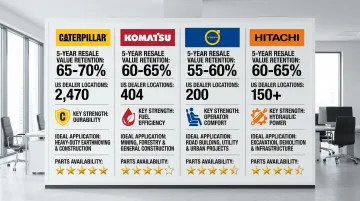
- Top brands (Caterpillar, Komatsu, Volvo, Hitachi) retain 55-70% resale value over five years
- Target machines under 10,000 hours with solid undercarriage and hydraulic systems
- Auctions offer 20-40% savings; certified dealers provide warranties at premium pricing
- Budget 15-20% of purchase price annually for maintenance and repairs
- Professional inspection prevents costly issues like hidden hydraulic damage ($95,000+ repairs)
Why Buy a Used Excavator Instead of New
Immediate Cost Savings and Budget Impact
Used excavators typically cost 30-50% less than new models, with some well-maintained machines just a few years old offering 50% savings. For a small to mid-size contractor, this differential translates directly to improved project ROI.
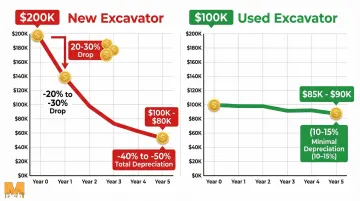
Instead of financing a $200,000 new excavator, purchasing a $100,000 used unit with comparable performance frees up $100,000 for additional attachments, workforce expansion, or bidding on more projects.
Depreciation advantages include:
- New excavators lose 20-30% of their value in year one alone
- Used machines have already absorbed the steepest depreciation hit
- Equipment retains 50-60% of original value by year five
- Your purchase stabilizes at current market value rather than continuing to drop
Beyond the direct cost savings, used equipment purchases offer practical advantages in today's market.
Availability Advantage in Supply-Constrained Markets
The global used construction equipment market reached $132.67 billion in 2023, according to Mordor Intelligence, driven partly by supply chain disruptions that stretched new equipment delivery times to 12-18 months. Used excavators offer immediate availability—you can inspect, purchase, and deploy equipment within days rather than waiting months for factory orders.
This "time-to-dirt" advantage allows contractors to bid on projects with confidence, knowing equipment will be available when work begins rather than gambling on delivery schedules.
Proven Performance with Documented History
Unlike new equipment with theoretical performance specs, used excavators with complete maintenance records provide real-world reliability data. You can see exactly how the machine performed under actual working conditions, what repairs were needed, and how well it held up over thousands of operating hours. This documented track record removes guesswork and provides concrete evidence of durability and performance that no manufacturer brochure can match.
Top 4 Used Excavator Brands to Consider
Brand selection should balance reputation, parts availability, resale value retention, and your specific project requirements. The following four brands consistently rank highest for used equipment quality and long-term value.
Caterpillar (CAT)
Caterpillar dominates the used excavator market with industry-leading resale value and the most extensive support network in North America.
Why CAT Leads the Market: CAT excavators retain 65-70% of their value over five years—the highest in the industry. This superior value retention stems from Caterpillar's reputation for durability in heavy-duty applications.
With approximately 2,470 locations across the U.S., CAT's dealer network ensures parts and service availability virtually anywhere you operate.
Large construction companies and mining operations prefer CAT excavators for demanding applications where downtime is unacceptable.
Popular models like the 320, 330, and 336 series consistently rank as top sellers in the used market. This makes resale faster and easier when you're ready to upgrade.
| Strengths | Ideal Applications | Considerations |
|---|---|---|
| • Exceptional durability • 2,470+ US dealer locations • 65-70% value retention |
• Heavy construction • Mining operations • Demolition • Large-scale earth moving |
• Higher used prices • Premium parts costs • Overkill for light duty |
Komatsu
Komatsu holds a strong second position in the used market, offering advanced technology and superior fuel efficiency at competitive pricing.
Komatsu excavators retain 60-65% of their value over five years while delivering measurable operational savings. The PC200 series consumes approximately 12-15 liters per hour compared to 13-16 liters for comparable CAT 320D models—a difference that saves roughly $2,400 annually over 1,000 operating hours.
Komatsu's Komtrax telematics system (standard since 2002) provides trackable equipment history on most used units. This gives buyers confidence in reported operating hours and maintenance intervals.
With approximately 404 dealer locations across the U.S., parts availability is strong in most regions.
| Strengths | Ideal Applications | Considerations |
|---|---|---|
| • Superior fuel efficiency • Advanced hydraulics • Competitive pricing • Komtrax telematics standard |
• Road construction • Utility work • Medium-large excavation • Long-hour operations |
• 404 US dealer locations • Complex electronics • Diagnosis may require specialists |
Volvo
Volvo excavators prioritize operator comfort, safety features, and environmental performance—factors that increasingly drive purchasing decisions.
Volvo excavators retain 55-60% of their value over five years, with strong appeal among contractors prioritizing operator retention. Volvo cabs feature low noise levels (approximately 69-70 dB) and ergonomic designs that reduce operator fatigue during long shifts.
Advanced safety features like Smart View with obstacle detection make Volvo excavators particularly attractive for urban construction and residential projects where safety is paramount. With approximately 200 dealer locations in the U.S., parts availability is solid though not as extensive as CAT or Komatsu.
| Strengths | Ideal Applications | Considerations |
|---|---|---|
| • Superior operator comfort • Smart View safety system • Low emissions (69-70 dB) • Intuitive controls |
• Urban construction • Residential projects • Environmentally-sensitive sites • Operator retention focus |
• Higher parts costs • 200 US dealer locations • Smaller North American selection |
Hitachi
Hitachi offers exceptional hydraulic performance and reliability at value-oriented price points in the used market.
Hitachi excavators retain 60-65% of their value over five years while typically commanding lower used prices than CAT or Volvo equivalents. Long-term fleet owners report excellent reliability, with machines often running 2.5-3 years in demanding applications before resale.
Hitachi's hydraulic systems deliver impressive power and speed. This makes them popular for general construction and utility work.
With approximately 150+ dealer locations in the U.S., parts availability is adequate in most markets, though not as extensive as top-tier brands.
| Strengths | Ideal Applications | Considerations |
|---|---|---|
| • Excellent hydraulic power • Strong reliability record • Lower used prices • 2.5-3 year service life |
• General construction • Landscaping • Utility installation • Value-focused contractors |
• Lower brand recognition • 150+ US dealer locations • Regional availability varies |
What to Look for When Buying a Used Excavator
Operating Hours Assessment
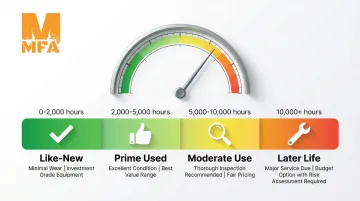
Operating hours function as the odometer for excavators, providing critical insight into remaining useful life.
- 0-2,000 hours: Like-new condition with minimal repairs needed
- 2,000-5,000 hours: Prime used territory; routine maintenance keeps these reliable
- 5,000-10,000 hours: Moderate use; thorough inspection required, wear visible on seals and hoses
- Over 10,000 hours: Later life stage; expect major component replacements soon
Always verify hour meter accuracy by cross-referencing with maintenance records and telematics data (if available).
Inconsistencies between reported hours and visible wear patterns signal potential meter tampering.
Undercarriage Condition
The undercarriage represents the single most expensive wear component, accounting for up to 50% of total lifetime maintenance costs. Replacement costs range from $15,000-$40,000 every 3,000-5,000 hours depending on machine size.
Critical inspection points:
- Track wear depth and tension
- Sprocket tooth condition and wear patterns
- Roller damage, cracks, or leaking seals
- Idler condition and mounting integrity
Poor undercarriage condition provides significant negotiating leverage, as it represents an immediate future liability that you can quantify in repair costs.
Hydraulic System Integrity
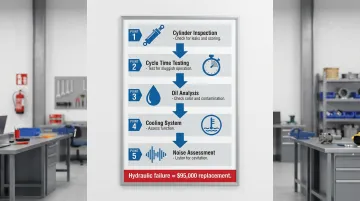
Hydraulic failures cause 45% of major excavator breakdowns, with complete system replacement costing up to $95,000. Hydraulic pumps alone require replacement every 6,000-8,000 hours at $5,000-$15,000 per replacement.
Evaluation checklist:
- Inspect all cylinders for leaks, scoring, or bent rods
- Test cycle times for sluggish operation (indicates pump wear)
- Check hydraulic oil color and contamination
- Assess cooling system function to prevent overheating
- Listen for unusual noises during operation (cavitation, worn pumps)
Identified any problems during your inspection? Investigate thoroughly before purchase. Repair costs can quickly exceed initial savings from buying used.
Maintenance Records and Service History
Complete maintenance documentation can add 10-15% to resale value while providing buyers confidence in equipment condition. Request and verify:
- Service records at critical intervals (500, 1,000, 2,000-hour marks)
- Major component replacements (engine, pumps, undercarriage)
- Fluid analysis reports showing contamination levels
- Warranty claim history and resolution
Missing records are a significant red flag. Without documentation, you cannot verify proper maintenance—deferred maintenance costs become your problem after purchase.
Where to Buy Used Excavators
Equipment Auctions
Auctions provide transparent market pricing and broad selection but require expertise to navigate successfully.
Advantages:
- Competitive pricing typically 20-40% lower than dealer retail
- Large selection concentrated in single events
- Transparent bidding process with clear final pricing
- Immediate possession after payment
Considerations:
- Limited inspection time (typically 1-2 days before auction)
- Sold "As-Is" with no warranties or guarantees
- Requires expertise to assess condition quickly
- Competition from professional buyers and dealers
Major auction houses like Ritchie Bros. sold approximately 15,000 excavators in the U.S. over a recent three-year period, demonstrating robust available inventory and consistent selection depth across events.
Certified Dealers
Certified used programs from dealers and OEMs reduce purchase risk through warranties and professional reconditioning, though at premium pricing.
Key benefits include:
- Warranty coverage (typically 6-12 months on powertrain/hydraulics)
- Professional reconditioning with up to 140-point inspections
- Financing options through manufacturer finance arms
- Post-sale support and service availability
Dealer pricing runs approximately 5-10% higher than auction prices, reflecting the value of warranties, reconditioning, and support services.
For less experienced buyers, this premium often represents worthwhile insurance against costly mistakes.

Online Marketplaces and Private Sales
Online platforms and private sales offer flexibility but require rigorous due diligence and often third-party inspection services.
Due diligence requirements:
- Professional third-party inspection (budget $500-$1,500)
- Verification of ownership and lien status
- Detailed photographic documentation
- Test operation under load conditions
- Complete maintenance record review
Remote and international buyers face additional complexity when purchasing sight-unseen. Mideast Equipment Auctions addresses this challenge with comprehensive services covering equipment location, professional inspection, export documentation, and freight forwarding coordination—simplifying what otherwise requires coordination across multiple vendors.
Common Mistakes to Avoid When Buying Used Excavators
Focusing Only on Purchase Price
The lowest purchase price rarely delivers the lowest total cost of ownership.
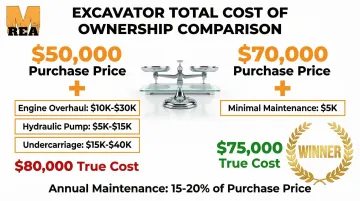
Maintenance and repair costs account for 15-20% of total ownership costs, with routine maintenance alone consuming 2-3% of purchase price annually.
Hidden cost examples:
- Engine overhaul: $10,000-$30,000 (every 8,000-10,000 hours)
- Hydraulic pump replacement: $5,000-$15,000 (every 6,000-8,000 hours)
- Undercarriage replacement: $15,000-$40,000 (every 3,000-5,000 hours)
Consider this: a $50,000 excavator requiring immediate $30,000 in deferred maintenance actually costs $80,000—potentially more than a better-maintained $70,000 unit needing minimal repairs.
Skipping Professional Inspection
Buying sight-unseen or without professional inspection is gambling with tens of thousands of dollars.
Undisclosed issues are common in the used equipment market, with hydraulic problems alone potentially costing $95,000 for complete system replacement.
Professional inspections deliver significant protection:
- Typical cost: $500-$1,500
- Can identify problems costing 10-50 times more to repair
- Essential for remote purchases
- Reveals issues photos and seller claims won't show
Not Verifying Machine History and Ownership
Skipping title and history verification can leave you owning equipment with liens, stolen status, or fraudulent documentation.
Verification steps:
- Confirm serial number matches all documentation
- Search for liens through UCC filings
- Verify seller ownership through title documentation
- Cross-reference maintenance records with reported hours
- Check for theft reports through equipment registries
Proper documentation protects your investment and ensures you can legally operate and eventually resell the equipment without title complications.
Conclusion
Purchasing a used excavator is a strategic investment that requires balancing upfront cost savings against long-term operational needs, going well beyond just selecting a recognizable brand name.
The 30-50% cost advantage delivers immediate budget relief, but smart buyers evaluate total cost of ownership—maintenance, parts availability, fuel efficiency, and resale value over the equipment's remaining useful life.
Work with experienced equipment specialists who can provide professional inspection services, market insights, and access to quality used excavators from reputable sources.
Their expertise helps you avoid costly mistakes that turn apparent bargains into money pits while identifying genuinely valuable opportunities.
Mideast Equipment Auctions provides comprehensive support for used excavator buyers:
- Expert guidance and thorough equipment inspections
- Global network of quality used excavators from reputable sources
- Equipment location services for specific project needs
- Flexible financing options through multiple lenders
- Complete export support for international buyers
Frequently Asked Questions
What is the best brand of used excavator to buy?
Caterpillar, Komatsu, Volvo, and Hitachi consistently rank highest for used equipment quality and value retention. CAT leads in resale value, Komatsu offers superior fuel efficiency, while your final choice depends on your budget and regional parts availability.
How many hours is too many for a used excavator?
Excavators under 10,000 hours are good purchases if well-maintained. Machines with 10,000-15,000 hours require thorough inspection and may need major component replacement soon. Over 15,000 hours should only be purchased at significant discount with expectation of immediate repairs.
What should I inspect before buying a used excavator?
Focus your inspection on these critical areas:
- Operating hours and meter accuracy verification
- Undercarriage condition (tracks, sprockets, rollers)
- Hydraulic system integrity (leaks, cycle times, pump performance)
- Engine performance and structural damage (boom, stick, bucket)
- Complete maintenance records and service history
Is it better to buy a used excavator at auction or from a dealer?
Auctions offer 20-40% lower prices and large selection but sell as-is without warranties, requiring buyer expertise. Dealers provide warranties, reconditioning, and support at 5-10% premium pricing. Mideast Equipment Supply offers both auction and dealer options, giving you flexibility based on your experience level and risk tolerance.
How much does a used excavator cost?
Used excavator prices vary by brand, size, age, and hours:
- Mini excavators (1-6 tons): $20,000-$60,000
- Compact excavators (7-10 tons): $40,000-$100,000
- Medium excavators (11-25 tons): $80,000-$180,000
- Large excavators (26-45 tons): $150,000-$350,000
What financing options are available for used excavators?
Financing is available through equipment financing companies, dealer programs, banks, and specialized lenders, with Mideast Equipment Supply connecting buyers to multiple competitive lenders. Terms typically range 3-7 years with 10-20% down, depending on equipment age and your creditworthiness.