Introduction
Logging operations demand bulldozers that can handle some of the toughest conditions in heavy equipment work—soft, swampy ground littered with stumps and roots, steep slopes that test stability, and dense slash piles that bog down underpowered machines.
The wrong dozer choice leads to frequent breakdowns, costly downtime, and frustration as equipment sinks into soft soil or struggles to push through debris.
The right bulldozer transforms these challenges into manageable tasks. Purpose-built logging dozers with Low Ground Pressure (LGP) tracks distribute weight to prevent sinking, while powerful engines and robust undercarriages handle the punishment of stump-filled terrain.
Specialized blade configurations move slash efficiently. Integrated winch systems pull logs from hard-to-reach spots. These features translate directly to faster site preparation, more efficient skid road construction, and lower operating costs.
Choosing a logging dozer requires evaluating specific capabilities:
- LGP track width and ground pressure for your soil conditions
- Winch capacity for log extraction needs
- Undercarriage protection against root and stump damage
- Blade configurations suited to both clearing and road building
This guide examines the top bulldozers that deliver these critical features for professional timber operations.
Key Takeaways
- LGP tracks cut ground pressure to 4.5-5.1 psi for soft terrain versus 6-8 psi with standard tracks
- Factory winches enable log extraction on steep or inaccessible slopes
- D6 XE LGP delivers 35% better fuel efficiency with 215 hp through electric drive technology
- Choose D6-D7 class for general logging; D4-D5 models handle selective cutting operations
Overview of Bulldozers in Logging Operations
Logging work destroys standard construction bulldozers. Forest environments demand specialized machines that can handle soft soil, heavy timber loads, massive debris piles, and constant punishment from stumps and roots.
A logging dozer needs four critical capabilities: ground pressure management to prevent sinking, sufficient drawbar pull to move timber and push through slash piles, blade capacity to handle debris efficiently, and undercarriage durability to survive impacts. Standard construction dozers lack the specialized features that make these tasks manageable.

Logging operations rely on bulldozers for multiple essential tasks:
- Building skid roads for log extraction equipment access
- Clearing and leveling landing areas where logs are processed
- Preparing reforestation sites by removing debris
- Pushing slash into piles for burning or decomposition
- Assisting with log extraction on steep slopes where the blade provides stability
Bulldozers remain the primary equipment choice for infrastructure development in terrain where wheeled skidders cannot operate safely.
The machines featured below were specifically selected for their proven performance in timber operations. Each offers the terrain capability, durability, and power-to-weight ratio that logging contractors need, with LGP configurations available and track records validated by forestry applications worldwide.
Top 5 Best Bulldozers for Logging
These bulldozers were selected based on terrain handling capability, undercarriage durability, power-to-weight ratio, LGP configuration availability, winch options, and proven track records in forestry applications.
Caterpillar D6 XE LGP
Caterpillar's machines are known for surviving harsh forestry conditions, and the D6 XE LGP represents the company's most fuel-efficient dozer for logging operations. This workhorse combines electric drive technology with low ground pressure configuration and available winch packages, making it ideal for contractors who work long days in soft terrain.
The electric drive system delivers up to 35% better fuel efficiency compared to conventional models—a significant cost reduction for remote operations where fuel delivery is expensive. It provides constant power to the ground without shifting, improving traction on steep slopes common in timber country.
Operators benefit from excellent visibility when working around standing timber, while the sealed and lubricated undercarriage resists debris damage from slash and bark. The dozer accepts various blade types including semi-U and angle configurations for efficient slash management and road building.
Caterpillar D6 XE LGP Specifications
| Specification Category | Details | Logging Application Benefit |
|---|---|---|
| Operating Weight & Ground Pressure | 23,820 kg (52,512 lb) operating weight; 35 kPa (5.1 psi) ground pressure with 915 mm (36 in) shoes | Enables work in swampy conditions and soft forest soils without sinking; pressure 35% lower than standard track configurations |
| Engine Power & Drawbar Pull | 161 kW (215 hp) net power at 1,700 rpm; electric drive provides constant power to ground | Moves large timber and works through dense slash piles; eliminates power loss during gear shifts on slopes |
| Winch & Blade Options | Winch-ready rear hydraulics; LGP VPAT blade (4.9 m³/6.5 yd³), LGP SU blade (5.8 m³/7.6 yd³), LGP S blade (3.8 m³/5.0 yd³) | VPAT blade offers versatility for road building and side-casting; larger SU blade handles heavy slash clearing; winch enables log skidding |
John Deere 750K LGP
John Deere's strong presence in forestry equipment extends to the 750K LGP, which offers a balanced mid-size option for logging contractors who need maneuverability without sacrificing power. This dozer delivers the ground pressure and stability required for wet conditions while maintaining enough muscle for serious clearing work.
SmartGrade technology enables precise skid road and landing construction without external masts—critical for working around standing timber. EcoMode delivers fuel savings during long logging operations by automatically adjusting engine and transmission settings.
Key features for forestry work include:
- Excellent undercarriage protection designed for stump-filled terrain
- Factory LGP option providing 4.57 psi ground pressure
- Wet-condition capability that would stop standard dozers
John Deere 750K LGP Specifications
| Specification Category | Details | Logging Application Benefit |
|---|---|---|
| Operating Weight & Ground Pressure | 17,121 kg (37,745 lb) operating weight; 31.5 kPa (4.57 psi) ground pressure with 865 mm (34 in) grouser width; standard configuration exerts 52.9 kPa (7.67 psi) | LGP configuration reduces ground pressure by 40% versus standard tracks; superior flotation in soft logging sites |
| Blade Capacity & Configuration | Power/Angle/Tilt (PAT) blade with 53,077 cm² (8,227 sq. in.) ground contact area | PAT blade provides hydraulic control of lift, angle, and tilt for precise road building and versatile slash management |
| Cab Features & Visibility | Spacious cab with low-effort joystick controls; meets ROPS (ISO 3471-2008) and FOPS (ISO 3449-2005) standards | Excellent visibility for safe operation near standing timber; climate control for long shifts in remote locations |
Komatsu D65PX-18
Komatsu's reliable undercarriage systems survive serious punishment, and the D65PX-18 is favored for logging work requiring durability in harsh conditions with roots, stumps, and rocky substrate beneath forest floors. This mid-size dozer delivers the robustness logging contractors need when equipment failure isn't an option.
The Parallel Link Undercarriage (PLUS) system reduces stress on components when navigating obstacles—potentially doubling wear life compared to conventional undercarriages in abrasive forestry soils. The hydrostatic transmission provides precise control on steep slopes, essential for safe operation in mountainous timber country.
The available LGP configuration and compatibility with logging-specific blade designs make this dozer versatile across different forest conditions.
Komatsu D65PX-18 Specifications
| Specification Category | Details | Logging Application Benefit |
|---|---|---|
| Undercarriage & Durability Features | Parallel Link Undercarriage System (PLUS) with rotary bushing design; delivers up to twice the life of conventional undercarriages; eliminates pin and bushing turns | Reduces maintenance costs in abrasive forest soils; minimizes downtime from undercarriage repairs in remote locations |
| Power & Transmission | 162 kW (217 HP) at 1,950 rpm; Hydrostatic Steering System (HSS) provides smooth, continuous power during turns | HSS allows counter-rotation and maintains power on slopes; precise control for navigating between standing timber |
| Ground Pressure & Terrain Capability | LGP (PX): 32.7 kPa (4.69 psi) with 915 mm (36 in) shoes; Standard (EX): 44.1 kPa (6.4 psi) with 610 mm (24 in) shoes | PX model specifically designed for soft, wet, or swampy conditions; standard model provides better traction on firm ground |
Case 1650M LGP
Case's focus on operator visibility and comfort makes the 1650M LGP an excellent choice for logging operations where operators need to navigate around standing timber and work long hours in challenging conditions. This dozer prioritizes the operator experience without compromising on the power and flotation logging work demands.
Industry-leading 360-degree cab visibility enables safe operation near trees—a critical safety feature when working around valuable standing timber. The Power-Pitch blade tilts forward for better slash penetration and back for easier dozing, adapting to different materials throughout the workday. Available LGP tracks provide the soft ground capability logging sites require, while intuitive controls reduce operator fatigue during extended shifts.
Case 1650M LGP Specifications
| Specification Category | Details | Logging Application Benefit |
|---|---|---|
| Visibility & Safety Features | Industry-leading cab-forward design with 360-degree visibility; fully enclosed ROPS cab meeting safety standards | Reduces risk of striking standing timber or equipment; operator can see obstacles like stumps and roots before contact |
| Power-Pitch Blade Technology | Hydraulic blade pitch adjustment from cab (55° +/- 5°); operator controls angle for different materials | Forward pitch penetrates slash piles more effectively; back pitch optimizes dozing efficiency; eliminates manual adjustment |
| Operating Specifications | 17,940 kg (39,557 lb) operating weight; 122 kW (164 hp); 0.33 kg/cm² (4.7 psi) ground pressure with 860 mm shoes; 322 L (85 gal) fuel tank | Competitive ground pressure for flotation; large fuel capacity supports extended operation in remote locations |
Caterpillar D4 or D5 (for Selective Cutting Operations)
Smaller dozers play a critical role in selective cutting and thinning operations where maneuverability matters as much as power. The D4 or D5 size class offers the ability to work in tight spaces between standing timber while still providing adequate power for clearing and road building in selective harvest areas.
Why these smaller dozers excel in selective logging:
- Lower ground pressure even in standard configuration reduces site disturbance and soil compaction
- Narrower width allows working between tree rows without damaging valuable timber
- Lower operating costs make them economical for smaller-scale operations
- Available winch packages enable light log skidding
- Easier transport between remote sites reduces mobilization costs
Caterpillar D4 & D5 Specifications
| Specification Category | D4 (2021 Model) | D5 (2019 Model) |
|---|---|---|
| Size & Maneuverability | 13,272 kg (29,259 lb) standard; 14,008 kg (30,882 lb) LGP | 19,170 kg (42,263 lb) LGP VPAT |
| Ground Pressure & Site Impact | 40.5 kPa (5.9 psi) standard; 31 kPa (4.5 psi) LGP | 32.6 kPa (4.7 psi) LGP |
| Power & Application Range | 97 kW (130 hp); 3.26 m³ (4.26 yd³) VPAT blade; 3.81 m³ (4.98 yd³) LGP VPAT blade; PA50 winch (222.4 kN / 50,000 lbf) | 127 kW (170 hp); 4.0 m³ (5.2 yd³) LGP VPAT blade; PA55 winch available; includes forestry arrangement with sweeps, screens, guards |
The D4 suits thinning operations and small landing construction where minimal site disturbance is critical. The D5 provides more power for selective cutting in medium timber while maintaining lower ground pressure than mid-size dozers. Both models offer factory forestry arrangements with essential protection against falling limbs and underbrush.
How We Chose the Best Bulldozers for Logging
Many logging contractors make the mistake of focusing solely on horsepower or brand reputation without considering critical factors like ground pressure for their specific terrain, undercarriage durability for stump-filled sites, or blade configurations for efficient slash management. A powerful dozer is worthless if it sinks in soft ground or suffers constant undercarriage damage.
Our evaluation criteria included:
- Terrain capability: LGP availability, ground pressure specs (targeting 4.5-5.1 psi for soft ground), and slope stability features
- Durability factors: Undercarriage protection systems, sealed components that resist debris damage, and expected hour ratings in forestry applications
- Power and efficiency: Drawbar pull for moving timber, fuel consumption during remote operations, and hydraulic capacity for blade and winch work
- Safety features: ROPS/FOPS protection, visibility for working near standing timber, and operator comfort for long shifts
- Service support: Availability in remote logging regions where downtime is costly
Finding the right dozer often involves exploring both new and used equipment markets. Mideast Equipment Supply provides inspected used bulldozers with documentation covering undercarriage condition, blade wear, and hydraulic system performance. Financing options make acquisition manageable, and worldwide shipping delivers machines to logging operations anywhere.
Conclusion
Selecting the right bulldozer for logging work requires matching machine capabilities to your specific terrain challenges, operation scale, and budget rather than simply choosing the biggest or most expensive model available.
For example, a D6 XE LGP with electric drive delivers exceptional fuel efficiency for contractors running long days, while a Komatsu D65PX-18 with PLUS undercarriage minimizes maintenance costs in harsh conditions.
Key factors to evaluate before purchasing:
- Ground conditions (soft/firm soil, slope angles, stump density)
- Typical task requirements (road building, landing clearing, slash management)
- Maintenance support availability in your region
Even the best dozer causes costly downtime if parts and service aren't accessible when problems arise.
When you're ready to source a quality used bulldozer, working with experienced equipment dealers like Mideast Equipment Supply can help you find the right machine with flexible financing, thorough inspections, and global delivery capabilities to support your logging operation's success.
Frequently Asked Questions
What size dozer for clearing trees?
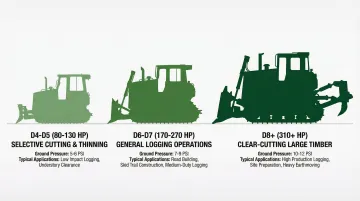
D4-D5 class (80-130 HP) works well for selective cutting and small trees. D6-D7 class (170-270 HP) handles general logging and medium timber, while D8+ class (310+ HP) tackles clear-cutting large timber or high-density forests. Match size to your tree diameter and acreage to avoid soil damage or wasted time.
What is the best equipment for loading logs?
Dedicated log loaders (knuckleboom loaders or log forklifts) are purpose-built for loading logs onto trucks with speed and precision. Bulldozers with grapple attachments work for moving and sorting logs in the landing area but lack the reach and efficiency of specialized loaders for production operations.
What is a swamp dozer?
A swamp dozer refers to a bulldozer equipped with Low Ground Pressure (LGP) tracks—extra-wide tracks (typically 30-36 inches) that distribute weight over a larger surface area. This reduces ground pressure from typical 6-8 psi down to 4.5-5.1 psi, allowing operation in soft, wet, or swampy terrain common in many logging sites without sinking or getting stuck.
What blade type is best for logging and land clearing?
Semi-U blades offer the best balance for logging work because they provide good capacity for moving slash piles while maintaining the ability to angle for windrow work. Straight blades work well for road building where precision grading matters. Angle blades excel at side-casting debris when clearing trails. VPAT (Variable Power Angle Tilt) blades provide the most versatility, allowing hydraulic adjustment of lift, angle, and tilt for different tasks throughout the day.
Do I need a dozer with a winch for logging operations?
A winch is highly valuable for logging work as it enables pulling logs from difficult spots, extracting equipment if stuck, and assisting with positioning large timber. However, it's not absolutely required if you have separate skidding equipment like cable skidders or forwarders. Dozers with winches become versatile support machines that can work in steep terrain where dedicated skidders cannot operate safely.
What's the difference between standard and LGP tracks for logging?
LGP tracks are wider (30-36 inches versus 22-24 inches), distributing weight over more surface area to reduce ground pressure from 6-8 psi to 4.5-5.1 psi. This makes them essential for soft logging sites, reducing soil compaction. Standard tracks provide better traction on firm ground but sink where LGP tracks float.