Key Takeaways
- Match bulldozer size to terrain—crawler models dominate rough terrain work (99% of market)
- Used dozers cost 30-70% less than new but require rigorous inspection and lack warranties
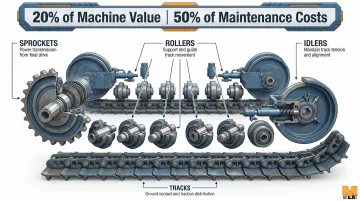
- Undercarriage components represent 20% of value but 50% of maintenance costs
- Factor in total ownership costs: fuel (1.34-20.52 gal/hr), parts availability, and maintenance
- Choose dealers offering inspection reports, equipment history, and post-sale support
What is a Bulldozer?
A bulldozer is heavy tracked or wheeled equipment featuring a front-mounted blade for pushing materials and often a rear-mounted ripper for breaking ground.
These machines are essential for projects requiring substantial earthmoving capability:
- Construction site preparation and grading
- Agricultural land clearing and development
- Mining operations and material handling
- Road building and infrastructure projects
- Demolition and debris removal
Understanding the key components helps you evaluate which bulldozer meets your project requirements.
Core Components and Capabilities
The blade — a front-mounted plate — pushes soil, debris, and rocks. Blade configurations vary—straight blades (S-blade) excel at fine grading work, while universal blades (U-blade) handle larger material volumes.
Mounted to the rear, the ripper uses claw-like tines to break hard surfaces, compacted soil, or rock before the blade pushes material. Not all dozers include rippers, but they're standard on medium and large models used for ground preparation.
The undercarriage system delivers mobility across challenging terrain through several integrated components:
- Tracks or wheels that distribute weight and provide traction
- Rollers, idlers, and sprockets that support and guide the track system
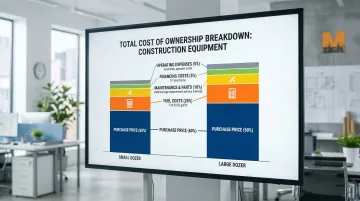
This critical system accounts for approximately 20% of the machine's value and 50% of total maintenance costs over the bulldozer's lifespan.
The operator cab houses controls for blade positioning, travel speed, and attachment operation. Modern cabs include advanced monitoring technology, climate control, and ergonomic designs that reduce operator fatigue during long shifts.
5 Expert Tips for Buying a Bulldozer
Tip 1: Determine the Right Size and Type for Your Needs
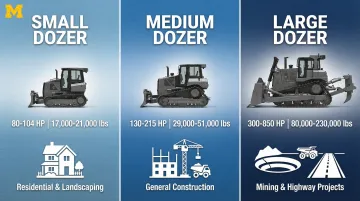
Bulldozers are categorized by horsepower and operating weight, with three primary size classes:
Size Classifications:
- Small: 80-104 hp, 17,000-21,000 lbs operating weight
- Medium: 130-215 hp, 29,000-51,000 lbs operating weight
- Large: 300-850 hp, 80,000-230,000 lbs operating weight
Crawler (tracked) dozers represent 99% of financed new bulldozer sales, offering superior traction on rough, muddy, or sloped terrain.
The 2025 financing data shows 60.5% standard crawler and 39.5% low ground pressure (LGP) crawler configurations.
Wheel dozers provide better maneuverability on hard surfaces and work well for facility maintenance or applications requiring tight turns. However, they represent a tiny market segment compared to tracked models.
Match equipment to your work:
- Assess terrain type (soft soil, rock, slopes, or hard surfaces)
- Calculate typical material volumes you'll move
- Evaluate jobsite space constraints
- Determine whether you need maximum traction or maneuverability
Compact models suit small projects like residential land clearing or farm pond construction. Large models tackle major earthmoving for highway construction, mining operations, or commercial site development.
Tip 2: Evaluate New vs. Used Options
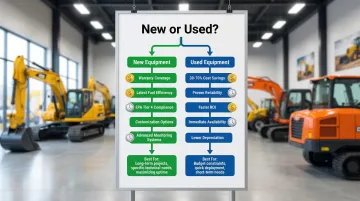
Used bulldozers typically cost 30-70% less than new models, creating significant budget flexibility.
The average used bulldozer price reached $267,143 in Q4 2024, up from $234,126 the previous year, reflecting strong demand and supply constraints.
New Equipment Benefits:
- Latest fuel efficiency technologies reducing operating costs
- Warranty coverage (1-3 years) protecting against major repairs
- Customization options for specific applications
- Advanced monitoring technology for productivity tracking
- Compliance with current EPA Tier 4 emissions standards
Used Equipment Advantages:
- Substantial cost savings (mid-range used: $100,000-$200,000 vs. new: $180,000-$340,000)
- Proven reliability—bulldozers often run 10,000+ hours with proper maintenance
- Faster ROI for part-time or seasonal operations
- Immediate availability without manufacturing wait times
Consider your operation:
- Heavy daily use (construction firms, mining operations) typically favors new equipment
- Part-time operators (farms, landscapers, seasonal contractors) often find better value in used models
- Budget constraints and financing terms
- Whether manufacturer warranty is critical to your risk tolerance
Operations requiring the latest technology and maximum uptime justify new equipment costs. Lower utilization rates often achieve better returns with quality used machines.
Tip 3: Inspect Critical Components Thoroughly
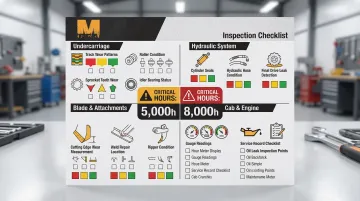
For used bulldozers, thorough inspection is essential. Undercarriage repairs alone can cost tens of thousands of dollars, with a typical undercarriage life of 4,000 hours before major intervention is needed.
Undercarriage Inspection:
- Check track condition: measure cleat wear and grouser bar height
- Examine rollers for warping, flat spots, or bearing play
- Inspect sprocket teeth for excessive wear or missing teeth
- Assess front idler condition and bearing integrity
- Look for stretched tracks that indicate poor maintenance
Hydraulic System Checks:
- Inspect all cylinders (lift, tilt, ripper) for chrome damage and seal leaks
- Examine hoses and connections for cracks, bulges, or active leaks
- Check final drives for gear oil leaks around seals
- Test blade response time—excessive slack indicates worn pins or bushings
Blade and Attachment Evaluation:
- Look for cracks or excessive wear on cutting edges
- Check for weld repairs that may indicate previous structural failure
- Test blade lift and lower functions for smooth operation
- Assess ripper shank condition if equipped
Cab and Engine:
- Verify all gauges and electronics function properly
- Review hour meter readings on both machine and attachments
- Request complete service records to identify maintenance gaps
- Check for oil leaks, loose belts, and engine blow-by
Machines with 5,000+ hours demand extra scrutiny, particularly undercarriage components.
Complete service records become critical above 8,000 hours, where major overhauls (engine, transmission, final drive) are commonly required.
Tip 4: Consider Total Cost of Ownership
Purchase price is only the beginning. Fuel consumption varies drastically by size—a small Cat D1 consumes 1.34-1.71 gal/hr under medium load, while a massive Cat D11 burns 15.45-20.52 gal/hr.
Calculate Your Operating Costs
Annual Fuel Expenses:
- Estimate annual operating hours (500 hours for seasonal use, 2,000+ hours for full-time operations)
- Research your model's fuel consumption specifications
- Multiply by local diesel prices to project annual fuel expense
- Example: A Cat D6 consuming 4.82 gal/hr at $3.50/gallon costs $8,442 annually (500 hours) or $33,768 (2,000 hours)
Parts Availability Matters:
- Popular brands (Caterpillar, John Deere, Komatsu) have extensive dealer networks
- Extensive parts inventories mean shorter downtime
- Obscure brands may face long lead times and premium prices
- Consider proximity to dealers and parts distribution centers
Maintenance Considerations:
- Factor regular service intervals (oil changes, filter replacements, greasing)
- Budget for replacement tracks/undercarriage components every few thousand hours
- Plan for hydraulic system servicing and seal replacements
- Major overhauls typically required at 7,000-10,000 hours
Financing Impact:
- Equipment financing typically ranges 3-7 years with 10-20% down payments
- Interest rates affect total amount paid significantly
- Monthly cash flow impacts your ability to take on additional work
- Compare financing terms from manufacturers, dealers, and third-party lenders
Tip 5: Choose the Right Seller or Dealer
The seller relationship is as important as the machine itself. Reputable sellers provide inspection reports, transparent history, warranty options, and ongoing support that protects your investment.
Equipment Auctions:
- Detailed listings with photos and video documentation
- Transparent pricing set by competitive bidding
- Wide inventory selection across brands and models
- Buyer fees typically 5-10% of purchase price
- Auctions sell equipment "as-is" with no warranty
- Requires buyer expertise to assess condition
Established Dealers:
- Financing assistance through manufacturer or third-party lenders
- Trade-in options for existing equipment
- Warranty coverage protecting against defects
- Parts and service support after purchase
- Operator training programs
- Complete service records and maintenance history
Verify Seller Credentials:
- Check online reviews and customer testimonials
- Ask about their inspection process and quality standards
- Inquire about post-sale support and parts availability
- Confirm they can provide complete service records
- Verify clear title and UCC lien status
For buyers needing specific equipment for project requirements, dealers like Mideast Equipment Supply offer equipment location services alongside financing options and export documentation for international shipments.
Critical Questions to Ask:
- Can they locate specific equipment matching your project requirements?
- What financing options do they offer and through which lenders?
- What is their return or warranty policy?
- Can they handle export documentation if shipping internationally?
- Do they provide ongoing maintenance support or service coordination?
First-time buyers benefit from dealers who provide education, support, and warranty protection. Experienced operators comfortable with equipment assessment may find competitive pricing at auctions.
How Mideast Equipment Can Help
Whether you're buying your first bulldozer or adding to an existing fleet, working with an experienced equipment dealer simplifies the entire process.
Mideast Equipment specializes in used heavy equipment sales, auctions, and export services. Since 2004, they've connected buyers with construction equipment across a global network spanning Australia, the Middle East, and Central America.
The company handles everything from equipment location and inspection to financing coordination and international shipping.
Key Benefits:
- Weekly email list connects you with 35,000 buyers and sellers for broader inventory access
- Multiple lender options to compare financing terms
- Location services for finding specific bulldozer models that match your project needs
- Coordination with freight forwarders for domestic and international shipping
- Multiple locations across the United States for convenient equipment inspection
With locations in Utah, Connecticut, Massachusetts, New York, and Florida, Mideast Equipment provides regional access while sourcing equipment nationwide and coordinating international shipments.
Conclusion
Buying a bulldozer requires balancing immediate budget constraints with long-term operational needs and total cost of ownership.
Your goal isn't finding the newest or cheapest option—it's identifying the machine that delivers the best combination of productivity, reliability, and value for your specific applications.
Smart bulldozer purchases start with three fundamentals:
- Honest assessment of your terrain, project scale, and usage frequency
- Thorough inspection of critical components (especially undercarriage) to avoid expensive surprises
- Total cost calculation that accounts for maintenance, fuel, and operating expenses beyond purchase price
Working with an experienced equipment dealer provides access to pre-inspected inventory, financing options, and guidance throughout the selection process. Whether you're buying locally or internationally, partnering with specialists who understand your operational requirements helps ensure your investment delivers reliable performance for thousands of operating hours.
Frequently Asked Questions
How much should I expect to pay for a bulldozer?
Small used dozers start around $45,000-$90,000, mid-range models run $100,000-$200,000, and new large dozers can exceed $1 million. Pricing depends on size, age, hours, condition, and brand.
What's better for most applications—a crawler or wheel dozer?
Crawler dozers handle 95% of applications better due to superior traction on soft, uneven, or sloped terrain. Wheel dozers work best for facility maintenance on hard surfaces but represent less than 1% of the market.
How many hours is too many on a used bulldozer?
Well-maintained dozers often exceed 10,000 hours, but machines with 5,000+ hours need thorough inspection, especially the undercarriage. Above 8,000 hours, complete service records are critical as major overhauls are typically needed.
Should I buy from an auction or a dealer?
Auctions offer competitive pricing and wide selection but require buyer expertise and provide no warranties. Dealers provide warranties, financing, inspection reports, and ongoing support—better for first-time buyers needing post-sale service.
What are the most important things to inspect on a used bulldozer?
Focus on undercarriage components (tracks, rollers, sprockets), hydraulic system leaks, blade condition and response time, hour meter accuracy, and service history. The undercarriage alone represents 20% of machine value.
Can I finance a bulldozer purchase?
Yes, financing is widely available through manufacturers, dealers, and third-party lenders. Terms typically range from 3-7 years with down payments of 10-20% depending on creditworthiness and equipment age. Multiple lenders competing for your business often yields the best rates and terms.