Introduction: Bridge Construction Equipment Essentials for Contractors
Bridge construction demands specialized heavy equipment capable of handling extreme loads, precise positioning, and complex site conditions. Contractors face critical decisions when selecting machinery for projects ranging from foundation piles driven 70 feet deep to lifting 900-ton precast segments.
The right equipment selection directly impacts project timelines, safety outcomes, and profitability.
According to industry data, rail-mounted gantry cranes can lift twin loads of 50-65 tons with millimeter-level accuracy, while strand jack systems synchronize up to 120 lifting points simultaneously for complex segmental construction.
This article covers the essential equipment categories contractors need for successful bridge projects, from foundation work through final assembly, along with practical sourcing strategies to acquire these specialized machines.
TLDR: Key Takeaways About Bridge Construction Equipment
- Gantry cranes, floating cranes, and strand jacks handle loads from 40 to 900+ tons
- Long-reach excavators dig 72 feet deep; pile drivers install foundation supports
- Hydro platforms and access equipment extend up to 66 feet for safe bridge reach
- Contractors source equipment through used machinery purchases and auction opportunities
Heavy Lifting Equipment for Bridge Construction
Gantry Cranes
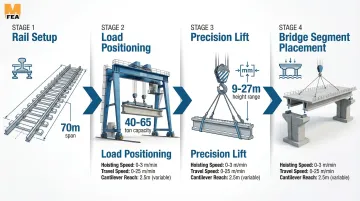
Rail-mounted gantry cranes (RMGs) provide the precision lifting capacity essential for placing precast bridge segments and handling heavy deck components. These cranes travel on elevated rail systems, positioning loads with millimeter accuracy across spans up to 70 meters.
Capacity and configurations:
- Single lift capacity: 40-50 tons for standard applications
- Twin lift capacity: 50-65 tons for synchronized operations
- Heavy-duty railway gantries: 50-900 tons for large-span bridges
- Lift heights: 9-27 meters depending on configuration
Operational specifications:
- Hoisting speeds: 28 m/min at rated load, 56 m/min without load
- Trolley travel: 70 m/min for precise positioning
- Gantry travel: up to 130 m/min for rapid repositioning
Full gantry configurations run on two parallel rail tracks, ideal for bridge deck yards and staging areas. Semi-gantry designs combine one elevated rail with one ground-level track, useful when site constraints limit full rail installation.
The cantilever reach extends up to 20 meters, allowing access to bridge sections beyond the rail span.
Floating Cranes and Crane Vessels
Water-based bridge construction over rivers and harbors requires floating cranes that maintain stability while lifting heavy loads from unstable platforms.
These specialized vessels use counterweight tank systems filled with water or ballast to offset lifting forces.
Critical stability requirements:
- Maximum list/trim: 5-7 degrees during lifting operations
- Minimum freeboard: 1 foot at rated capacity plus 25% safety margin
- Wind rating: Must maintain stability in 60 mph winds
The Liebherr CBG 350 floating crane delivers 35-tonne capacity at 36-meter outreach for grab operations, or 80-tonne capacity at 26-meter radius for hook operations. Crawler cranes mounted on barges, like the Manitowoc 999, provide 230-ton capacity at 15-foot radius with a 70-foot boom.
Naval Architectural Analysis (NAA) determines safe load ratings based on vessel dimensions, counterweight configuration, and operating conditions. Contractors must verify stability calculations before each lift to prevent capsizing risks.
Strand Jacks and Synchronous Lifting Systems
Hydraulic strand jacks enable precise, synchronized lifting of multiple bridge sections simultaneously, essential for balanced cantilever construction and span launching.
Each jack grips steel strands and lifts in controlled increments, with computerized systems coordinating multiple units.
System capabilities:
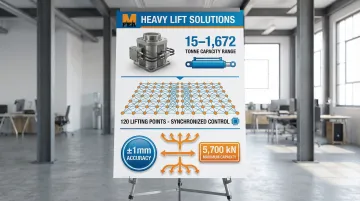
- Per-unit capacity: 15 tonnes to 1,672 tonnes
- Maximum system capacity: 5,700 kN (640 tons) per jack
- Synchronization: Up to 120 lifting points controlled simultaneously
- Precision: ±1mm accuracy across all lifting points
A single operator controls the entire synchronized system through computerized interfaces that monitor load distribution, detect overloads, and adjust stroke equalization in real-time. This precision prevents structural damage during lifts and ensures balanced loading on bridge components.
Applications include launching precast segments in span-by-span construction, lifting arch sections into position, sliding completed bridge decks onto permanent bearings, and replacing bridge sections during renovation projects.
Overhead Cranes and Bridge Launching Equipment
While strand jacks provide vertical lifting control, bridge launching equipment moves completed segments horizontally into their final position.
Launching Gantries
These self-propelled systems travel along completed bridge sections to install the next segment, eliminating the need for ground-based cranes or scaffolding.
- Segment capacity: 50-900 tons depending on bridge design
- Effective span range: 20-50 meters per segment
- Longitudinal speed: 0-5 m/min for controlled positioning
- Configuration options: Overhead or underslung models
Hinged launching gantry designs accommodate tight horizontal curves down to 75-meter radius, essential for modern highway interchanges. The gantry picks up precast segments from delivery trucks, positions them precisely, and post-tensions connections before advancing to the next span.
Form Travelers
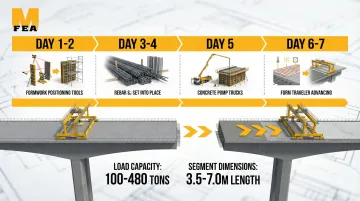
Cast-in-situ balanced cantilever construction uses form travelers that support formwork, reinforcement, and concrete placement for each new segment.
- Load capacity: 100-480 tons including formwork and wet concrete
- Segment dimensions: 3.5-7.0 meters length, 5-35 meters width
- Production cycle: 5-7 days per segment
- Applications: Box girder bridges, cable-stayed bridges
The traveler anchors to the completed segment, extends the formwork, places reinforcement, pours concrete, and cures the section before releasing and advancing. This method builds bridges without ground-based falsework, ideal for crossing deep valleys or water.
Carry Deck and Crawler Cranes
Carry Deck Cranes
Compact mobile cranes offering quick setup and maneuverability in confined bridge sites.
- Lifting capacity: 3-20 tons depending on model
- Deck capacity: Up to 17,000 lbs for material transport
- Operating requirements: Smooth, level paved surfaces
- Speed limitation: Under 3 mph for pick-and-carry operations
These units excel at placing smaller bridge components, positioning formwork, and handling materials in areas inaccessible to larger cranes.
Crawler Cranes
Track-mounted cranes provide heavy lifting capacity with low ground bearing pressure, suitable for soft or uneven terrain.
- Capacity range: 110-330+ tons for bridge applications
- Terrain capability: Operates on slopes and unprepared surfaces
- Stability: Wide track stance provides secure lifting platform
- Mobility: Self-propelled movement around construction sites
Crawler cranes handle main girder erection, pier cap placement, and other heavy lifts where floating cranes or gantries aren't practical.
Earthmoving and Foundation Equipment
Excavators for Site Preparation
Standard and long-reach excavators prepare bridge sites by removing soil, rock, and debris while creating precise foundation excavations.
Long-reach excavator specifications:
- Digging depth: Up to 72 feet for deep foundations
- Maximum reach: 91 feet at ground level
- Underwater capability: Waterproofed sensor boxes enable submerged operation
- Grade control: 2D systems with E-fence boundaries
The Cat 395 LRE super long reach excavator eliminates costly dewatering or complex cofferdam construction by excavating directly underwater.
Waterproofed sensors maintain grade control accuracy even when fully submerged, essential for bridge pier foundations in rivers and harbors.
Standard excavators handle approach roadway excavation, material loading, and general site preparation.
Most bridge contractors deploy 30-50 ton class excavators for foundation work, with smaller units supporting utility relocation and finish grading.
Pile Driving Equipment
Contractors match pile drivers to soil conditions and pile specifications when installing deep foundation supports for bridge piers and abutments.
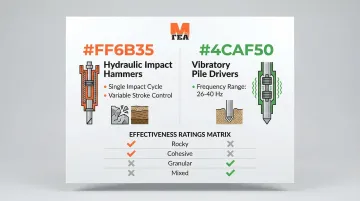
| Feature | Hydraulic Impact Hammers | Vibratory Pile Drivers |
|---|---|---|
| Mechanism | Hydraulic fluid lifts ram; gravity plus hydraulic assist drives impact | Counter-rotating eccentric weights create oscillating force |
| Frequency | Single impact per cycle | Standard (up to 26 Hz) or high frequency (up to 40 Hz) |
| Best Soil Types | Broad range including hard rock and cohesive soils | Granular, submerged soils |
| Control | Variable stroke adjustment for different pile types | Frequency and amplitude adjustment |
| Limitations | Noise levels require mitigation in urban areas | Less effective in stiff clays; can damage precast concrete piles |
Soil conditions determine equipment selection - vibratory hammers excel in sandy, water-saturated soils, while hydraulic impact hammers handle varied conditions including bedrock. Refusal criteria (typically 10 blows per inch) prevent pile damage during driving operations.
Drilling Equipment and Caisson Installation
Rotary drilling rigs create drilled shaft foundations for large bridge piers, installing permanent casing into rock or unstable soils.
Key specifications:
- Capacity: Defined by maximum torque and crowd (downward force)
- Standard diameter: Up to 4 feet with segmental casing
- Large diameter: Requires oscillators or rotators with hydraulic jaws
- Applications: Drilled shafts, secant walls, permanent rock casing
Oscillators twist casing while applying vertical force, advancing through cobbles and fractured rock that would jam standard rotary methods. This equipment proves essential for bridge foundations requiring deep penetration into variable geology.
Caisson installation in deep water uses similar drilling technology combined with cofferdam systems that create dry work environments for foundation construction below the water table.
Bulldozers and Motor Graders
Bulldozers level and grade approach roadways leading to bridge structures, spreading fill material and creating stable embankments. Most bridge projects use 200-300 horsepower dozers with GPS grade control for precise elevation management.
Motor Graders create precise road surfaces and slopes on bridge approaches, with 12-16 foot moldboards that fine-tune elevations to within 0.1 feet. Laser leveling systems maintain exact cross-slopes for proper drainage.
Backhoes and Skid Steer Loaders
Backhoes handle trenching for utilities, backfilling foundation excavations, and placing bedding material around bridge abutments. The combination of front loader and rear excavator provides versatility in confined spaces.
Skid steer loaders move materials in tight areas around bridge piers and abutments where larger equipment cannot access. Compact dimensions (typically 6-7 feet wide) allow operation between formwork and existing structures.
Access and Positioning Equipment
Aerial Lifts and Boom Lifts
Articulating and telescopic boom lifts provide access to above-deck bridge components during construction, inspection, and finishing work.
Key specifications:
- Articulating booms reach 40-60 feet with up-and-over capability
- Telescopic booms extend 60-120 feet in straight-line reach
- Platforms carry 500-1,000 lbs depending on extension
- Units comply with ANSI A92.2 and OSHA 29 CFR 1926.453 standards
Daily operational checks verify boom and basket load limits, control functionality, and safety systems.
Operators must maintain awareness of overhead obstructions and power lines when positioning lifts near bridge structures.
Hydro Platforms and Under-Bridge Equipment
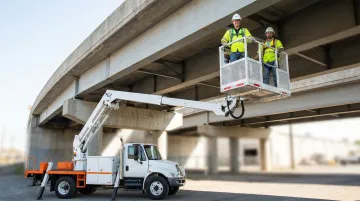
While aerial lifts handle overhead work, truck-mounted hydro platforms provide access beneath bridge decks for inspection, maintenance, and repair.
Typical hydro platform capabilities:
- Horizontal reach extends up to 66 feet from truck position
- Vertical drop reaches 21 feet 7 inches below deck level
- Platforms support 1,000-1,400 lbs of personnel and tools
- 180-degree rotation provides flexible positioning around obstacles
Rapid deployment under 15 minutes minimizes lane closures and traffic disruption during bridge work.
ANSI A92.20 compliance ensures safe operation for inspection crews and maintenance personnel accessing bridge undersides.
Scaffolding and Temporary Work Platforms
Bridge construction scaffolding provides stable working platforms during concrete pours and structural assembly.
Critical safety requirements:
- Scaffolds support their own weight plus 4x the maximum intended load
- Suspension ropes withstand 6x the maximum intended load
- Competent person inspects systems before each shift
- Two-point scaffolds require engineered articulated connections for bridging
Suspended scaffolding systems hang from bridge decks to provide access to pier caps and abutment faces during formwork installation and concrete finishing.
Skidding Systems and Bridge Sliding Equipment
Beyond vertical access equipment, contractors also need horizontal positioning systems. Hydra-Slide systems and PTFE-coated tracks slide precast bridge sections laterally into final position, avoiding heavy crane lifts.
Core system components include:
- PTFE sliding surfaces with low-friction coefficients (0.03-0.05) for controlled movement
- Synchronous push-pull cylinders that maintain alignment during slides
- Load capacities handling multi-thousand-ton bridge sections
- Hydraulic controls providing millimeter-level positioning accuracy
This method works especially well for bridge replacement projects where new sections slide into position after removing old structures, minimizing road closure duration.
Telehandlers and Material Positioning
Telescopic handlers extend reach for placing materials and positioning bridge components in areas inaccessible to cranes.
- Lift capacity: 5,000-12,000 lbs depending on model
- Maximum reach: 40-55 feet at full extension
- Attachments: Forks, buckets, work platforms, lifting hooks
- Applications: Material placement, formwork positioning, worker access
Work platform attachments convert telehandlers into mobile elevated work platforms, providing flexibility for tasks requiring both material handling and personnel access.
Specialized Construction Tools and Equipment
Hydraulic Cylinders and Jacking Systems
High-tonnage hydraulic cylinders lift bridge sections for bearing replacement, alignment corrections, and incremental construction.
- Capacity range: 50-500+ tons per cylinder
- Stroke length: 6-24 inches typical
- Synchronization: Computer-controlled systems coordinate multiple jacks
- Applications: Bearing replacement, bridge jacking, demolition support
Jack-up systems gradually lift bridge sections during construction. This allows installation of permanent supports beneath completed spans—a method essential for bridges built using launching techniques.
Concrete Equipment and Placement Systems
Coordinated concrete delivery, placement, consolidation, and finishing ensure bridge decks achieve specified strength and durability.
Batching and Pumping:
- Mobile batch plants: 100-200 cubic yards per hour capacity
- Concrete pumps: Boom pumps with 100-200 foot reach
- Placement booms: Articulating arms position concrete precisely in forms
Finishing Equipment:
- Concrete vibrators: Internal and external types consolidate concrete
- Screeds: Automated systems create level deck surfaces
- Finishing machines: Ride-on equipment produces specified surface texture
Cutting and Welding Equipment
Steel and concrete fabrication demands specialized cutting and joining equipment.
Concrete Cutting:
- Walk-behind saws: Cut control joints and deck sections
- Wall saws: Track-mounted units cut vertical surfaces
- Wire saws: Diamond wire cuts through thick concrete sections
Welding:
- AASHTO/AWS D1.5M/D1.5 Bridge Welding Code governs all bridge welding
- SMAW and GMAW processes for steel girder connections
- Certified welders must handle all fracture-critical member welding
- Quality control includes visual inspection and NDT testing
Support Equipment and Power Systems
Generators and Power Distribution
Portable and trailer-mounted generators power tools, lighting, and temporary facilities throughout bridge construction sites.
Sizing considerations:
- Large equipment: Gantry cranes require 400+ kVA continuous rating
- Tool power: 50-100 kVA for typical construction tools
- Lighting: 20-30 kVA for comprehensive site coverage
- Total load: Calculate peak demand plus 20% safety margin
Bridge sites often deploy multiple generators with load distribution panels, sized according to simultaneous equipment operation and starting surge requirements.
Light Towers and Lighting Systems
Beyond powering equipment, bridge sites need extensive lighting for night work and naturally dark areas beneath deck structures. Portable light towers provide this coverage.
- Coverage area: 5,000-7,000 square feet per tower
- Lamp types: Metal halide or LED (LED preferred for efficiency)
- Runtime: 8-12 hours on single fuel tank
- Positioning: Strategic placement eliminates shadows in work areas
Air Compressors and Pneumatic Tool Support
Portable air compressors power pneumatic tools and cleaning equipment.
- CFM requirements: 100-185 CFM for typical construction tools
- Pressure: 100-150 PSI standard operating pressure
- Configuration: Portable (towable) or stationary (skid-mounted)
- Applications: Impact wrenches, sandblasting, joint cleaning
Match compressor capacity to your simultaneous tool usage. Used support equipment from dealers like Mideast Equipment Supply often provides cost-effective alternatives to new purchases for these auxiliary systems.
Equipment Selection and Sourcing Strategies
Choosing Equipment Based on Bridge Type and Scale
Your equipment choices depend heavily on the bridge specifications and site conditions. Start by evaluating span length requirements.
Span length considerations:
- Short spans (<100 feet): Mobile cranes, standard formwork
- Medium spans (100-300 feet): Launching gantries, form travelers
- Long spans (>300 feet): Specialized gantries, strand jacks, cable systems
Bridge types:
- Girder bridges: Mobile cranes or gantries for beam placement
- Segmental bridges: Launching gantries or form travelers
- Arch bridges: Strand jacks and temporary support systems
- Cable-stayed: Specialized erection equipment for tower and cable installation
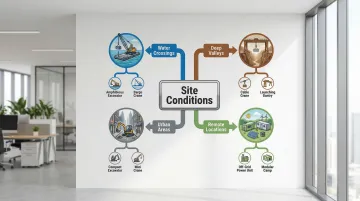
Site conditions often dictate equipment selection as much as bridge design:
- Water crossings: Floating cranes, marine access equipment
- Deep valleys: Overhead gantries, minimal falsework systems
- Urban areas: Compact equipment, noise-controlled machinery
- Remote locations: Self-sufficient equipment with minimal support needs
Buying vs. Renting Bridge Construction Equipment
Purchase considerations:
- Project duration: Multi-year projects favor ownership
- Utilization rate: Equipment used >60% of time supports buying
- Maintenance: In-house capability reduces ownership costs
- Depreciation: Tax benefits and residual value considerations
- Storage: Adequate facilities for equipment between projects
Rental advantages:
- Short-term projects: Pay only for actual usage period
- Specialized equipment: Access without capital investment
- Maintenance included: Rental company handles repairs and service
- Flexibility: Upgrade or change equipment as project needs evolve
The financial breakpoint between renting and buying typically occurs around 3-4 months for most equipment types. Long-term projects spanning years benefit from ownership, while short-term work favors rentals.
- Hybrid approach: Own core equipment, rent specialized items
Equipment Acquisition Options for Contractors
Used equipment auctions provide cost-effective access to bridge construction machinery. Specialized dealers like Mideast Equipment Auctions connect contractors with used heavy equipment through online and in-person auction formats, handling everything from initial inspection and condition assessment through final delivery.
Competitive bidding environments establish fair market pricing, with contractors often acquiring equipment at 40-60% of new equipment costs.
Auction platforms like Proxibid, Equipment Facts, and Bidspotter provide nationwide access to specialized machinery that may not be available locally.
Equipment dealers maintain inventories of used construction equipment including excavators, cranes, and foundation machinery. Mideast Equipment Auctions serves contractors across North America and international markets with equipment location services that identify specific machinery for project requirements.
Their worldwide network of dealers and sellers enables sourcing of hard-to-find specialized equipment.
Financing options:
- Equipment loans: 3-7 year terms with fixed rates
- Lease-to-own: Monthly payments with purchase option
- Operating leases: Off-balance-sheet financing for tax benefits
- Manufacturer financing: Competitive rates through OEM programs
Established contractors can access favorable financing terms that preserve working capital.
Safety and Compliance Considerations
Equipment inspection requirements:
- Daily: Operator pre-use inspection of critical systems
- Monthly: Competent person detailed inspection
- Annual: Qualified person comprehensive inspection with documentation
- Load testing: Mandatory for new, altered, or repaired lifting equipment at 125% rated capacity
OSHA 29 CFR 1926.1427 requires crane operators to be trained, certified/licensed, and evaluated. Specialized equipment requires manufacturer-specific training, and contractors must maintain certification records and evaluation results for all operators.
Safety features:
- Load moment indicators: Prevent overload conditions
- Anti-two-block devices: Stop hoist before contact
- Outrigger monitoring: Verify proper setup before lifting
- Emergency stop systems: Accessible from all control stations
Regulatory compliance:
- OSHA construction standards: 29 CFR 1926 subparts
- ANSI standards: Equipment-specific safety requirements
- State regulations: Additional requirements vary by jurisdiction
- Insurance requirements: Verify coverage meets project specifications
Frequently Asked Questions
What equipment is used in bridge construction?
Bridge construction requires heavy lifting equipment (gantry cranes, floating cranes, strand jacks), earthmoving and foundation equipment (excavators, pile drivers, drilling rigs), and access equipment (aerial lifts, scaffolding). Specialized tools include concrete pumps and hydraulic jacking systems.
What are the components of bridge construction?
Bridge construction consists of the substructure (foundations, piers, abutments) built with excavators, pile drivers, and drilling rigs, and the superstructure (deck, girders, beams) erected using cranes, gantries, and launching systems matched to project specifications.
How do contractors choose the right bridge construction equipment?
Selection depends on bridge specifications (span length, height, type), project timeline, site access constraints, and budget. Long-span bridges require launching gantries or heavy-lift systems, while water crossings need floating cranes.
What's the difference between buying and renting bridge equipment?
Buying makes sense for multi-year projects with high utilization rates (>60%), providing long-term cost savings despite capital investment. Renting suits short-term projects, offers maintenance-free operation, and provides flexibility to change equipment as project needs evolve.
What safety considerations are important for bridge construction equipment?
Critical safety requirements include operator training per OSHA standards, daily equipment inspections, load testing at 125% rated capacity, and ANSI compliance. Equipment must feature load moment indicators and emergency stop systems, with mandatory inspection documentation.
Where can contractors source bridge construction equipment?
Primary sourcing channels include equipment dealers and auction houses like Mideast Equipment Auctions that specialize in used construction machinery, rental companies for short-term needs, and manufacturers for new purchases. Specialized dealers offer equipment location services, financing, and international shipping.