
When businesses compare auction companies for equipment, customer reviews are often the first filter because they signal risk. Equipment auctions directly affect asset recovery, cash flow timing, and operational continuity, and a weak auction does more than reduce pricing. It can delay settlements, disrupt projects, and create post-sale issues that take time to resolve.
Most sellers want to understand how consistently an auction company executes across valuation guidance, inspections, buyer participation, and post-auction handling. This is why review-driven evaluation becomes especially important when auction companies operate within active dealer and seller networks.
Auctions remain central to how construction and industrial equipment moves through the U.S. market. In 2025, total U.S. construction spending exceeded $2.1 trillion, reinforcing sustained demand across infrastructure, commercial, and industrial projects. As activity increases, auction performance, not platform visibility, plays a growing role in how effectively equipment is sold and redeployed.
This guide examines auction companies through a review-first lens, with a focus on manufacturing plants and industrial equipment.
Key Takeaways
Reviews reveal execution quality: The most useful feedback shows how consistently an auction firm handles pricing accuracy, inspections, settlements, and post-sale coordination.
Consistency matters more than scale: Auction management firms that deliver repeatable outcomes across sales tend to outperform larger platforms focused mainly on visibility.
Inspection accuracy protects value: Clear, documented condition reporting reduces buyer disputes and supports stronger pricing for manufacturing plant equipment.
Post-auction handling drives real outcomes: Settlement timelines, documentation quality, and release coordination are where auctions most often succeed or break down.
The right fit depends on risk and asset type: Review patterns are most valuable when evaluated against the specific equipment, timeline, and execution control required.
How Auction Companies Are Evaluated
Auction companies are rarely judged by what they promise. They are judged by what happens after the listing goes live and after the hammer drops. Customer reviews tend to reflect this reality, which is why they are one of the most reliable inputs when evaluating auction companies for equipment.
A review-first evaluation usually looks at outcomes, not features. Sellers assess whether pricing guidance matched market reality, whether bidding was competitive, and how quickly funds were released. Buyers focus on inspection accuracy, listing clarity, and whether the equipment received matched what was represented. When reviews consistently point to the same strengths or failures, they reveal how the auction company actually operates under pressure.
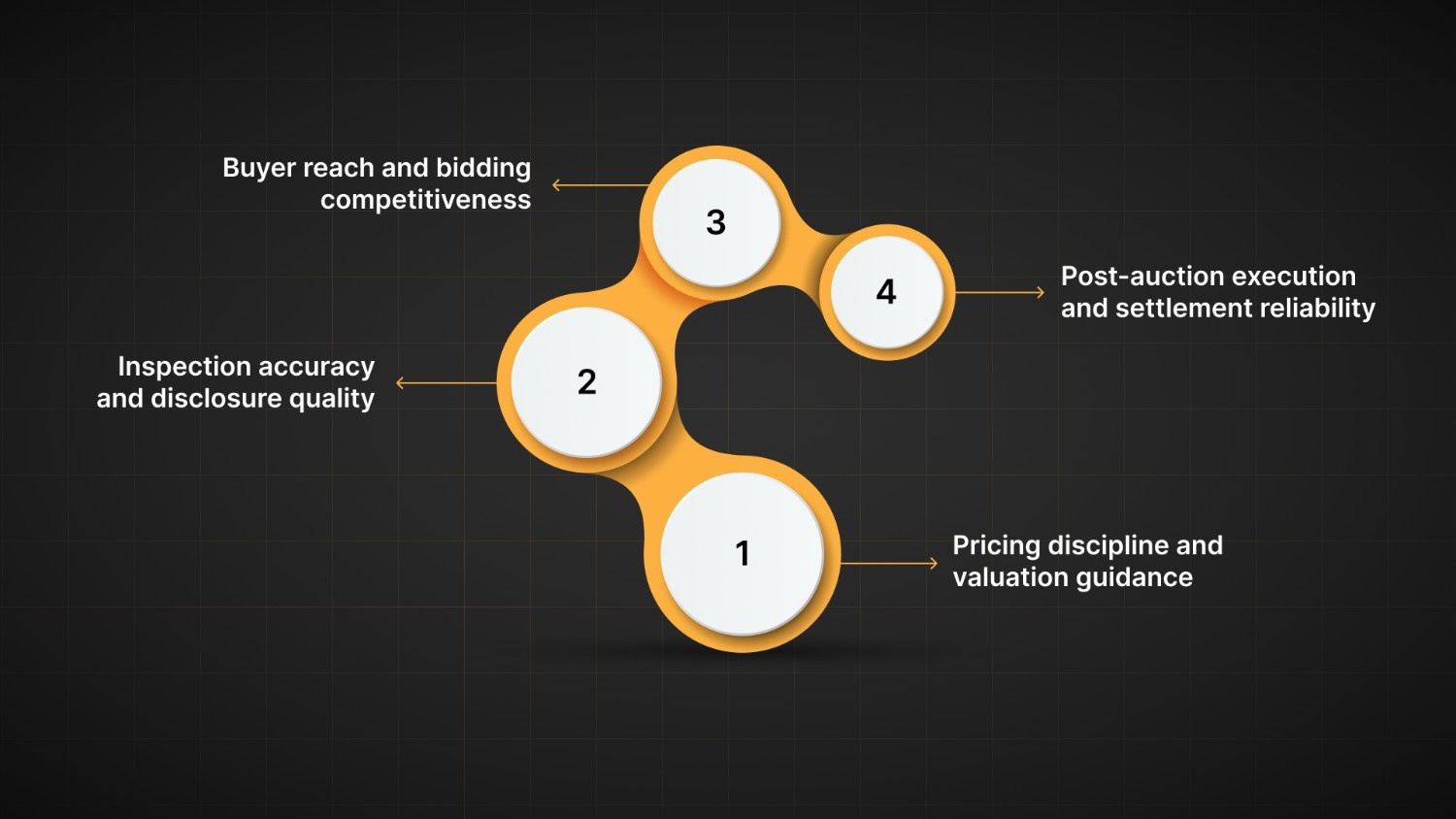
The most meaningful review signals typically fall into four evaluation areas.
Pricing discipline and valuation guidance
Reviews often indicate whether reserve pricing was realistic and supported by active buyer demand. Strong auction companies tend to receive feedback that pricing outcomes aligned with expectations, even when markets were soft. Poor reviews frequently mention overpromising on value or weak bidding due to mispriced reserves.
Inspection accuracy and disclosure quality
Repeated buyer reviews about condition mismatches are a red flag. Auction companies with disciplined inspection processes tend to receive consistent feedback that listings were accurate, photos were current, and disclosures reduced post-sale disputes. This matters most for high-value construction and transport equipment where small inaccuracies can materially affect value.
Buyer reach and bidding competitiveness
Reviews indirectly reveal buyer depth. Sellers often mention whether bidding activity felt thin or competitive. When multiple reviews reference strong participation across auctions, it usually reflects established buyer networks rather than one-off demand spikes.
Post-auction execution and settlement reliability
This is where reviews become most decisive. Delayed payments, unclear documentation, or slow release coordination appear frequently in negative feedback. In contrast, consistently positive reviews mention predictable payment timelines, clean paperwork, and smooth pickup or transport coordination.
What matters most is consistency across reviews, not isolated praise or complaints. One strong auction does not indicate a strong auction company. Patterns do. Review-first evaluation works because it highlights whether execution quality is repeatable across equipment categories, regions, and auction cycles.
Used correctly, reviews help buyers and sellers assess whether an auction company delivers structured outcomes or relies on favorable conditions. That distinction is what separates dependable auction partners from platforms that only perform well occasionally.
Reviews of Auction Management Firms for Manufacturing Plant Equipment
Based on the evaluation criteria outlined above, here’s how leading auction companies compare when it comes to manufacturing and industrial equipment. This review is execution-led and review-informed, focusing on how well each company performs for plant assets rather than how visible the brand is.
1. Mideast Equipment Supply
Best for: Execution-led auctions for manufacturing, industrial, and fleet assets
Mideast Equipment Supply stands out in reviews for how consistently it handles the full lifecycle of industrial equipment sales. Sellers frequently highlight structured inspections, realistic pricing guidance, and fewer delays after the auction closes. Rather than operating as a pure marketplace, Mideast combines dealer-style asset knowledge with auction execution, which tends to work well for manufacturing equipment where condition, documentation, and buyer qualification matter as much as exposure.
Where Mideast performs particularly well is in process continuity. Reviews often reference smooth coordination across inspection, marketing, payment, and release, reducing the risk of post-auction friction. Its regional auction presence, combined with access to national and international buyers, makes it a strong fit for plant equipment, commercial trucks, and mixed industrial inventories. Connect now!
2. Ritchie Bros. Auctioneers
Best for: Large-scale, global, high-volume industrial auctions
Ritchie Bros. is frequently reviewed as a strong option for sellers with large fleets or significant asset volumes. Its global buyer reach and large auction events often support competitive bidding, especially for standardised equipment categories. Reviews tend to praise bidder volume and transaction scale.
However, some sellers note that the process can feel less tailored for specialised manufacturing equipment or smaller plant dispersals. Execution is strong at scale, but the model works best when volume outweighs the need for custom handling.
Not ideal for: Smaller manufacturers or niche plant assets that require category-specific positioning.
3. IronPlanet
Best for: Online-only, inspection-driven equipment sales
IronPlanet reviews often focus on inspection transparency and online convenience. The platform is well-suited for sellers who prioritise documented condition reporting and remote buyer access. Buyers frequently reference confidence in inspections as a key strength.
That said, seller reviews sometimes note that pricing outcomes depend heavily on market timing and asset demand, as the model relies less on active auction strategy and more on online exposure.
Not ideal for: Sellers who need guided reserve pricing or hands-on post-auction coordination.
4. HGP Industrial
Best for: Manufacturing plant liquidations and facility closures
HGP Industrial is often reviewed in the context of full or partial plant shutdowns. Its strength lies in managing complex asset groups, including machinery, tooling, and facility equipment. Reviews commonly mention structured project handling and familiarity with manufacturing environments.
This model works well for large-scale liquidations but may be less flexible for isolated equipment sales or ongoing fleet turnover.
Not ideal for: Sellers looking to auction individual assets outside a broader liquidation event.
5. Proxibid
Best for: Auction technology and bidding infrastructure
Proxibid is best understood as an auction platform rather than an auctioneer. Reviews focus on its bidding interface and access to multiple auction houses. Performance depends heavily on the auction company using the platform.
As a result, seller and buyer experiences vary widely. Proxibid works well when paired with experienced auctioneers but is not a standalone solution for managing manufacturing equipment sales.
Not ideal for: Sellers expecting end-to-end auction management from a single provider.
Reviews consistently show that manufacturing and industrial equipment auctions succeed when execution, inspection discipline, buyer qualification, and post-sale handling are aligned. Companies that operate with an execution-led model tend to deliver more predictable outcomes than platforms focused primarily on scale or visibility.
A quick look
Auction Company | Best For | Equipment Focus | Buyer Reach | Inspection Depth | Execution Support |
Mideast Equipment Supply | Execution-led industrial auctions | Manufacturing plant assets, trucks, mixed industrial | Regional + national + international | High, seller-verified and documented | End-to-end: pricing, inspection, settlement, logistics |
Ritchie Bros. Auctioneers | High-volume, global sales | Standardised construction and fleet equipment | Global | Standardised at scale | Strong at volume; less tailored |
IronPlanet | Online, inspection-driven sales | Construction and light industrial | National | High, platform-led inspections | Limited hands-on execution |
HGP Industrial | Plant closures and liquidations | Manufacturing facilities and machinery | Targeted, project-based | High, project-specific | Strong for complex liquidations |
Proxibid | Bidding technology | Depends on auctioneer | Depends on auctioneer | Depends on auctioneer | Platform only, not full service |
Across multiple reviews of auction management firms for manufacturing plant equipment, execution consistency appears to matter more than platform size.
How to Choose the Right Auction Company for Manufacturing Equipment
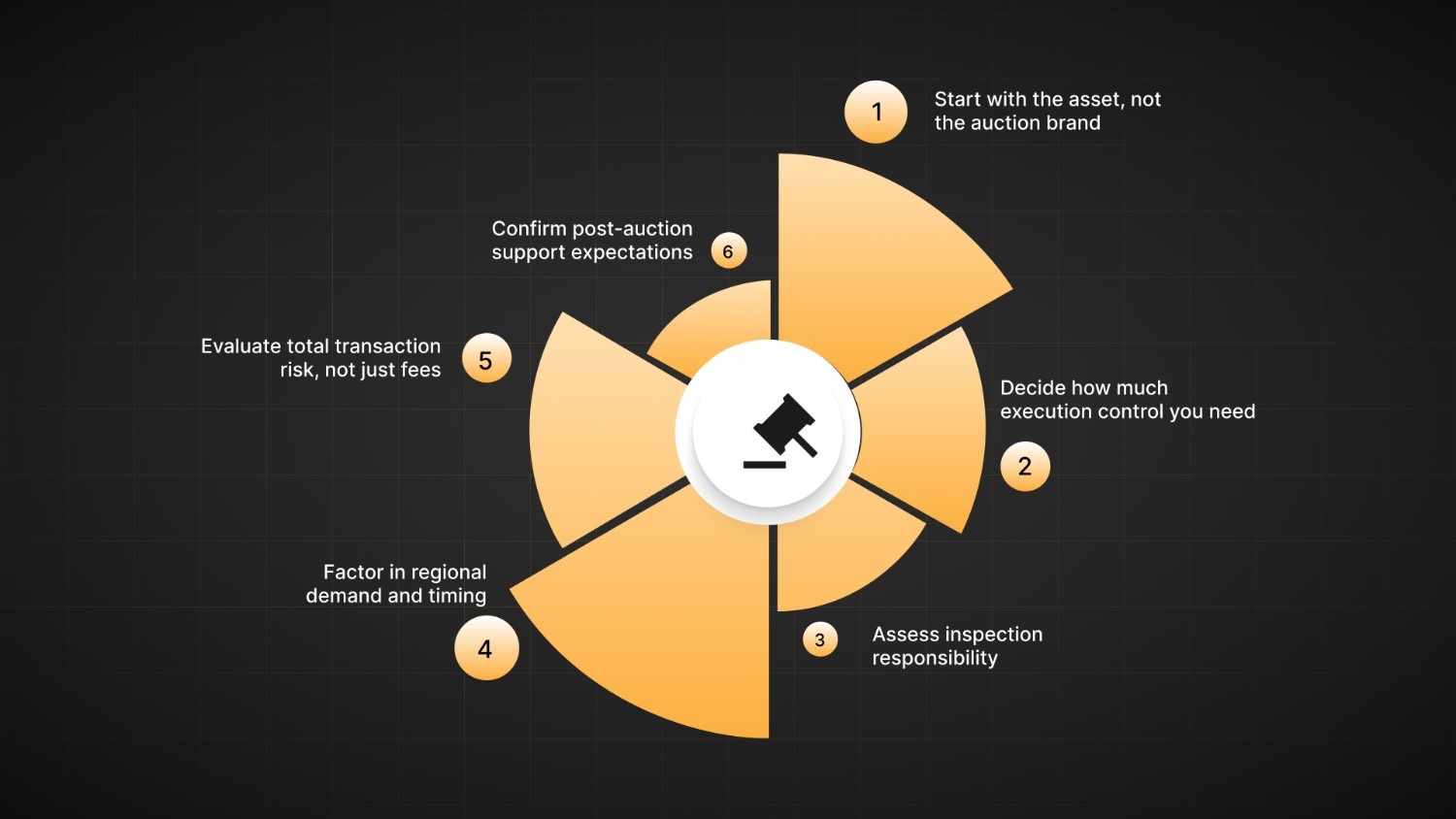
Choosing an auction partner for manufacturing assets is not about finding the most visible platform. It is about selecting a service model that matches the asset, the timeline, and the risk profile of the sale.
Use the decision logic below to narrow options without duplicating review analysis.
Start with the asset, not the auction brand: Plant machinery, production lines, and mixed industrial assets require hands-on inspections and documentation control. Standard fleet equipment can perform well in larger or online auction environments when demand is broad.
Decide how much execution control you need: If cash recovery timing, downtime, or operational continuity matters, prioritise auction partners that manage pricing guidance, buyer qualification, and settlement as a single workflow.
Assess inspection responsibility: For manufacturing equipment, inspection accuracy should be repeatable and verifiable. Avoid models where condition reporting is outsourced or inconsistent across listings.
Factor in regional demand and timing: Location-sensitive equipment often performs better in regional auctions aligned with local buying cycles. National exposure does not always translate into stronger outcomes.
Evaluate total transaction risk, not just fees: Lower commissions can be offset by delayed payments, documentation gaps, or release issues. Total execution reliability matters more than headline pricing.
Confirm post-auction support expectations: If the sale requires coordinated pickup, title transfer, export handling, or financing support, platform-only auction models may introduce friction after bidding closes.
The right auction company is the one whose execution model aligns with your equipment type, timing constraints, and risk tolerance. For manufacturing assets, predictable outcomes usually come from partners that treat auctions as managed transactions rather than standalone bidding events.
Common Mistakes When Relying Only on Auction Reviews
Auction reviews are useful signals, but they are often misunderstood or over-weighted. The most common mistakes happen when reviews are treated as verdicts instead of context.
Reading star ratings without understanding the transaction type: A negative review may reflect market timing, asset condition, or seller expectations rather than auction performance. Reviews only make sense when tied to the type of equipment and sale scenario.
Mixing buyer and seller feedback: Buyer reviews often focus on inspection accuracy and listing clarity, while seller reviews reflect pricing outcomes and settlement speed. Treating them as interchangeable hides important execution risks.
Ignoring post-auction issues unless they are extreme: Delayed payments, release coordination problems, or documentation gaps may appear in reviews as minor complaints but can materially affect cash flow and operations.
Judging platforms instead of service models: Many reviews compare brand names rather than how auctions are actually run. Execution-led firms and platform-only marketplaces operate very differently, even if both host bidding.
Overvaluing one-off experiences: A single strong or weak auction does not define a company. Consistent patterns across regions, asset categories, and auction cycles matter far more than isolated outcomes.
Reviews work best when used to identify trends, not to confirm assumptions.
Final Thoughts
Auction reviews are not rankings. They are indicators of how consistently an auction company performs once real assets, real buyers, and real timelines are involved. The most reliable insights come from patterns showing whether pricing holds up, inspections remain accurate, payments move on schedule, and post-auction steps do not slow execution.
For manufacturing and industrial equipment, outcomes depend less on platform visibility and more on how tightly valuation, inspections, buyer access, compliance, and settlement are managed together. This pattern is especially visible in reviews of top-rated industrial asset auction companies in the US, where execution reliability outweighs brand visibility.
Companies such as Mideast Equipment Supply reflect this execution-focused model in practice. Operating since 2004, the firm works across used equipment sales, consignment, and both online and regional auctions, supporting a wide range of manufacturing plant assets, commercial trucks, trailers, generator sets, and specialised industrial equipment. Their ability to manage inspection, documentation, logistics coordination, and multi-state compliance helps reduce friction after the hammer drops, where many auctions typically break down.
The takeaway is straightforward. Reviews are most valuable when they help assess execution reliability, not popularity. When read alongside how auctions are structured and supported end to end, they become practical decision signals for high-value manufacturing and industrial equipment transactions where predictability matters more than exposure.
FAQs
Q: Are auction management firms reliable for selling manufacturing plant equipment?
A: Auction management firms can be reliable when reviews show consistent inspection discipline, competitive bidding, and predictable payment cycles. Reliability is best judged through repeated seller feedback across similar industrial equipment transactions.
Q: Which auction management firms are best for manufacturing and industrial equipment?
A: Reviews often highlight execution-led firms that manage inspections, buyer qualification, and settlements as a single workflow. Firms experienced with manufacturing plant equipment tend to outperform platform-only auction marketplaces in complex asset sales.
Q: How do reviews help compare auction companies for industrial equipment?
A: Reviews help identify patterns in pricing outcomes, inspection accuracy, and post-auction handling that are not visible in marketing materials. Comparing these patterns across multiple auctions provides a clearer picture of real-world performance.
Q: Are online auction platforms suitable for manufacturing plant equipment sales?
A: Online platforms can work well for standardised equipment when inspections are well documented and demand is broad. Reviews show that specialised manufacturing assets often perform better with auction firms offering hands-on execution and post-sale support.
Q: What are common risks mentioned in reviews of equipment auction companies?
A: Common risks include delayed settlements, inaccurate condition reports, and poor coordination after the sale closes. Reviews frequently show that these issues impact cash flow and operational planning more than auction fees or bidder volume.