
Introduction: Understanding Construction Excavation in 2025
Excavation is the literal foundation of every construction project—from residential homes to commercial developments, nothing gets built without first moving earth. One misstep in excavation can lead to foundation failures, drainage nightmares, and repairs costing tens of thousands of dollars.
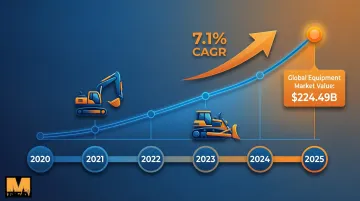
The excavation industry has evolved dramatically by 2025. The U.S. excavation contractors industry is projected to generate $203.1 billion in revenue this year, reflecting a 7.1% annual growth rate over the past five years.
New technologies like GPS-guided machinery and electric excavators are changing how contractors work, while updated safety regulations demand stricter compliance than ever before. Whether you're operating your own equipment or sourcing used machinery for a specific project, understanding these changes impacts both operations and budgeting.
This guide covers what contractors need to know:
- What excavation entails and the five main types
- The step-by-step excavation process
- Essential equipment and 2025 technology updates
- Current safety standards and OSHA requirements
- Realistic cost considerations for project budgeting
TLDR:
- Excavation generates $203.1 billion annually in the US, growing 7.1% yearly since 2020
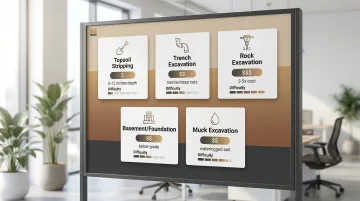
- Five main excavation types: topsoil stripping, trenching, rock removal, basement/foundation, and muck excavation
- OSHA requires protective systems for trenches 5+ feet deep; competent person inspections are mandatory
- Rock excavation costs 3-5x more than common earth removal
- GPS-guided excavators reduce grading errors and fuel costs by 20-30%
What is Construction Excavation?
Construction excavation is the process of removing earth, rock, and other materials from a site to prepare it for building foundations, utilities, and infrastructure. According to OSHA, an excavation is any man-made cut, cavity, trench, or depression in an earth surface formed by earth removal.
Primary purposes include:
- Creating stable foundations that support structural loads
- Installing underground utilities (water, sewer, electrical, gas)
- Grading sites for proper drainage and water management
- Preparing ground conditions for structural development
Why Excavation Matters for Structural Integrity
Proper excavation is critical for long-term building stability. The Millennium Tower case study in San Francisco demonstrates how soil shifts in foundation areas—caused by adjacent excavation work—can result in significant settlement and tilt.
When excavation affects surrounding soil conditions, buildings can experience structural damage that costs millions to remediate.
Poorly executed excavation leads to:
- Foundation settlement and cracking
- Inadequate drainage causing water intrusion
- Soil instability beneath structures
- Costly repairs that far exceed initial savings
Market Growth and Industry Outlook
Understanding excavation's structural importance helps explain the sector's continued expansion through 2025:
- $203.1 billion in U.S. revenue projected for 2025
- 7.1% compound annual growth rate from 2020-2025
- Global heavy construction equipment market valued at $224.49 billion in 2025
Federal infrastructure spending, industrial building projects, and ongoing urbanization primarily drive this growth.
Contractors entering 2025 face both opportunity and competition in this expanding market.
Types of Construction Excavation
Topsoil and Strip Excavation
Topsoil stripping removes the uppermost soil layer—typically 6-12 inches—which contains organic matter unsuitable for building.
This organic-rich layer lacks the load-bearing capacity needed for foundations and will decompose over time, causing settlement.
Common applications:
- Clearing vegetation before foundation work
- Site preparation for parking lots and roadways
- Landscaping projects requiring stable subgrade
Most specs require removing topsoil to 12 inches depth, though some projects need only 4-6 inches. Soil core sampling determines the exact stripping depth for your site.
Trench Excavation
Trench excavation creates narrow, deep cuts for utilities, pipelines, cables, and drainage systems. OSHA defines a trench as any excavation where depth exceeds width, with maximum width of 15 feet at the bottom.
Typical specifications:
- Utility crossings under roadways require boring or tunneling with proper encasement
- Depth and width determined by utility type and local codes
- Bore pits within 10 feet of pavement edges need reinforcement to prevent collapse
Trench work presents the highest cave-in risk of all excavation types, making protective systems mandatory for depths exceeding 5 feet.
Rock Excavation
Rock excavation is the most challenging and expensive excavation type. Removing solid rock formations requires specialized equipment—and sometimes controlled blasting.
Unlike soil excavation, rock removal needs drilling, hydraulic hammers, or explosives.
What drives the cost:
- Significantly higher costs than common earth excavation
- Reduced production rates compared to soil removal
- Often requires blasting permits and specialized contractors
- Essential when bedrock lies at shallow depths
Cost estimating guides like RSMeans provide distinct line items for rock excavation versus common earth, reflecting the substantial cost differential. Encountering cap rock or hardpan layers can double or triple excavation expenses.
Basement and Foundation Excavation
This excavation type digs below grade to create space for basements, crawl spaces, or deep foundations. Depth requirements vary based on building design, frost lines, and soil conditions.
Essential requirements:
- Proper shoring and support systems to prevent cave-ins
- Dewatering systems if groundwater is encountered
- Precise depth control to match foundation specifications
- Adequate space for workers to construct foundation walls
Deep excavations for high-rise buildings pose potential risks due to complex strata and surrounding structures, requiring careful engineering and monitoring throughout the process.
Muck Excavation
Muck is waterlogged soil that must be removed and replaced with stable fill material. This unstable, wet soil can't support structures and requires complete excavation.
Common challenges:
- Difficulty operating equipment in saturated conditions
- Need for dewatering before excavation can proceed
- Disposal of unsuitable material
- Replacement with engineered fill and proper compaction
Muck excavation often appears as a costly change order when unexpected groundwater or poor soil conditions are discovered during construction.
Underground and Specialized Excavation
Specialized methods address unique project requirements:
- Tunneling: For underground passages and subway systems
- Caisson work: Deep foundations in water or unstable soil
- Shaft excavation: Vertical excavations for elevator pits or utilities
These methods require specialized contractors, equipment, and engineering oversight beyond typical excavation projects.
The Excavation Process: Step-by-Step Guide
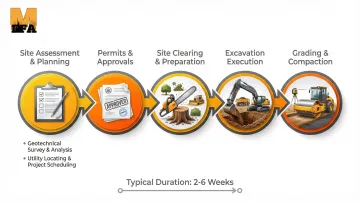
Site Assessment and Planning
Before breaking ground, comprehensive site assessment establishes the foundation for successful excavation.
This phase includes surveying to establish exact elevations and boundaries, soil testing to determine bearing capacity and composition, and creating detailed excavation plans with proper slopes and dimensions.
Critical assessment activities:
- Identify underground utilities using ground-penetrating radar or utility location services
- Classify soil types (Stable Rock, Type A, B, or C) per OSHA requirements
- Determine groundwater levels and dewatering needs
- Assess adjacent structures that may be affected
OSHA mandates that employers determine the approximate location of utility installations before starting work—including sewer, telephone, fuel, electric, and water lines. Failure to locate utilities causes costly damage, project delays, and safety hazards.
Obtaining Permits and Approvals
The 2025 permitting landscape requires multiple approvals before excavation begins:
Stormwater permits: The Clean Water Act requires permits for construction activities disturbing 1 acre or more.
Right-of-way permits: Municipalities require separate excavation permits for each street cut. Cities like Austin assess daily fees from the first cut until final restoration.
Trench safety plans: Some jurisdictions require accepted trench safety plans for excavations exceeding 5 feet in depth before issuing permits.
Permit timelines vary by jurisdiction. Start the permitting process 4-6 weeks before excavation.
Site Clearing and Preparation
Clearing the site removes vegetation, debris, existing structures, and surface obstructions that interfere with excavation.
Preparation steps:
- Remove trees, shrubs, and root systems
- Demolish and remove existing structures
- Strip topsoil and stockpile for later use
- Install erosion control measures (silt fencing, sediment basins)
- Establish site access routes and equipment staging areas
Most stormwater permits mandate erosion control during clearing to prevent sediment from leaving the site during excavation work.
Excavation Execution
Digging requires careful attention to safety, technique, and soil conditions. Methods vary by soil type. Cohesive soils like clay behave differently than granular soils like sand.
Execution best practices:
- Maintain proper slopes, benches, or shoring systems as excavation deepens
- Monitor excavation walls for signs of instability
- Keep excavated materials at least 2 feet from trench edges
- Provide safe access and egress for workers
- Conduct daily inspections before workers enter excavations
For trenches 5+ feet deep, protective systems (sloping, benching, or shielding) are mandatory unless excavating in stable rock.
Grading, Compaction, and Final Preparation
After excavation reaches the specified depth, the area must be graded to proper elevations and compacted to create a stable base for construction.
Quality control measures:
- Grade excavated surfaces to design elevations
- Compact soil in lifts (layers) to specified density
- Conduct density testing using Standard Proctor (ASTM D698) or Modified Proctor (ASTM D1557) methods
- Verify compaction meets specifications (typically 95% of maximum density)
ASTM D1557 uses modified effort (56,000 ft-lbf/ft³) for higher design loads, while ASTM D698 applies standard effort for lighter applications. Proper compaction prevents future settlement and structural damage.
Essential Excavation Equipment in 2025
Selecting the right equipment determines project efficiency, cost, and timeline.
The global heavy construction equipment market is valued at $224.49 billion in 2025, with electrification and digital technology driving major market opportunities through 2030.
Primary Excavation Equipment
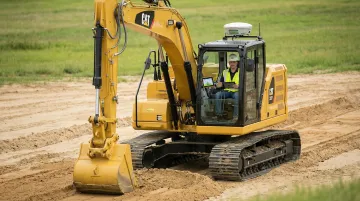
Excavators are the workhorse of excavation projects, ideal for digging foundations, trenches, and loading material. Track-mounted models provide stability on uneven terrain, while wheeled excavators offer mobility for urban projects.
Bulldozers handle the heavy lifting—pushing material, rough grading, and clearing sites. Dozers excel at moving large volumes of earth over short distances. Companies like Mideast Equipment Supply offer quality used dozers—such as the Caterpillar D6N LGP and John Deere 700H LT models—with financing options that help contractors manage equipment budgets.
For smaller-scale work, backhoes combine digging capability with loading functions, making them perfect for utility work and residential projects.
Trenchers specialize in cutting narrow trenches quickly for utilities and drainage lines, while skid steers offer versatility through numerous attachments—useful for confined spaces and finish grading work.
Finishing any excavation requires proper compaction equipment, including tamping-foot rollers, pneumatic rollers, and vibratory compactors selected based on soil type and density requirements.
Equipment Selection Criteria
Choose equipment based on these factors:
- Project size and scope: Large excavations require track excavators and articulated trucks, while residential projects may only need a backhoe or mini excavator
- Soil conditions: Rocky terrain demands machines with greater hydraulic power and specialized attachments; soft, wet soils require low-ground-pressure equipment to prevent getting stuck
- Excavation type: Trench work needs trenchers or narrow-bucket excavators, while basement excavation requires larger machines with greater reach and bucket capacity
- Haul distance: Scrapers work best for medium-haul distances of 3,000 feet or less, while longer hauls require articulated trucks
Emerging Equipment Technologies in 2025
The autonomous construction equipment market is valued at $13.86 billion in 2024, projected to reach $30.09 billion by 2033 as automation gains traction.
Key technology trends reshaping excavation work:
- GPS-guided machinery: Automated grade control reduces operator error and improves accuracy
- Electric excavators: Zero-emission machines for urban projects and environmentally sensitive sites
- Telematics systems: Real-time equipment monitoring for maintenance and productivity tracking
- Automated systems: Semi-autonomous operation for repetitive tasks
45% of builders report no AI implementation, indicating technology adoption remains gradual across the industry.
Safety Standards and Regulations in 2025
Excavation remains one of construction's most hazardous activities. In 2023, the fatal injury rate for construction and extraction occupations was 12.9 per 100,000 FTE workers, highlighting the critical importance of safety compliance.
OSHA's Key Excavation Requirements
OSHA's 29 CFR 1926 Subpart P establishes mandatory excavation safety standards:
- Protective systems required: Trenches 5 feet or deeper require protective systems (sloping, benching, shoring, or shielding) unless excavated entirely in stable rock. Shallower trenches also need protection if a competent person identifies hazards.
- Competent person on-site: Every site must have a competent person who identifies hazards, has authority to correct them, and inspects excavations daily before work begins.
- Access and egress: Safe means of egress required in excavations 4+ feet deep, with ladders, ramps, or stairs positioned so workers travel no more than 25 feet laterally.
- Atmospheric testing: Required before workers enter excavations greater than 4 feet in depth where hazardous atmospheres could exist.
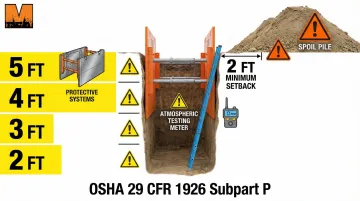
- Spoil pile placement: Excavated materials must be kept at least 2 feet from trench edges to prevent surcharge loads that could cause cave-ins.
Understanding the 5-4-3-2 Safety Rule
While not official OSHA terminology, the "5-4-3-2" rule serves as a helpful mnemonic for critical depth thresholds in 29 CFR 1926 Subpart P:
- 5 feet: Depth requiring protective systems (sloping, benching, shielding)
- 4 feet: Depth requiring safe access/egress and atmospheric testing when hazards suspected
- 2 feet: Minimum distance for spoil piles from excavation edges
Remember that these are minimum requirements. Competent persons may require protections at shallower depths based on soil conditions and site-specific hazards.
2025 Regulatory Updates
OSHA maintains a National Emphasis Program on Trenching and Excavation, focusing on increased inspections and enforcement. This ongoing emphasis makes staying current with excavation standards more important than ever for contractors.
Required Safety Measures
- Daily inspections: Competent persons must inspect excavations, adjacent areas, and protective systems daily and after hazard-increasing events (rainstorms, equipment vibration, nearby construction)
- Worker training: All workers entering excavations must receive training on hazard recognition, protective systems, and emergency procedures
- Emergency preparedness: Sites must have rescue equipment readily available and emergency action plans for cave-ins or other incidents
- Protective system design: Excavations 20+ feet deep require protective systems designed by a registered professional engineer
Cost Factors and Budgeting for Excavation
Excavation costs vary significantly based on site conditions, project scope, and regional factors. Understanding these drivers helps contractors develop accurate budgets and avoid overruns.
Primary Cost Drivers
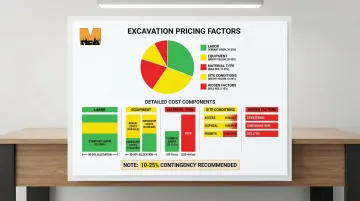
- In May 2023, median hourly wages for construction equipment operators were $28.20, while construction laborers earned $22.06 per hour. Labor represents 30-50% of total excavation costs.
- Equipment costs vary between ownership (purchase, maintenance, insurance, depreciation) and rental (higher per-day expenses, no long-term commitment). Your choice significantly affects both productivity and total costs.
- Larger projects benefit from economies of scale, reducing per-cubic-yard costs. Small excavations face higher relative costs due to mobilization and setup expenses.
- Common earth excavates quickly and inexpensively. Rock excavation requiring drilling or blasting costs significantly more due to specialized equipment and slower production rates.
- Confined urban sites with limited access increase costs through smaller equipment requirements, hand work, and difficult material handling.
- Disposal costs vary by material type and local landfill rates. Contaminated soil requires specialized disposal at substantially higher costs.
Typical Cost Ranges
Costs fluctuate by region and market conditions, but these ranges help establish budgeting baselines:
- Common earth excavation: $8-$15 per cubic yard for standard excavation and hauling
- Rock excavation: $20-$40+ per cubic yard depending on rock hardness and removal method
- Trench excavation: $10-$20 per linear foot for utility trenches 4-6 feet deep
- Basement excavation: $15-$25 per cubic yard including shoring and dewatering if needed
These 2025 estimates vary significantly by location. Use RSMeans Data or local contractors for region-specific pricing adjusted for over 970 locations.
Hidden Cost Factors
- Unexpected rock adds 150-300% to excavation costs compared to soil removal.
- High water tables require dewatering systems like wellpoints, which are time-intensive and reduce production rates significantly.
- Suspected contamination requires environmental evaluation and remediation, potentially doubling or tripling excavation budgets.
- Unmarked or incorrectly located utilities cause delays, damage claims, and emergency repairs that devastate project budgets.
Tips for Accurate Cost Estimation
- Invest in proper geotechnical reports that identify soil types, rock depth, and groundwater levels before bidding.
- Add 10-15% contingency for straightforward projects, 20-25% for complex sites with unknowns.
- Compare equipment rental rates and ownership costs to determine the most economical approach for your project duration. If you're considering purchasing used excavation equipment, dealers like Mideast Equipment Supply offer construction equipment options that can reduce your long-term operating costs.
- Winter excavation in cold climates increases costs due to frozen ground and weather delays.
- Research disposal costs and permitted facilities before excavation begins to avoid last-minute surprises.
Frequently Asked Questions
What is construction excavation?
Construction excavation removes earth, rock, and materials from a site to prepare it for building foundations, underground utilities, and infrastructure. This process creates stable conditions for construction while ensuring proper drainage and structural support.
What are the three main types of excavation?
The three most common types are topsoil/strip excavation (removing the organic surface layer), trench excavation (narrow cuts for utilities and drainage), and basement/foundation excavation (digging below grade for building support systems).
What is the 5-4-3-2 rule excavation?
This OSHA safety guideline covers key thresholds: excavations 5+ feet deep require protective systems, 4+ feet requires safe access/egress and atmospheric testing when hazards exist, and spoil piles must be kept 2+ feet from excavation edges.
How much does excavation usually cost?
Excavation costs typically range from $8-$15 per cubic yard for common earth, $20-$40+ per cubic yard for rock excavation, and $10-$20 per linear foot for utility trenches. Actual costs vary significantly based on soil conditions, site accessibility, disposal fees, and regional labor rates.
When is a permit required for excavation work?
Permits are typically required for excavations disturbing 1+ acre, work within public rights-of-way, excavations exceeding certain depths (varies by jurisdiction), and projects near property lines. Check with local building departments for specific requirements.
How long does a typical excavation project take?
Duration varies widely by project scale. Residential foundation excavation may take 1-3 days, while commercial projects can require weeks or months. Average productivity ranges from 200 cubic yards per day for complex work to 4,000 cubic yards per day for large-scale operations, depending on soil type, equipment, and site conditions.