Introduction
Selecting the wrong dozer for a project can cost contractors 20-30% more in fuel and time while risking equipment damage. Yet many operators treat all bulldozers as interchangeable—a mistake that leads to missed deadlines and budget overruns.
Dozers (bulldozers) are tracked or wheeled earthmoving machines designed for specific ground conditions and tasks. The differences between crawler dozers, wheel dozers, and specialized variants directly impact:
- Project efficiency: Matching blade type and power to terrain
- Operating costs: Fuel consumption varies 40%+ between configurations
- Equipment longevity: Wrong application accelerates wear
This guide breaks down dozer types by capability, ideal applications, and selection criteria to help you match the right machine to your project requirements.
Key Takeaways
- Match dozer size to project scope: compact units (<100 HP) for residential work, mining giants (850+ HP) for large-scale excavation
- Tracked dozers provide stability on slopes and soft ground, while wheeled models move faster on paved or compacted surfaces
- Blade type controls your material capacity: straight blades for precision grading, universal blades for high-volume pushing
- Prioritize terrain conditions and material type when selecting, then factor in operator skill level and ownership costs
What Is a Dozer?
Choosing the right heavy equipment can make or break a project timeline and budget. When jobs require moving massive amounts of material across rough terrain, contractors turn to one workhorse machine above all others.
A dozer is a heavy tractor equipped with a front-mounted blade designed to push, spread, and grade soil, sand, rubble, and other materials. Unlike excavators that dig and lift or haul trucks that transport over long distances, dozers specialize in pushing material across short distances and rough grading terrain.
Dozers excel at jobs where raw pushing power and stability matter most:
- Clearing vegetation on forestry and development sites
- Creating access roads through undeveloped land
- Rough grading building pads and foundation areas
- Spreading fill material across large areas
- Working in challenging conditions where other equipment would bog down or tip over
This guide breaks down the main dozer types, their specific applications, and how to match the right machine to your project requirements.
Why Dozers Are Essential for Construction and Earthmoving Projects
Dozers provide powerful, stable platforms for moving massive volumes of earth efficiently. Their low center of gravity and wide track or tire base allow them to operate safely on slopes and uneven ground that stops wheeled loaders or excavators.
Without the right dozer, projects suffer predictable failures:
- Extended timelines from underpowered equipment making multiple passes
- Fuel costs spiraling from inefficient machine-to-task matching
- Equipment damage from operating outside design parameters
- Operator fatigue and safety risks on unsuitable terrain
- Surface damage from excessive ground pressure on soft soil
These machines handle specialized tasks other equipment cannot manage:
- Ripping compacted soil or fractured rock with rear-mounted shanks
- Clearing heavy timber with reinforced forestry blades
- Maintaining traction on steep slopes where wheeled machines slip
Types of Dozers
Two primary characteristics define dozer classifications: size and configuration. Size categories (small, medium, large) are based on horsepower and operating weight. Configuration refers to the traction system—crawler tracks or wheels.
Understanding both classifications helps you match equipment to your terrain, project scale, and productivity needs.
Size Classifications
Dozer size directly affects pushing power, blade capacity, and how much work you complete per hour:
- Small dozers: 80-105 HP, 10,000-20,000 lbs operating weight, ideal for residential grading and landscaping projects
- Medium dozers: 106-200 HP, 20,000-50,000 lbs, suited for commercial site preparation and utility work
- Large dozers: 200+ HP, 50,000-100,000+ lbs, designed for mining operations, highway construction, and major earthmoving
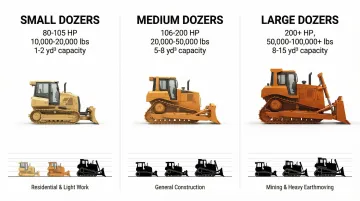
Blade capacity scales with size. Small dozers move 1-2 cubic yards per pass, while large dozers handle 8-15 cubic yards or more.
Configuration Types
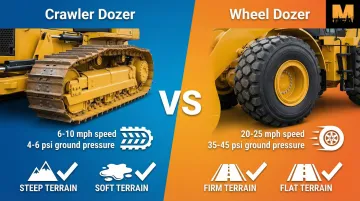
Crawler Dozers use continuous tracks that distribute weight over a larger surface area. This design excels in soft soil, steep slopes, mud, and rough terrain where wheeled equipment would sink or lose traction. The tracks provide superior pushing force and stability but limit travel speed to 6-10 mph.
Wheel Dozers mount on four large rubber tires. They travel faster (20-25 mph) between work areas, making them efficient for projects spread across large sites. The wheeled configuration works best on hard, level ground like paved surfaces or compacted soil. Ground pressure is higher than tracks, so they struggle in soft or unstable conditions.
Your terrain determines which configuration delivers better productivity. Rocky slopes and wetlands demand crawlers. Highway widening projects with frequent repositioning benefit from wheel dozers' mobility.
Dozer Sizes: Small, Medium, and Large
Small Dozers
Description: Small dozers feature horsepower ratings below 100 HP and operating weights under 20,000 lbs. Models like the Caterpillar D3 (104 HP, 21,810 lbs) and Komatsu D39 (105 HP, 22,817 lbs) represent this class, typically equipped with tracks for traction and blades holding 2.6-3.1 cubic yards.
How they differ: Their compact footprint and lightweight design enable operation in confined spaces where medium and large dozers cannot fit. They sacrifice raw pushing power for maneuverability, making them ideal for precision work around existing structures.
Best suited for:
- Residential construction and backfilling around foundations
- Landscaping projects and finish grading
- Driveway construction and small parking lots
- Hobby farming and light agricultural work
- Projects in tight urban environments with access restrictions
Key strengths:
- Easy transportation on standard trailers without oversize permits
- Fuel efficiency averaging 1.3-2 gallons per hour under load
- Lower operating costs compared to larger machines
- Simple controls suitable for less experienced operators
- Ability to navigate residential lots without damaging surrounding property
Limitations:
- Limited capacity for heavy materials like rock or clay
- Reduced effectiveness on slopes exceeding 25-30 degrees
- Slower productivity on projects exceeding 5 acres
- Inability to rip compacted soils without supplemental equipment
Medium Dozers
Description: Medium dozers occupy the 100-400 HP range with operating weights between 20,000-100,000 lbs. The Caterpillar D6 (215 HP), John Deere 750L (225 HP), and Komatsu D65 (217 HP) exemplify this versatile class, offering blade capacities from 5-8 cubic yards.
These machines balance pushing power with fuel efficiency and transportability. While delivering significantly more force than small dozers, they maintain reasonable fuel consumption (4-6 gallons per hour) and can often be transported without extreme oversize permits on most routes.
Best suited for:
- Commercial construction site preparation
- Road building and highway grading projects
- Land clearing for 5-20 acre developments
- Material stockpiling and spreading operations
- Agricultural land development and pond construction
Key strengths:
- Versatility across diverse applications from rough grading to finish work
- Good power-to-weight ratio for moderate slopes
- Ability to handle both loose soils and moderately compacted materials
- Compatibility with GPS grade control systems for precision grading
- Reasonable fuel economy for production-level work
Limitations:
- Lack the raw power for massive mining operations moving thousands of cubic yards per hour
- May be oversized and costly for simple residential grading
- Still require specialized transport for longer moves despite being more manageable than large units
Large Dozers
Description: Large dozers exceed 400 HP (often 850+ HP) with operating weights over 100,000 lbs. The Caterpillar D11 (850 HP, 229,800 lbs) and Komatsu D475 (890 HP, 254,195 lbs) dominate this category. Blade capacities range from 35-58 cubic yards—more than 10 times that of small dozers.
How they differ: Their massive pushing power and blade capacity enable moving material volumes that would require multiple passes from smaller machines. A D11 can push 57 cubic yards per pass compared to 3 cubic yards for a D3—a 19x difference in single-pass capacity.
Best suited for:
- Open-pit mining and coal operations
- Major highway construction and dam projects
- Large-scale demolition and land reclamation
- Quarry development and material processing
- Landfill management and waste handling
Key strengths:
- Exceptional productivity on large projects with material volumes exceeding 50,000 cubic yards
- Ability to work in harsh conditions with heavy rock and compacted soils
- Superior performance on steep grades up to 45 degrees
- Reduced cycle times that lower cost-per-yard moved on massive projects
- Capability to rip rock with rear-mounted shanks
Limitations:
- Fuel consumption of 15-25 gallons per hour creates operating costs exceeding $300/hour
- Transport requires specialized heavy-haul equipment and oversize permits in all jurisdictions
- Requires highly experienced certified operators
- Physically cannot access confined job sites or residential areas
Dozer Configurations: Crawler vs. Wheel
Crawler Dozers (Track Dozers)
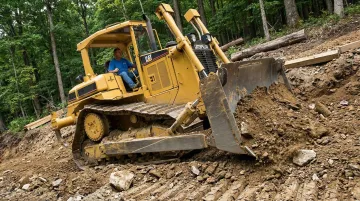
Description: Crawler dozers mount on continuous tracks (caterpillar treads) that distribute machine weight evenly across the ground surface. The Komatsu D61PX-24 exerts just 4.61 psi ground pressure despite weighing over 40,000 lbs—less pressure than a human footprint.
How they differ: Tracks provide superior traction and flotation compared to wheels, enabling operation on soft, muddy, uneven, or steep terrain where wheeled machines sink or lose traction. The continuous ground contact prevents spinning and maintains pushing force.
Best suited for:
- Rough terrain with rocks, stumps, and debris
- Steep slopes from 25-45 degrees
- Soft ground including mud, sand, and wetlands
- Forestry applications with slash and vegetation
- Mining sites with loose overburden
Key strengths:
- Excellent traction on all terrain types regardless of surface conditions
- Superior pushing power from stable platform
- Ability to work slopes up to 45 degrees (though operation above 35 degrees is considered extreme)
- Low ground pressure prevents surface damage and sinking
- Counter-rotation capability for tight maneuvering
- Stability that enhances operator safety on challenging terrain
Limitations:
- Travel speeds limited to 5-9 mph compared to 20+ mph for wheel dozers
- Higher maintenance costs for track systems with undercarriage often representing 50% of total maintenance expenses
- Limited mobility on paved roads where tracks damage asphalt
- Difficulty relocating between distant job sites without transport equipment
Wheel Dozers
Description: Wheel dozers mount on large rubber tires designed for faster travel speeds and mobility on firm surfaces. Models like the Caterpillar 834K reach 22 mph forward speed, nearly four times faster than comparable crawler dozers.
How they differ: Wheels sacrifice traction and flotation for speed and road mobility. They excel at repositioning quickly between work zones and can legally travel on public roads without transport equipment, but their 35-45 psi ground pressure limits soft-ground capability.
Best suited for:
- Road maintenance and surface mining on stable ground
- Material stockpiling operations in flat areas
- Projects requiring frequent relocation between zones
- Firm surfaces including gravel, compacted soil, and rock
- Applications prioritizing speed over maximum pushing power
Key strengths:
- Fast travel speeds enable rapid repositioning without stopping production
- Ability to operate on public roads between job sites
- Lower maintenance costs than tracks with tire replacement simpler than undercarriage rebuilds
- Quicker cycle times when pushing distances exceed 300 feet
- Better fuel efficiency during transit phases
Limitations:
- Reduced traction on soft, muddy, or loose terrain where tires spin and dig in
- Less effective on slopes exceeding 20-25 degrees
- Higher ground pressure (35-45 psi) causes surface disturbance on soft soils
- Limited pushing power compared to crawler dozers of similar weight due to traction limitations
Specialized Dozer Types and Blade Configurations
Blade configuration often matters more than dozer size when matching equipment to specific project demands. The right blade type can double productivity in certain applications, while the wrong choice creates unnecessary material spillage and wasted fuel.
Angle Dozers
Angle dozers feature blades that pivot left or right up to 25 degrees from center, allowing operators to push material to the side rather than straight ahead.
This capability is essential for ditching, side-casting material away from roadbeds, pioneering access roads through timber, and clearing drainage channels. Road construction crews particularly value this versatility—a single angle dozer can cut a drainage ditch while simultaneously casting spoil away from the roadbed in one pass.
Coal U-Blade and Push Dozers
Coal U-blade dozers feature large, curved blades with high side wings designed to carry maximum material volume without spillage. The U-shape retains light, loose materials like coal, wood chips, or sandy soil that would spill over straight blades.
Blade capacities reach 35-58 cubic yards on large models, enabling massive productivity in mining and bulk material handling. Push dozers optimize for moving enormous volumes over long distances in land reclamation, often working in tandem with scrapers to load material.
Blade Types and Their Applications
Understanding how each blade type performs across different materials helps contractors select the right configuration for maximum efficiency:
| Blade Type | Capacity | Best For | Key Feature |
|---|---|---|---|
| S-Blade (Straight) | 5.0 yd³ | Hard materials, rock, fine grading | No wings; maximum penetration force |
| U-Blade (Universal) | 15.4 yd³ | Light materials, long pushes | Large wings retain maximum volume |
| SU-Blade (Semi-Universal) | 7.5 yd³ | General earthmoving, production work | Balanced penetration and capacity |
| PAT Blade (Power-Angle-Tilt) | 8.6 yd³ | Precision grading, spreading | 6-way hydraulic control |
| Angle Blade | 6.8 yd³ | Ditching, side-casting, road pioneering | Angled left/right up to 25° |
| Forestry Blade | 5.6 yd³ | Land clearing, timber work | Reinforced with brush rack |
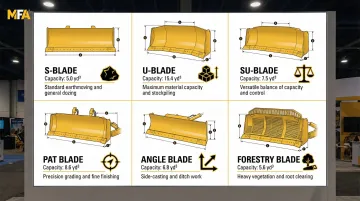
Match blade to material characteristics:
- Loose soil and sand: U or SU blades prevent spillage during long pushes
- Rock and hard-packed clay: S-blades concentrate force for penetration
- Mixed vegetation and stumps: Forestry blades with protective racks prevent costly damage
When purchasing used dozers, verify blade condition matches your primary application—replacing or retrofitting blades adds $15,000-$45,000 to project costs.
How to Choose the Right Dozer for Your Project
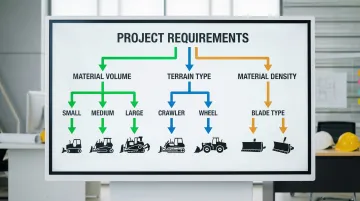
The "right" dozer matches machine capabilities to project requirements rather than defaulting to the largest or most powerful option available.
Project Scope and Material Volume
Calculate total material volume to determine appropriate size:
- Under 5 acres or 5,000 cubic yards: Small dozers (under 100 HP) provide sufficient capacity without excessive fuel costs
- 5-20 acres or 5,000-50,000 cubic yards: Medium dozers (100-400 HP) balance productivity with operating costs
- Over 20 acres or 50,000+ cubic yards: Large dozers (400+ HP) reduce cost-per-yard through higher productivity despite higher hourly rates
Timeline matters equally. A medium dozer completing work in 2 weeks may cost less overall than a small dozer requiring 6 weeks despite lower hourly rates.
Factor in extended labor, supervision, and project overhead costs when comparing options.
Terrain and Ground Conditions
Match configuration to ground conditions:
Crawler dozers work best for:
- Slopes exceed 25 degrees
- Ground is soft, muddy, sandy, or unstable
- Surface contains rocks, stumps, or debris
- Low ground pressure is required to prevent environmental damage
Wheel dozers excel when:
- Terrain is firm, flat, and stable
- Frequent repositioning between zones is required
- Road travel between sites eliminates transport costs
- Speed matters more than maximum pushing power
Ground bearing capacity assessment: Soft soils supporting less than 5 psi require Low Ground Pressure (LGP) crawler models. Standard crawlers handle 6-10 psi conditions. Wheel dozers need 35+ psi bearing capacity to avoid sinking.
Material Type and Density
Dense materials require more horsepower per cubic yard moved:
- Rock, compacted clay, and frozen soil demand 30-50% more power than loose topsoil or sand
- A medium dozer adequate for sandy soil may lack power for clay-heavy sites
Blade selection follows material characteristics: S-blades for rock and hard materials requiring penetration, U-blades for light materials maximizing volume, SU-blades for mixed conditions, and forestry blades for vegetation with protective racks.
Operator Skill Level and Availability
Large dozers require certified, experienced operators who understand machine limitations and safety protocols. OSHA Standard 29 CFR 1926.602(d) mandates operator training and certification for earthmoving equipment. Operators unfamiliar with large machines risk equipment damage, project delays, and safety incidents.
Small and medium dozers are more forgiving for operators with basic training, making them practical when experienced operators are unavailable or expensive in your market.
Budget Considerations: Buying vs. Renting
Operator availability and skill level directly impact your equipment budget—experienced operators command higher wages but prevent costly mistakes.
Cost analysis framework:
Purchase when:
- Project duration exceeds 12-18 months
- You have multiple projects lined up requiring similar equipment
- Ownership costs (depreciation, maintenance, storage) are justified by utilization rates exceeding 60%
- Financing terms enable affordable purchase
Rent when:
- Project duration is under 6 months
- Equipment need is specialized or infrequent
- Capital preservation is prioritized over ownership
- Maintenance and downtime risk stays with the rental company
Hidden ownership costs to calculate:
- Undercarriage maintenance for crawlers often exceeds 50% of total maintenance costs over machine life
- Track replacement: $30,000-$100,000+ depending on size
- Wheel dozer tires: $5,000-$15,000 each (less frequent replacement than tracks in abrasive conditions)
For contractors seeking cost-effective alternatives to new equipment, Mideast Equipment Supply specializes in sourcing quality used dozers through both direct sales and auctions. Their equipment location services help contractors find specific dozer types matching project requirements, while financing assistance through multiple competing lenders makes used equipment acquisition more accessible within budget constraints.
Common Mistakes to Avoid When Selecting a Dozer
Choosing Size Based on Power Alone
Selecting the largest available dozer when a smaller machine suffices creates unnecessary costs. A D8 consuming 10 gallons per hour costs $40/hour in fuel alone at $4/gallon, while a D6 consuming 5 gallons per hour costs $20/hour—a $160/day difference that adds up fast.
Oversized machines also trigger higher transport costs, require specialized trailers and permits, and may damage surfaces with excessive ground pressure or weight.
Ignoring Terrain and Ground Conditions
Wheel dozers struggle on soft terrain—spinning tires, lost productivity, and potential equipment damage follow. Crawler dozers on projects requiring frequent road travel waste time on slow repositioning and may damage paved surfaces with track marks.
Slope capacity matters just as much. Wheel dozers lose traction and risk tipping on slopes exceeding 20-25 degrees, while crawler dozers operate safely up to 35-40 degrees.
Overlooking Total Cost of Ownership
Purchase price is just the starting point. Fuel consumption varies 19x between size classes—from 1.34 gallons per hour for a D1 to 25.59 gallons per hour for a D11 under load.
Over 2,000 operating hours annually, this difference equals $193,000 in fuel costs at $4/gallon.
Financial impact extends beyond fuel consumption:
- Maintenance schedules and parts availability
- Undercarriage replacement costs (often $20,000-$80,000 depending on size)
- Operator wages and insurance premiums
- Transport and mobilization expenses
- Downtime costs when parts aren't readily available
A cheaper used machine with poor parts availability may cost more over 3 years than a slightly more expensive unit with better dealer support.
Selecting Equipment Without Operator Input
Experienced operators understand machine capabilities and limitations from daily use. They recognize when equipment is underpowered for conditions, when blade configuration limits productivity, or when terrain exceeds safe operating parameters.
Consulting operators before finalizing equipment selection prevents costly mismatches and leverages practical field knowledge that specifications alone don't capture.
Conclusion
Dozers remain essential earthmoving machines, ranging from compact 100 HP units for residential work to massive 850+ HP mining machines. Understanding the distinctions between small, medium, and large dozers, crawler versus wheel configurations, and specialized blade types helps you match equipment to your specific project needs.
The right dozer selection directly impacts your bottom line:
- Maximizes productivity through appropriate power and blade configuration
- Controls operating costs with proper size-to-task matching
- Ensures operator safety and efficiency
- Improves project profitability
Choosing the right machine means balancing pushing power, terrain suitability, and material handling capacity with operator skill requirements and total cost of ownership. Whether you're sourcing equipment for a single project or expanding your fleet, working with experienced dealers like Mideast Equipment Supply can help you find quality used dozers that match your requirements and budget.
Frequently Asked Questions
What is the difference between a wheel dozer and a crawler dozer?
Crawler dozers use tracks for superior traction on soft, steep, or uneven terrain with low ground pressure (4-6 psi), while wheel dozers use rubber tires for faster travel speeds (20+ mph) on firm surfaces. Crawlers excel at pushing power; wheels provide mobility.
What is a crawler dozer used for?
Crawler dozers handle rough terrain grading, land clearing, steep slope work (up to 35-45 degrees), mining operations, and forestry projects. They excel on challenging ground including mud, sand, rock, and debris-covered surfaces.
What is the difference between a scraper and a dozer?
Dozers push material with a front-mounted blade over short distances (typically under 300 feet) for grading and spreading, while scrapers cut, load, haul, and dump material using a bowl mechanism for moving earth over longer distances (300-3,000 feet) more efficiently than dozers.
What size dozer do I need for land clearing?
Small dozers (under 100 HP) suit 1-5 acres with light brush and vegetation. Medium dozers (100-400 HP) handle 5-20 acres with mixed vegetation and trees. Large dozers (400+ HP) are required for extensive clearing projects exceeding 20 acres or heavy timber with stumps and root systems.
How much does it cost to operate a dozer per hour?
Operating costs range from $75-$300+ per hour depending on size. Fuel consumption varies from 2-4 gallons/hour (small) to 15-25+ gallons/hour (large). Add operator wages ($30-$50/hour), maintenance, depreciation, and insurance for total cost.
Can I rent a dozer instead of buying one?
While rentals suit short-term needs, purchasing used equipment often provides better value for ongoing projects. Dealers like Mideast Equipment Supply offer quality used dozers with financing options, delivering lower total cost than extended rentals for most contractors.