Introduction
Purchasing used construction equipment involves high stakes—the right decision can save you $50,000 or more while securing reliable machinery that drives profitability for years. However, the wrong choice can saddle your operation with chronic breakdowns, costly repairs, and project delays that quickly erase any initial savings.
When approached strategically, the used equipment market offers significant value. Contractors who balance affordability with reliability consistently find exceptional machines at 25-50% below new prices.
With new equipment delivery times stretching 12-18 months due to supply chain constraints, used assets provide immediate availability that keeps projects moving forward. Success requires understanding what to inspect, where to buy, and how to verify equipment history before committing your capital.
Key Takeaways
- Used equipment cuts costs by 25-50% compared to new while providing similar performance for most applications
- Check age, operating hours, and maintenance records before purchase
- Verify equipment through detailed inspection and reputable sources
- Focus on engine, hydraulics, undercarriage, and structural integrity before purchase
- Work with trusted dealers who offer inspection services, financing, and potential warranties
- Strategic timing and understanding market values maximize ROI
What is Used Construction Equipment?
Used construction equipment includes previously owned heavy machinery—excavators, dozers, loaders, graders, and similar assets—resold for continued use in construction, roadwork, agriculture, and industrial applications. Contractors upgrading fleets, rental companies cycling inventory, and businesses liquidating assets bring these machines to the secondary market.
The "used" category spans a wide spectrum:
- Nearly-new machines: Under 1,000 hours from rental fleet disposals or contractors who overestimated capacity needs
- Mid-life equipment: Moderate hours with proven reliability, balancing cost and performance
- Older machines: Requiring refurbishment but offering extreme affordability for budget-conscious operations or specialized short-term projects
This variety reflects a substantial and well-established market. The North American construction equipment market reached $60.5 billion in 2024 and is projected to grow to $80.5 billion by 2031, with used assets driving significant transaction volume.
Buyers can choose from multiple purchasing channels. Dealers, auction platforms, and private sellers each offer distinct levels of support, transparency, and pricing.
Benefits of Buying Used Construction Equipment
Significant Cost Advantage
Used equipment typically costs 25-50% less than comparable new models, freeing substantial capital for other business priorities. This price differential allows contractors to:
- Acquire multiple machines for the cost of one new unit
- Expand capabilities without overextending financially
- Maintain stronger cash reserves for operational expenses like payroll and materials
The savings become even more pronounced when comparing specific models. A three-year-old excavator with 3,000 hours might cost $120,000 versus $240,000 new—identical capability at half the investment.
Minimal Depreciation Impact
Unlike new equipment that loses 15-25% of its value the moment it leaves the dealer lot, used machines have already experienced their steepest depreciation. This value retention protects your investment and improves resale potential when you eventually upgrade.
Equipment depreciation isn't linear. Certain model years experience dramatic value drops (28.83% year-over-year in some cases), while older machines stabilize and hold value remarkably well.
By purchasing used, you skip the steepest depreciation and buy at a more stable point in the value curve.
Immediate Availability
Used equipment is typically ready for delivery within days, not the 12-18 months now common for new machinery orders. With construction equipment lead times nearly three times longer than 2019 levels, this immediate availability can be the difference between winning and losing project bids.
Contractors facing unexpected equipment failures or sudden project opportunities can't afford to wait a year for new machinery. The used market provides the bridge solution that keeps operations running and revenue flowing.
Key Factors to Consider When Buying Used Equipment
Successful used equipment purchases depend on evaluating multiple interconnected factors that directly impact operational costs, productivity, and return on investment. Overlooking even one element can transform an apparent bargain into a financial burden.
Equipment Age and Model Year
Age matters less than condition and maintenance history, though machines 3-7 years old typically offer the best balance of modern features, remaining lifespan, and affordability. These mid-age machines incorporate current technology standards—improved fuel efficiency, operator comfort, and emission compliance—while carrying significantly lower price tags than new units.
Older models present parts availability challenges. Manufacturers discontinue support for equipment beyond certain age thresholds, making repair parts expensive or impossible to source.
Very recent used equipment may still carry premium pricing with limited savings over new purchases, particularly if it's only 1-2 years old.
Operating Hours
Evaluate operating hours in context rather than as an absolute disqualifier. Excavators with 5,000-8,000 hours typically have significant productive life remaining if maintenance was consistent. Machines approaching 10,000+ hours generally face major component overhaul needs—engine rebuilds, hydraulic system refurbishment, or undercarriage replacement.
Hour meters can be tampered with, so cross-reference readings with maintenance records, wear patterns, and overall condition.
A machine showing 4,000 hours but displaying severe wear inconsistent with that usage should raise immediate red flags. However, a well-maintained machine with 9,000 documented hours and comprehensive service records may outperform a neglected 5,000-hour unit.
Maintenance History and Documentation
Comprehensive service records showing regular oil changes, filter replacements, and scheduled maintenance indicate responsible ownership and predict future reliability. Detailed documentation should include dates, service provider information, and specific work performed.
Request records of major repairs or component replacements—engine rebuilds, hydraulic pump replacements, undercarriage work—that affect remaining equipment life and resale value.
These expensive repairs can either be positive indicators (recent overhaul extends life) or warning signs (repeated failures suggest systemic issues). Rental fleet disposals typically provide the most thorough documentation, as rental companies maintain detailed service logs to maximize asset use and resale value.
Equipment History and Ownership
Verify clean title with no liens before finalizing any purchase. Confirm the seller has legal right to sell and check the equipment serial number against theft databases like NER's IRONcheck, which accesses over 20 million heavy equipment theft and ownership records. State-level UCC (Uniform Commercial Code) searches are essential for identifying existing liens that could cloud ownership.
Investigate how many previous owners the equipment had and what applications it served. Single-owner machines used for consistent work often show better condition than equipment passed through multiple dealers or used in varying high-stress applications. A dozer used exclusively for land clearing by one contractor will typically outlast a similar-age unit that changed hands three times and worked in demolition, then mining, then general construction.
Purchase Source: Dealer vs. Auction vs. Private Seller
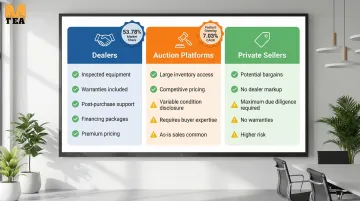
Understanding where to buy is as critical as what to buy. Three main channels dominate used equipment sales, each with distinct advantages and limitations:
Dealers held 53.78% of market share in 2025, offering inspected equipment with warranties and post-purchase support, but at premium prices reflecting these services. They provide financing packages, delivery coordination, and recourse if issues arise shortly after purchase.
Auction platforms are the fastest-growing channel (7.03% CAGR), providing access to large inventories at competitive market prices. Condition transparency varies—some auctions offer detailed inspection reports while others sell "as-is, where-is" with minimal disclosure. Experienced buyers comfortable with equipment assessment find exceptional value here.
Private sellers offer potential bargains as individuals or small contractors liquidate assets without dealer markup. However, these transactions require maximum buyer due diligence, offer no warranties or recourse, and carry higher risk of undisclosed problems or ownership complications.
Financing and Total Cost of Ownership
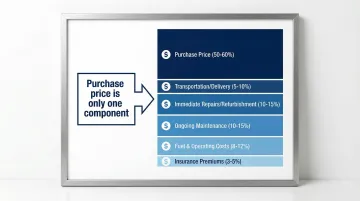
Purchase price represents only one component of total cost of ownership. Factor in transportation/delivery fees (which can reach thousands for heavy equipment), immediate repairs or refurbishment needs, ongoing maintenance costs, fuel efficiency differences between models, and insurance premiums.
Calculate whether monthly payments plus operating costs fit your budget and project revenue projections. Financing options for used equipment account for age and condition, with terms and rates varying significantly from new equipment loans. Equipment 5+ years old may face higher interest rates or require larger down payments.
How to Inspect Used Construction Equipment
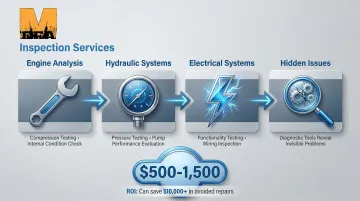
Thorough inspection is your primary defense against costly surprises. Investing $500-1,500 in professional inspection services can save tens of thousands in avoided repair costs and prevent purchasing equipment that never delivers acceptable productivity.
Visual Inspection Fundamentals
Conduct a comprehensive walk-around looking for structural cracks, excessive rust, fluid leaks, damaged hoses, worn pins and bushings, and signs of poor repairs or modifications. Pay particular attention to:
- Frame and structural components for cracks, especially near stress points and welds
- Hydraulic hoses and fittings for leaks, cracking, or improper repairs
- Pins and bushings at attachment points for excessive play indicating wear
- Operator cab for damage suggesting abuse or rollover incidents
Undercarriage Assessment (Tracked Equipment)
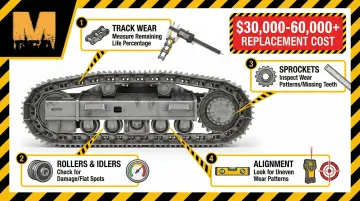
The undercarriage represents one of the most expensive replacement costs on tracked equipment, often $30,000-60,000+ depending on machine size.
When inspecting undercarriage components:
- Measure track wear carefully and calculate remaining life percentage
- Inspect rollers and idlers for damage or flat spots
- Check sprockets for wear patterns and missing teeth
- Look for uneven wear indicating alignment issues
Components wear at different rates. Tracks may have 40% remaining life while rollers are at 70%, requiring you to budget for replacements at different times.
Request documentation of previous undercarriage work, as a recent replacement significantly increases equipment value.
Operational Testing
Start the equipment and run it through a complete functional test:
- Run the engine and listen for unusual noises, excessive smoke, or vibration
- Test all hydraulic functions for smooth operation and adequate power
- Operate through full range of motion checking for binding or unusual sounds
- Verify all functions complete their cycles without hesitation
- Test under load when possible—problems often appear only under working conditions
Weak cylinders or jerky movement suggest hydraulic system issues requiring expensive repairs.
Professional Mechanical Assessment
Bring or hire a qualified mechanic for detailed assessment of technical components requiring diagnostic tools and expertise.
A professional inspection covers:
- Engine compression and internal condition
- Hydraulic pressure and pump performance
- Electrical system functionality and wiring condition
- Hidden problems invisible to visual inspection
Professional inspection typically costs $500-1,500 depending on equipment complexity and location. This investment provides invaluable insight into true equipment condition and helps you negotiate price adjustments based on identified issues.
How Mideast Equipment Can Help
Mideast Equipment Supply connects contractors, dealers, and international buyers with quality used machinery across the United States. Operating since 2004, the company handles the complete process from inspection through export.
Their services address the key challenges buyers face when purchasing used equipment.
Complete Auction and Sales Services:
Mideast Equipment provides:
- Equipment inspection with detailed condition reporting
- Transparent sales processes with full condition disclosure
- Access to diverse inventory across all categories—trucks, trailers, construction equipment, farm machinery, and industrial assets
This experience helps buyers find equipment matching specific project requirements.
Financing and Documentation Support:
The company provides financing options through multiple lenders, creating competitive offers that benefit buyers with better rates and terms.
For international purchases, Mideast Equipment coordinates full export documentation and shipping logistics. They work with experienced freight forwarding partners who handle equipment from compact machinery to large earthmovers.
Extensive Industry Network:
Mideast Equipment's weekly email updates reach 35,000+ subscribers throughout the construction equipment industry.
This network helps buyers locate specific equipment types for particular projects, accessing inventory beyond what's immediately visible in their listings.
Contact Mideast Equipment at (860) 222-3393 or auctions@mideastequip.com to discuss your equipment needs and explore current inventory.
Conclusion
Buying used construction equipment successfully requires thorough research, careful inspection, and realistic assessment of your operational needs versus equipment capabilities. The goal isn't finding the cheapest option available—it's securing equipment that delivers reliable performance at a price point improving your profitability.
The used market offers exceptional value when approached strategically. Machines 3-7 years old with documented maintenance history, verified clean titles, and thorough pre-purchase inspections consistently deliver years of productive service at 30-50% below new equipment costs.
Finding the right equipment is only half the equation—working with the right partner matters just as much. Experienced auction houses like Mideast Equipment Supply provide inspection services, documentation transparency, and post-purchase support that reduce risk throughout the buying process.
These partnerships maximize your investment value, transforming what could be a gamble into a calculated business decision that strengthens your competitive position.
Frequently Asked Questions
Is buying used equipment worth it?
Yes, when purchased from reputable sources with thorough inspections. You can achieve 30-50% cost savings while obtaining reliable equipment with years of productive life remaining, provided you verify maintenance history.
How to buy used heavy machinery?
Define your needs and budget, then research market values through auction results and dealer listings. Inspect equipment thoroughly (or hire professionals), verify documentation, negotiate based on condition, and arrange financing and transportation.
How many hours is too much for a used excavator?
Excavators with 8,000-10,000+ hours are approaching major overhaul territory, while machines under 5,000 hours typically have substantial life remaining. Maintenance history matters more than absolute hours—a well-maintained 9,000-hour machine often outperforms a neglected 6,000-hour unit.
How to price used construction equipment?
Base pricing on market comparables from recent auctions and dealer listings, considering age, hours, condition, and maintenance history. Typical used equipment values fall at 40-70% of comparable new pricing, with well-maintained machines commanding premium prices.
What should I inspect before buying used construction equipment?
Focus on engine condition, hydraulic systems, undercarriage wear (tracked equipment), structural integrity, operator controls, and hour meter verification. Test all functions under load, or hire a professional mechanical assessment for comprehensive evaluation.
Should I buy from a dealer or at auction?
Dealers typically offer inspected equipment with warranties and financing but at premium prices, making them better for buyers wanting support and guarantees. Auctions provide access to larger inventories at competitive market prices with varying condition disclosure, suiting experienced buyers comfortable with equipment assessment and willing to accept higher risk for potentially better pricing.