
Start here if you want the highest-probability shortlist. These models are the usual first pass for many U.S. fleets:
Freightliner Cascadia
Kenworth T680
Peterbilt 579
Volvo VNL
International LT
In this guide, ‘best’ means the option you can support, standardize, and rotate without friction. There is no universal winner.
Use the fit matrix to align the truck choice to your lanes, duty cycle, shop model, and driver constraints, then pressure-test the selection with a short spec and verification checklist.
The shortlist is the easy part. The margin comes from a fit that holds up in operations.
Key Takeaways
“Best” depends on lane profile, duty cycle, and uptime tolerance.
Service network and parts availability often outweigh spec-sheet advantages.
Lock the critical specs that actually change duty-cycle outcomes (powertrain, axle ratio, axle ratings/GVW, wheelbase).
Verify support reality before you commit (dealer coverage, parts availability/lead times, and maintenance/build history where available).
Best Semi Trucks By Use Case: Operational Fit Matrix
This matrix is designed for standardization and execution.
It focuses on the operating variables that usually separate stable performance from rework: issue-resolution speed on your lanes, cab specs that keep drivers consistent day after day, how tightly you can hold a single build template across the fleet, and how cleanly the unit exits when it’s time to rotate.
Row | Freightliner Cascadia | Kenworth T680 | Peterbilt 579 | Volvo VNL | International LT |
|---|---|---|---|---|---|
Truck | Fleet-standard highway tractor with the broadest day-to-day fleet footprint | Highway tractor designed for repeatable OTR/regional specs and strong dealer ecosystems | Highway tractor often selected where driver-facing fit/finish and cab experience matter | Highway tractor with strong appeal in fleets that plan around integrated support and driver comfort | Highway tractor widely used where standardized acquisition and service pathways are tightly controlled |
Best For | Large fleets, mixed lanes, high utilization, frequent refresh cycles | OTR/regional fleets that want spec discipline and consistent shop outcomes | Fleets balancing OTR/regional work with higher driver-experience pressure | OTR/regional carriers that value structured support paths and driver comfort | Cost-controlled fleets, high-volume procurement, standard duty highway cycles |
Why It Wins In Ops | High standardization potential at scale; easier to hold common builds across terminals and lanes | Performs best under template governance; supports repeatable maintenance planning and parts predictability | Helps when driver experience impacts retention; can reduce productivity loss tied to cab dissatisfaction | Strong when your operating model assumes a consistent support plan and disciplined spec control | Fits environments built around process compliance and purchasing consistency; supports controlled fleet programs |
Wrong-Fit Signal | Your default requirement is niche vocational behavior or frequent non-standard upfits | Spec drift is common across lanes and business units, creating fragmented configurations | You are optimizing only for the lowest acquisition cost and treating driver inputs as noise | Your footprint cannot support the service model consistently across lanes | Your duty cycle has high variability that is better served by a more vocational orientation |
Uptime / Support Sensitivity (Where downtime becomes expensive fastest) | Lowest risk in dense dealer corridors and common fleet specs; risk rises when lanes run remote, and you cannot pre-stage common parts | Low risk when dealer access is stable on your primary lanes; risk rises when routes shift across thin support areas, or many spec variants exist | More network-dependent: holds well where service access and shop capability are stable; weakens when support is uneven and cab-heavy specs vary widely | Moderate: strongest when support access and service plan execution are consistent; risk rises when your footprint is fragmented, and escalation paths vary | Moderate to high, depending on local network and parts flow; risk rises when lanes are remote or you cannot maintain consistent build history and shop routines |
Driver Acceptance Sensitivity (How much the cab spec affects outcomes) | Medium; improves when cab ergonomics and sleeper choices are standardized across the fleet | Medium; strongly influenced by sleeper/cab template consistency and driver expectations by lane | Medium-High; benefits most when comfort/ergonomics are treated as a defined baseline, not a per-unit choice | High; often chosen when driver acceptance is a hard operating constraint | Medium; improves when the cab spec is held consistent, and driver expectations are managed by lane |
Used-Market Leverage (Exit optionality when you rotate) | High liquidity when kept in common fleet specs and clean records | High demand when spec stays standard, and maintenance history is strong | High when maintained well and configured in common highway specs | Medium-High when maintenance history is complete, and spec is disciplined | Medium; improves with a clean history, common specs, and predictable condition |
What to Standardize (So results repeat) | Lane-based spec templates; wheelbase + axle ratings bands; tire program; safety/telematics package; approved option limits | Axle ratio bands by lane; cooling + braking options; sleeper/cab template; maintenance intervals; option governance rules | Driver-facing cab template; safety/ADAS package; lane-based axle ratings; interior feature limits to prevent variation | Sleeper/cab template; safety/ADAS; service plan expectations; lane-based axle ratings; escalation/repair workflow ownership | Lane-based spec template; service network plan by terminal; tire/brake standard; replacement timing rules; build history discipline |
After the matrix gives you a front-runner, lock the decision in a way that procurement, the shop, and dispatch can execute without interpretation gaps.
Run a quick internal alignment pass across three functions:
Maintenance lead sign-off: Confirm which failure modes you are most exposed to in your lanes (cooling, aftertreatment downtime, electrical, braking wear). Then standardize the service parts and diagnostic approach that supports that exposure.
Dispatch reality check: Validate that the truck’s intended duty cycle matches how loads actually get assigned (deadhead percentage, idle time, average grade/terrain, seasonal peaks). Many “good picks” underperform because dispatch uses them outside the assumed pattern.
Driver spec baseline: Set a minimum cab/sleeper and ergonomics baseline that fits your hiring market, then treat it as a baseline requirement, not a negotiation line item.
Finally, translate the operating profile into spec terms, so procurement and the dealer will interpret the same way.
The Spec Signals That Actually Change Outcomes
Fleet specs break down less from technical complexity and more from translation failure. Procurement, dispatch, the shop, and the dealer often use the same labels to mean different things.
The fix is to write requirements as operating constraints, then lock them into controlled templates that map cleanly to the build sheet.
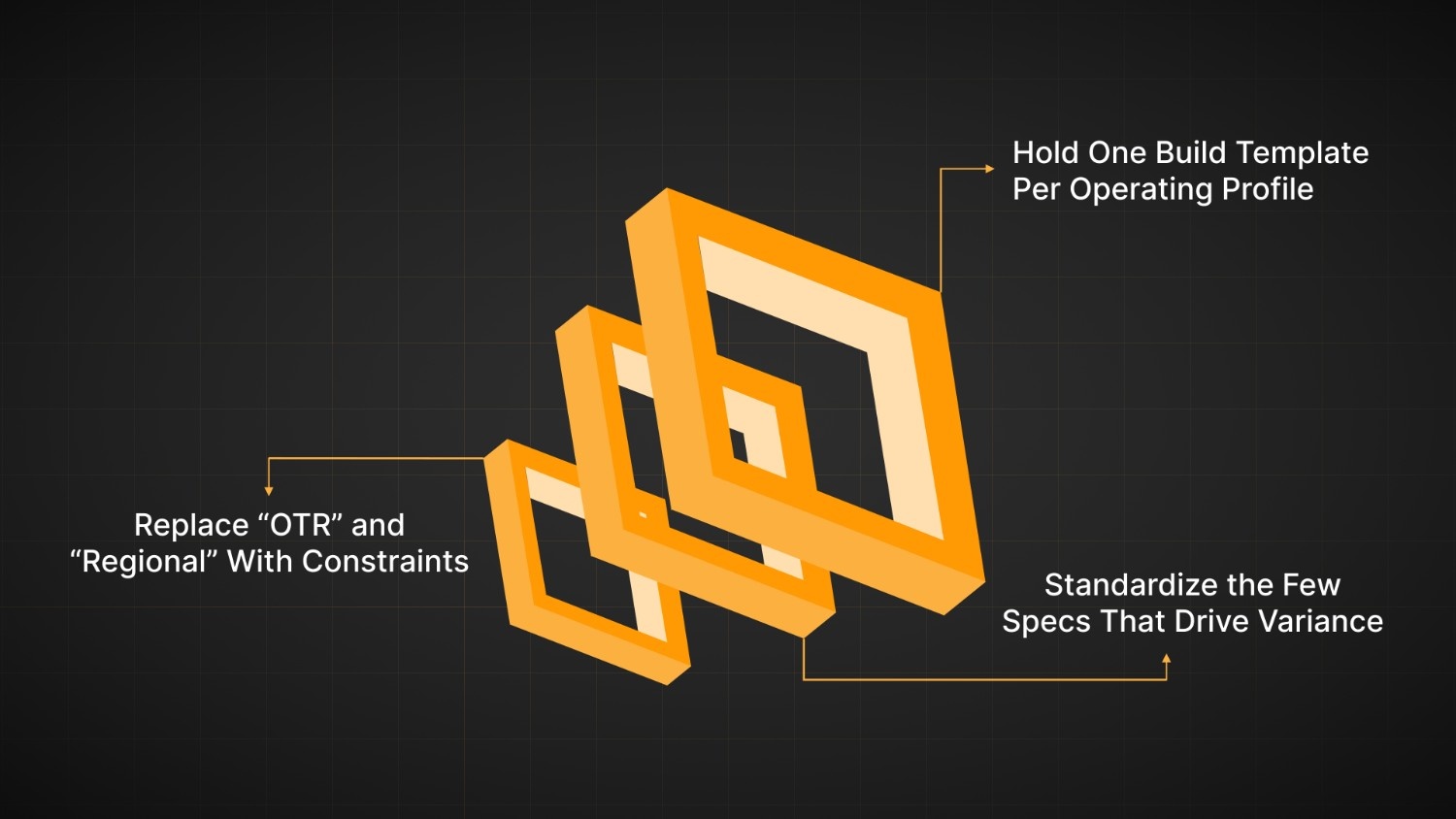
1) Replace “OTR” and “Regional” With Constraints
Duty-cycle labels do not travel well across teams. Constraints do.
Define the operating reality in one line, using only what changes configuration choices:
Average daily miles and steady-state vs stop/start profile
Idle exposure and dwell patterns
Grade/terrain exposure
Typical gross range plus seasonal peaks
Lane stability vs weekly variance
2) Hold One Build Template Per Operating Profile
Most cost-per-mile spread comes from variation, not from the base platform.
Set governance that prevents drift:
One approved template per profile (OTR/regional/mixed)
A named exception path (who can approve and why)
Option limits (what cannot vary without approval)
3) Standardize the Few Specs That Drive Variance
These items change shop planning, parts predictability, and driver experience.
Lock these as policy decisions, not per-truck preferences:
Axle ratio bands by lane profile (no one-off ratios)
Axle rating / GVW bands that reflect peak season, not averages
Wheelbase ranges tied to yard/dock geometry and trailer set reality
Cab/sleeper class as a lane baseline (avoid mixed standards inside one profile)
ADAS baseline package by template (training, calibration, and incident review consistency)
Support assumptions written as checkable coverage (where, when, and what “support” means)
Spec clarity prevents misbuilds and controls drift. The remaining delays usually come from planning mistakes that show up after dispatch assigns real work to the truck.
Common Semi Truck Selection Mistakes That Create Downtime And Spec Churn
Most fleets do not choose the “wrong” truck model. The miss shows up after the model decision when the fleet program is executed without clear controls across lanes, vendors, and internal handoffs.
That is when downtime increases and spec churn becomes a recurring cost.
Mistake 1: Having A Standard Without An Enforcement Mechanism
Templates exist, but no one owns compliance. Terminals order “close enough.” Exceptions get approved informally. Over time, the fleet standard becomes a label, not a control.
What breaks operationally: the shop cannot plan consistently, parts stocking becomes reactive, and lane coverage suffers because units are no longer interchangeable.
Mistake 2: Letting Availability Decisions Enter The Fleet Quietly
Availability pressure is normal. The failure is allowing changes to enter without a required log, approval trail, and audit loop. Variants accumulate because each decision looks small in isolation.
What breaks operationally: maintenance routines fragment, parts predictability erodes, and vendor performance becomes harder to measure because the fleet is no longer comparable unit-to-unit.
Mistake 3: Putting Units Into Service Before They Are “Fleet-Ready”
A truck can be delivered and still not be ready to run your program. The gap is usually governance: onboarding checks are not treated as a gate, so the unit reaches dispatch before it is validated, documented, and set up for shop and driver use.
What breaks operationally: dispatch absorbs the risk through workaround assignments, the shop inherits surprises, and the fleet loses time to post-deployment corrections.
Mistake 4: Allowing Driver Fit To Become A Unit-By-Unit Negotiation
When driver requirements are handled late or inconsistently, fleets either accept avoidable dissatisfaction or start customizing by unit. Both outcomes undermine fleet interchangeability.
What breaks operationally: dispatch flexibility shrinks because assignment becomes personality-based, and internal pressure builds for “special case” equipment.
Mistake 5: Buying For A Future Lane That The Fleet Does Not Actually Run
Some decisions are made for a planned operating shift that never materializes. The fleet then runs the truck in a different pattern than the program assumed.
What breaks operationally: expected wear and maintenance patterns do not match reality, operating costs become harder to forecast, and the platform gets blamed for a planning miss.
Mistake 6: Treating Exit Planning As Someone Else’s Problem
Even in liquid markets, disposition does not run itself. If timing, documentation standards, condition expectations, and the selling channel are not decided early, rotation drifts.
What breaks operationally: replacement cycles slip, capital stays tied up longer than planned, and fleets keep units past the intended window because the exit path is not ready.
Practical prevention: assign an owner for standard compliance, require a logged exception path, gate deployment with a “fleet-ready” checklist, and decide the exit channel and documentation standard at purchase time.
Verification Checklist Before You Standardize Or Buy
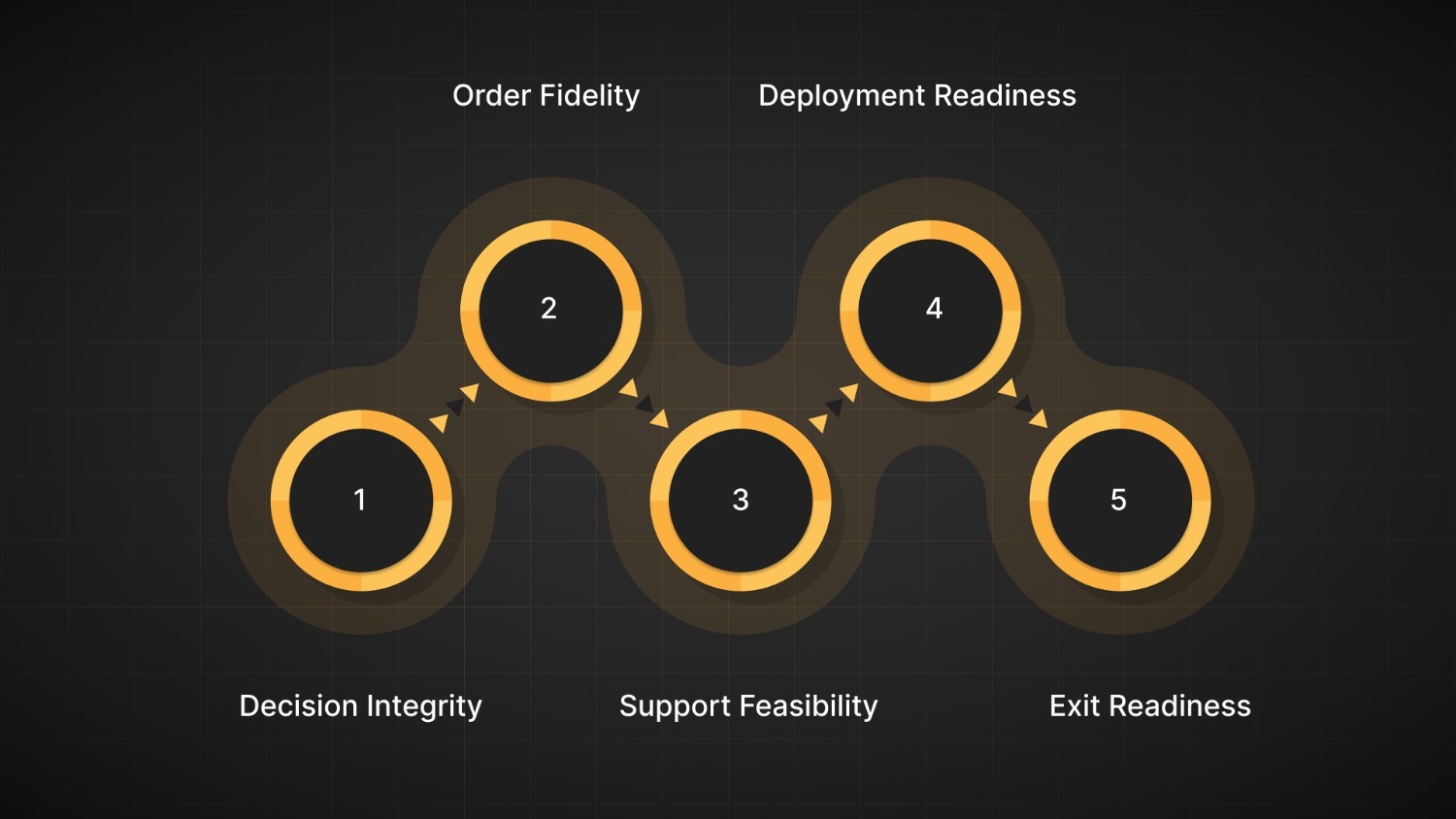
Use this as a final gate before you commit to a platform decision or approve a specific unit. It is designed to prevent “right truck, wrong execution.”
1. Decision Integrity
The operating profile is written as constraints. Daily miles pattern, stop/start density, idle exposure, grade/terrain, typical gross plus peak season, and lane stability are documented in one line.
A lane template is assigned. The purchase references Lane Template A/B/C, with a named exception path and approvers.
2. Order Fidelity
Substitution rules are explicit. The dealer/vendor cannot swap components or option packages without documented approval and a revised build sheet.
Template match is verified before the unit is released. Someone signs off that the build sheet matches the lane template, not just the quote summary.
3. Support Feasibility
Service coverage is checked on your primary corridors and operating hours. You can name service points that match your routes and schedules.
Parts assumptions are confirmed for your highest-impact downtime items. You know how priority parts will be sourced and how escalation works when a unit is down on the road.
4. Deployment Readiness
Maintenance onboarding ownership is assigned. PM baseline, diagnostics access, and shop readiness are planned before the unit is placed in service.
The driver baseline is confirmed for the lane profile. Cab/sleeper and ergonomics meet the fleet baseline for that profile, so the unit does not become a “special case” assignment.
5. Exit Readiness
The disposition plan is decided at purchase time. The intended channel, documentation standard, and condition expectations are set early so rotation does not stall later.
When these checks repeat across units and cycles, the problem stops being selection and becomes consistent sourcing and rotation execution at scale.
When Semi Truck Sourcing, Rotation, Or Liquidation Needs A Partner
If availability, configuration fit, and timing are creating delays across purchases or fleet rotations, partner support reduces execution friction.
A “full-service” partner in this lane should do more than share listings. They should help you keep the program consistent when the market is not.
That typically includes sourcing assistance against a defined lane template, support for buying and selling, clear consignment paths when you need to move units without running the process internally, auction options when timing and volume matter, documentation that makes condition and configuration legible, and pickup/logistics coordination when the handoff is not simple.
Mideast Equipment Supply operates in that execution role as a used equipment dealer and broker. The team supports sourcing across trucks and jobsite equipment, facilitates buy/sell/consignment transactions, runs seasonal auctions for structured buying and selling windows, and can coordinate logistics or export when the buyer or destination requires it.
Browse current inventory and upcoming auctions, or speak with the Mideast team about sourcing against your lane templates or consigning equipment for the next rotation cycle.
Conclusion
Selecting the best semi truck is not a popularity call. It is an operating decision that needs to hold up across lanes, shops, and driver realities. Start with a credible shortlist, then use the fit matrix to choose the platform that matches how your freight actually runs.
Once the front-runner is clear, protect the outcome with two controls: a clean spec template that cannot drift, and a short verification pass that confirms support, configuration, and documentation before you commit. That is what keeps uptime stable and prevents a “standard” from turning into a collection of one-offs.
When sourcing and rotation become recurring work, treat it as an execution workflow. A repeatable process is what keeps the fleet moving quarter after quarter.
FAQs
What is the most reliable semi truck for long haul?
There is no single “most reliable” model in every lane. The safest answer is the platform you can keep supported on-route, with a configuration your shop can maintain consistently.
What is the most powerful semi-truck?
“Most powerful” varies by how it is measured and by configuration. Unless you are running specific heavy-duty conditions, peak output alone is rarely the deciding factor in a fleet decision.
Which semi truck is best for an owner-operator?
The best fit is usually the one you can service quickly and exit cleanly if you sell later. Prioritize support access, predictable maintenance pathways, and a common resale-friendly configuration.
What is the most fuel-efficient semi truck?
Fuel results are driven more by duty cycle, gearing, aero spec, and operating behavior than by nameplate alone. Treat fuel efficiency as a spec-and-operation outcome, not a model guarantee.
What should I look for when buying a used semi truck?
Focus on proof, not promises: clear build/configuration identifiers, complete maintenance records, and clean title/ownership documentation. Confirm there are no gaps that will delay registration, pickup, or onboarding.
Which truck brand has the best resale value?
Resale is strongest when the configuration is easy for the next buyer to finance, insure, and run. Mainstream specs with clean records typically hold value better than niche builds or inconsistent documentation.