Introduction: Emergency Equipment Services Explained
Finding the right heavy equipment when project timelines are tight can make or break your operation. Whether you're sourcing a specialized excavator for an urgent construction project or liquidating fleet assets quickly, the dealer you choose determines your total cost of ownership, resale value, and operational efficiency. Research shows that equipment depreciation reaches 20-30% in the first year alone, making that choice an important financial decision from day one.
Emergency equipment services cover the full spectrum of heavy equipment transactions: sales, auctions, financing, export logistics, and ongoing support. These services span construction machinery (excavators, loaders, dozers), industrial equipment (generators, mixer trucks), and transportation assets (semi trucks, trailers, dump trucks).
The right dealer goes beyond the transaction. They provide inspection services, source hard-to-find machinery, facilitate financing, handle international shipping documentation, and maintain industry relationships that move deals faster when time is short.
TLDR:
- Emergency equipment services include sales, auctions, financing, export support, and equipment sourcing across construction, industrial, and transportation categories
- Choosing the right dealer affects total cost of ownership through depreciation management, maintenance support, and resale value
- Professional dealers use global networks to locate specific equipment or find qualified buyers quickly
- Full-service dealers cover everything from pre-purchase inspection to international customs clearance
- Dealers with strong networks and digital platforms close deals faster across wider markets
Understanding Emergency Equipment Services: What Dealers Offer
Professional equipment dealers provide far more than simple buy-sell transactions. The most capable ones function as complete transaction managers — covering every step from initial equipment search through final delivery. Core services typically include:
- Used equipment sales and acquisition
- Auction facilitation and bidding management
- Equipment location for specific project needs
- Inspection and condition assessment
- Documentation and title management
- Post-sale support and logistics coordination
The Power of Dealer Networks
Established dealers leverage extensive industry relationships to deliver value that individual buyers and sellers cannot access independently. These networks include manufacturer partnerships, contractor relationships, wholesale dealer connections, and international buyer databases spanning multiple continents. When you need a specific piece of machinery for an urgent project, dealers with strong networks can locate equipment that isn't publicly listed, often finding solutions within days rather than weeks.
Mideast Equipment Supply has built this kind of reach since 2004, maintaining relationships with dealers and sellers across Australia, the Far East, Middle East, and Central America. Their worldwide client base — backed by a weekly email list of 35,000 past buyers and sellers — creates immediate access to markets that individual operators would take years to develop on their own.
Geographic Coverage and Multi-Location Operations
Multi-location dealers provide distinct advantages: faster parts availability, regional market knowledge, reduced transportation costs, and localized service accessibility. Dealers operating across multiple states or countries understand regional pricing variations, seasonal demand patterns, and local regulatory requirements that impact equipment transactions.
Key benefits of geographic coverage include:
- Access to regional inventory pools not available nationally
- Knowledge of local market conditions affecting pricing
- Established relationships with regional freight companies
- Understanding of state-specific documentation requirements
- Faster response times for inspection and service needs
Technology Platforms That Streamline Transactions
Modern dealers use sophisticated technology systems to reach buyers and manage transactions efficiently. CRM systems document equipment digitally and automatically feed listings to multiple marketing channels simultaneously. Online auction platforms like Proxibid enable real-time bidding from anywhere in the world, while digital marketing tools ensure equipment reaches qualified buyers across multiple touchpoints.
Technology components that accelerate transactions:
- Centralized CRM systems that automate distribution to multiple marketing channels
- Auction platforms with transparent, real-time bidding (such as Proxibid)
- Photo and video galleries that support remote inspection before purchase
- Online financing applications connecting buyers with competing lenders in minutes
- Email marketing reaching thousands of qualified prospects with new inventory updates
Mideast Equipment Supply's CRM pushes listings directly to Iron Planet, Mascus, Trader Online, Machinery Zone, and IEDA Used — the platforms where serious buyers actively search.
Types of Sales Models: Auctions vs. Direct Sales
Choosing the right sales model comes down to three factors: how fast you need to move, the type of equipment involved, and the level of support the transaction requires.
Auction Sales Model
Auctions provide a transparent, market-driven pricing mechanism where competitive bidding determines final value. Unreserved auctions eliminate seller reserve prices, meaning competing bidders alone establish the selling price on auction day. This transparency gives both buyers and sellers confidence that the final price reflects true market value.
Benefits for sellers:
- Competitive bidding often drives prices above initial estimates
- Faster turnover compared to private negotiations (typically 2-4 weeks from listing to sale)
- Access to broad buyer audiences through online platforms
- Transparent process with clear timeline and defined payment terms
Benefits for buyers:
- Market-driven pricing without hidden negotiations
- Wide variety of equipment available in single events
- Ability to compare multiple similar units side-by-side
- Clear inspection periods before bidding
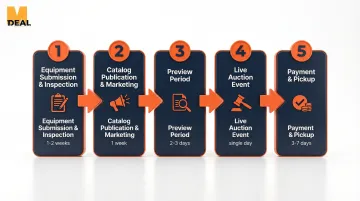
Typical auction timeline:
- Equipment submission and inspection (1-2 weeks before auction)
- Catalog publication and marketing (1 week before)
- Preview period for buyer inspections (2-3 days before)
- Live auction event (single day or timed online period)
- Payment and pickup (typically 3-7 days after)
Online platforms have made auctions accessible for both rapid disposal and strategic acquisition, extending reach well beyond local markets. Mideast Equipment Supply conducts auctions through Proxibid, Equipment Facts, and Bidspotter, providing both in-person and online bidding capabilities that reach international buyers.
Direct Sales Model
Direct sales involve one-on-one negotiations where buyers and dealers agree on price and terms privately. Unlike auctions, this model supports detailed inspections, custom financing, and value-added services like warranties and maintenance agreements.
When direct sales make more sense:
- Equipment requires specialized knowledge or customization
- Buyer needs specific warranty or financing terms
- Seller wants to control minimum acceptable price
- Transaction involves trade-ins or complex payment structures
- High-value assets where relationship and trust matter most
Critical elements of direct sales:
- Physical and functional inspections by qualified mechanics
- Review of maintenance records and service history
- Title verification to ensure equipment is lien-free
- Negotiation of transport, attachments, and support services
- Customized payment and financing structures
Consignment Sales Arrangements
Consignment allows equipment owners to leverage dealer networks and marketing reach while retaining ownership until sale. The dealer handles inspection, appraisal, marketing, buyer qualification, and transaction management, typically earning a commission on successful sales.
Consignment advantages:
- Professional marketing across multiple channels
- Access to dealer's qualified buyer database
- No upfront costs (commission paid at closing)
- Equipment remains in owner's possession until fully funded
- Dealer handles negotiations and paperwork
Mideast Equipment Supply's consignment model ensures equipment doesn't leave the seller's location until they are fully funded and satisfied, eliminating transaction risk while providing comprehensive marketing through their 35,000-subscriber email list and multiple online platforms.
Equipment Sourcing Services
Dealers with extensive networks can locate specific equipment to meet urgent project needs, tapping industry contacts to find hard-to-source machinery not publicly listed. When a project depends on a specific machine and public listings come up empty, a sourcing service can find options that aren't on the market yet.
The sourcing process typically includes:
- Assess project requirements — equipment type, specs, and operational parameters
- Contact dealers, wholesalers, and contractors across the global network
- Present multiple viable options with competitive pricing for comparison
- Coordinate independent inspections and condition verification
- Manage negotiations, financing arrangements, and shipping logistics
Choosing the Right Sales Model
| Priority | Best Model | Why |
|---|---|---|
| Speed (2-4 weeks) | Auction | Competitive bidding with fixed timeline |
| Specialized equipment | Direct sale | Expert evaluation, custom terms |
| Flexible timeline, no upfront cost | Consignment | Dealer handles marketing and negotiations |
| Hard-to-find machinery | Sourcing service | Taps private networks beyond public listings |
Comprehensive Support Services: Beyond the Sale
A dealer's real value shows up before and after the sale. Pre-purchase inspections, financing facilitation, export logistics, and post-sale support all directly affect whether a transaction goes smoothly — or expensively sideways.
Pre-Purchase Services
Thorough pre-purchase services protect buyers from costly mistakes. Professional dealers conduct multi-point inspections covering mechanical systems, hydraulics, electrical components, structural integrity, and operational performance.
Critical inspection components:
- Engine performance testing and fluid analysis
- Hydraulic system pressure tests and leak detection
- Undercarriage and wear component assessment
- Hour meter verification and service history review
- Operational demonstration under load conditions
- Complete photographic documentation from multiple angles
- Video walk-around with audio to capture engine sounds
Mideast Equipment Supply's inspection process includes comprehensive video documentation, operational demonstrations by qualified operators, and detailed condition reports that enable remote buyers to make confident decisions without physical site visits.
Financing Facilitation
Equipment dealers typically work with multiple lenders, creating competition that results in better rates and terms than buyers could secure independently. Standard financing terms include 24, 36, 48, and 60-month loans with down payment options including cash, trade-in equity, or rental equity.
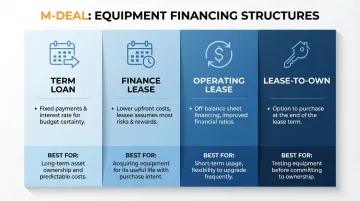
Most dealers offer four core financing structures:
| Loan Type | Key Feature | Best For |
|---|---|---|
| Term loan | Fixed payoff schedule, builds equity | Buyers who want ownership from day one |
| Finance lease | Lower payments, purchase option at end | Operators managing cash flow |
| Operating lease | Lowest payments, treated as expense | Short-term or tax-sensitive use cases |
| Lease-to-own | Gradual ownership transition | Buyers needing flexible terms |
The competitive lender approach allows multiple financial institutions to review applications simultaneously, with buyers selecting the most favorable offer. This process typically takes 60 seconds to submit and delivers competing offers within hours.
Export and International Shipping Support
Cross-border transactions add a layer of complexity that catches unprepared buyers off guard — customs documentation, biosecurity rules, and destination-country permits all require advance planning. Professional dealers simplify this through experienced freight forwarding partnerships and knowledge of local requirements.
Essential export documentation:
- Electronic Export Information (EEI) filed through Automated Export System (AES) for shipments over $2,500
- Commercial invoices clearly stating goods and amounts
- Bills of lading serving as contracts of carriage
- Packing lists detailing contents, weights, and dimensions
- EPA Certificate of Conformity for engines meeting emissions standards
Regional import requirements vary significantly:
- Saudi Arabia: Fasah clearing procedures with customs declarations 48 hours before arrival
- Singapore: Customs permits required before importation with GST categorization
- Panama: Commercial invoice, original bill of lading, and liquidacion de aduana
- Australia: Strict biosecurity cleaning requiring machinery free from soil, seeds, and organic material
Mideast Equipment Supply works with established freight forwarders including Uni International and Hansen Shipping, giving customers access to proven global networks and negotiated dealer pricing.
Post-Purchase Support Expectations
The sale is a starting point, not a finish line. Evaluate these capabilities when choosing a dealer — they determine how quickly you recover when something goes wrong.
Post-purchase support to evaluate:
- Parts availability and inventory stocking policies
- Warranty offerings for used equipment
- Maintenance service agreements and preventive maintenance programs
- Technical support hotlines and troubleshooting assistance
- Access to service documentation and operator manuals
Third-party warranty products — such as Titan Machinery's Advantage Warranty — offer 1-year or 500-hour coverage with $0 deductibles on major powertrain, hydraulic, and electrical components. Total Maintenance & Repair agreements lock in maintenance costs for the contract duration, covering oil changes, fluid analysis, and major repairs. Ask your dealer which warranty programs they can facilitate before signing.
Financing and Export Solutions for Equipment Buyers
Financing and international logistics are two areas where buyers lose the most time — and money — coordinating on their own. The right dealer handles both end-to-end, letting you focus on your project rather than chasing lenders and freight forwarders.
Equipment Financing Options
Dealers connect buyers with multiple competing lenders, creating a marketplace where financial institutions bid for the business. This competitive approach typically results in better rates than traditional single-lender applications.
Typical financing structures:
Term Loans:
- Duration: 24-60 months standard
- Builds equity with each payment
- Fixed or variable interest rates
- Down payment: 10-20% typical
Lease-to-Own:
- Lower monthly payments than term loans
- Ownership transfers at lease end
- Tax advantages treating payments as operating expenses
- Flexible end-of-term purchase options
Rental Purchase Agreements:
- Lowest barrier to entry
- Rental payments build toward ownership
- Flexibility to return equipment if project needs change
- Ideal for seasonal or project-specific needs
Qualification requirements typically include:
- Business financial statements (2 years for established companies)
- Personal credit check for owners/guarantors
- Down payment or trade-in equity
- Proof of insurance coverage
- Business tax returns and bank statements
The application process through dealer platforms takes approximately 60 seconds, with multiple lenders reviewing simultaneously and presenting competing offers within hours. Minimum financing amounts typically start at $1,500, making financing accessible even for smaller equipment purchases.
The International Export Process
Ocean freight shipping generally ranges from 20-45 days, though peak seasons and port congestion can extend timelines. Understanding each step helps buyers plan project schedules and budget appropriately.
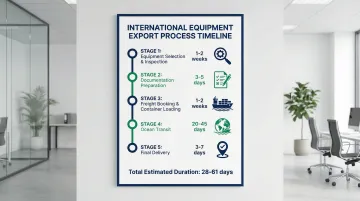
Complete export process timeline:
Equipment selection and inspection (1-2 weeks)
- Remote or physical inspection
- Condition documentation
- Price negotiation and agreement
Documentation preparation (3-5 days)
- Commercial invoices
- Export declarations through AES
- EPA certifications if required
- Customs clearance paperwork
Freight booking and container loading (1-2 weeks)
- Freight forwarder coordination
- Container selection based on equipment dimensions
- Securing cargo per IMO/ILO/UNECE CTU Code standards
- Biosecurity cleaning if required by destination
Ocean transit (20-45 days)
- Port-to-port shipping
- Real-time tracking updates
- Customs clearance at destination port
Final delivery (3-7 days after arrival)
- Customs inspection and release
- Local transportation to final destination
- Equipment offloading and placement
How Dealers Simplify Cross-Border Transactions
Dealers with active international operations maintain direct relationships with freight forwarders who specialize in heavy equipment — not just general cargo. That specialization matters for oversized loads, container weight limits, and destination-country import rules that general logistics brokers routinely miss.
Dealer-provided export support includes:
- Freight forwarder coordination and rate negotiation
- Documentation preparation and AES filing
- Biosecurity cleaning coordination when required
- Container loading supervision and cargo securing
- Customs broker coordination at destination
- Real-time shipment tracking and status updates
Mideast Equipment Supply ships to buyers across Australia, the Middle East, Central America, and beyond, working with freight forwarders they've vetted over years of volume shipping. That track record translates directly into faster container booking, better rates, and fewer surprises at the destination port.
Choosing the Right Equipment Dealer: Key Selection Criteria
Dealer selection should be approached as a strategic decision based on objective criteria rather than convenience or price alone. The right dealer becomes a long-term partner who protects your investment through market knowledge, service quality, and ongoing support.
Critical Evaluation Factors
When evaluating dealers, look at these five factors:
Years in business: Dealers with 15+ years have navigated market downturns and built reputations that depend on consistent ethical practices. Verify standing through BBB ratings, testimonials, and industry association memberships.
Manufacturer relationships: Authorized dealer status unlocks technical support, warranty administration, and parts availability that independent operators often can't access. Ask about training certifications and direct manufacturer channels.
Geographic presence: Multi-location dealers offer faster parts delivery, regional market knowledge, and lower transportation costs for customers near their sites.
Customer reviews: Read detailed reviews — not just star ratings. Focus on how dealers handle problems, response times, and post-sale support. Ask for references from customers with similar equipment types.
Service breadth: Full-service dealers who cover inspection, financing, logistics, and export simplify the process. Look for dealers that offer:
Pre-purchase inspection services
Financing facilitation with multiple lenders
Export documentation and freight forwarding
Equipment sourcing for specific needs
Post-purchase parts and service support
Dealer Expertise and Industry Connections
Access to global networks of buyers and sellers accelerates transactions significantly. Dealers with established international relationships can locate specialized equipment not publicly listed or find qualified buyers for unusual assets within days rather than weeks.
Indicators of strong industry connections:
- Membership in exclusive dealer associations (IEDA, AED)
- Participation in international trade shows and industry events
- Partnerships with major auction platforms and listing services
- Established freight forwarding relationships with volume discounts
- Email marketing lists with thousands of qualified past customers
Equipment-specific expertise matters: Dealers who specialize in your equipment category (construction, transportation, agricultural) understand market values, common issues, and resale factors better than generalists. Ask about team experience with your specific equipment types and their typical transaction volume in those categories.
How Comprehensive Dealers Differentiate Themselves
Mideast Equipment Supply illustrates what a full-service dealer looks like in practice. Youness Bakr brings deep construction equipment expertise and an industry-wide contact network — the kind of reach that surfaces deals before they're publicly listed.
Their differentiators include:
- Manages the full transaction from inspection to export, with equipment staying at the seller's location until fully funded
- Serves buyers across Australia, the Far East, Middle East, and Central America
- Maintains a weekly email list of 35,000 past buyers and sellers, with a CRM feeding multiple marketing platforms
- Runs online auctions through Proxibid, Equipment Facts, and Bidspotter
- Works with freight forwarders Uni International and Hansen Shipping at dealer pricing
- Assigns dedicated brokers by industry for equipment-specific expertise
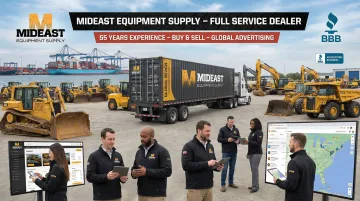
That combination of market reach and structured transaction management is what separates dealers who close deals quickly from those who leave sellers waiting.
Frequently Asked Questions
What services do emergency equipment dealers typically provide?
Professional dealers offer used equipment sales, auction facilitation, financing connections with competing lenders, export documentation, freight forwarding coordination, equipment sourcing, pre-purchase inspections, and post-sale parts and service support. Capabilities vary by dealer, so confirm which services are available before committing.
How do equipment auctions work for buyers?
Buyers register on auction platforms, review detailed catalogs with equipment specifications and photos, attend preview periods for physical inspection, submit bids during live or timed online events, and arrange payment (typically within 3-7 days) and pickup according to auction terms. Online platforms enable participation from anywhere with real-time bidding.
What should I look for when choosing an equipment dealer?
Key factors to evaluate include:
- Years in business, customer testimonials, and industry associations
- Breadth of services: inspection, financing, export support, and sourcing
- Geographic coverage and technology platforms that expand market reach
Strong dealers manage the full transaction, not just the sale itself.
Can I finance heavy equipment purchases through a dealer?
Yes, dealers typically work with multiple lenders who compete for your business, often producing better rates than applying individually. Terms commonly include 24-60 month loans with 10-20% down. Qualification requires business financials, a personal credit check, and proof of insurance. Applications are straightforward, with competing offers typically delivered within a few hours.
How does international equipment export work?
Export involves AES electronic filing, commercial invoices, bills of lading, and EPA certifications where required. Freight forwarders handle container booking and customs clearance, with ocean transit typically running 20-45 days. Dealers with established forwarding partnerships make the process significantly more straightforward.
What kind of support should I expect after purchasing equipment?
Quality dealers offer parts availability, warranties on used equipment (typically 1 year or 500 hours), maintenance agreements, and technical support. Support levels vary widely, so ask about these capabilities before you buy rather than after.