Understanding payment terms before you bid isn't just smart—it's essential. Recent data shows wire transfer fraud cost businesses $2.8 billion in 2024 alone, making secure payment protocols critical. Beyond fraud, missing a payment deadline can mean forfeiting your deposit, losing the equipment, and facing bans from future auctions.
This guide covers everything you need to navigate payment terms confidently: standard timelines, accepted methods, deposit requirements, financing options, and the most common pitfalls that trip up even experienced buyers.
TLDR: Key Payment Terms You Need to Know
- Payment windows vary by platform: 2-3 days for online-only auctions, up to 7 days for traditional auction houses
- Buyer's premium adds 10-15% to your winning bid—budget accordingly
- Wire transfer is fastest and most secure, typically clearing same-day to next business day
- Secure financing pre-approval before bidding—post-win loan applications miss payment deadlines
- Expect 8-14 day removal windows after payment clears—no equipment release before that
Standard Payment Timelines in Industrial Equipment Auctions
The payment clock starts ticking the moment the auctioneer's hammer falls. Understanding these deadlines prevents costly mistakes and ensures smooth equipment transfer.
Payment Due Dates Vary by Auction Format
Traditional auction houses like Ritchie Bros. and Euro Auctions typically allow 7 days for full payment, giving buyers more breathing room to arrange funds.
Online-only platforms operate on tighter schedules: IronPlanet requires payment within 3 business days, while Purple Wave requires funds within just 2 business days.
Mideast Equipment Auctions follows a 3-day payment window after auction close, balancing speed with buyer convenience. This timeline applies to both online timed auctions and live on-site events.
Why the rush? Auction houses manage high-volume asset turnover. Sellers expect quick payment, and auction yards have limited space for storing sold equipment. The tight timeline also reduces the risk of buyer's remorse and payment defaults.
What Happens When You Miss the Deadline
Missing payment deadlines triggers a cascade of consequences:
- Your deposit is forfeited to cover administrative costs and seller compensation
- The equipment is re-auctioned, often to the second-highest bidder
- You may face restrictions or bans from bidding at future auctions
- In extreme cases involving high-value equipment, auction houses may pursue legal action to recover damages
At Mideast Equipment Auctions, equipment remaining unpaid after the 3-day window cannot be released. If equipment sits on the yard beyond 7 days without payment, storage fees accumulate.
Items left 45 days are deemed abandoned and revert to the seller—you lose everything.
Equipment Release and Load-Out Windows
Once payment clears, you must remove equipment within specified windows to avoid additional charges.
Standard load-out timelines:
- IronPlanet: 8 business days after Item Release
- Ritchie Bros.: Up to 3 weeks after auction
- Yoder & Frey: 2 weeks maximum
- Mideast Equipment Auctions: 7 days from sale date
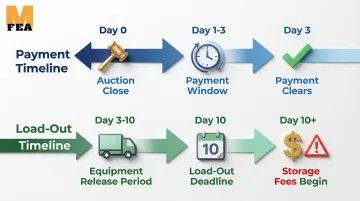
Load-out hours are typically Monday-Saturday, 8:00 AM to 4:00 PM, with some facilities offering limited Sunday hours. Schedule your transport immediately after payment clears—waiting until the last minute risks equipment damage, rushed loading, and potential storage fees.
Payment Methods Accepted at Equipment Auctions
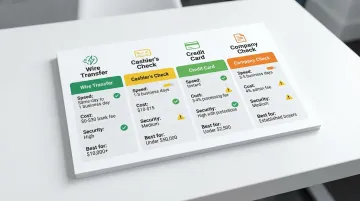
Different payment methods offer varying speeds, security levels, and costs. Choosing the right method can save you hundreds or thousands of dollars in fees.
Wire Transfer: The Industry Standard
Wire transfer remains the preferred method for industrial equipment purchases because it's fast, secure, and can't be reversed once completed.
How to execute a wire transfer:
- Contact your bank immediately after winning—same-day processing requires early submission (typically before 2:00 PM)
- Request the auction house's wire instructions by phone, not email (more on fraud prevention below)
- Provide your bank with the routing number, account number, and beneficiary name exactly as specified
- Request a confirmation number and estimated clearing time
- Forward the wire confirmation to the auction house immediately
Domestic wires typically clear same-day if initiated early, or next business day for later submissions.
International wires using SWIFT GPI clear within 30 minutes approximately 60% of the time, with nearly all completing within 24 hours.
Critical security warning: Business Email Compromise targeting wire transfers resulted in $2.8 billion in losses in 2024.
Always verify wire instructions by phone directly with the auction house. Fraudsters spoof email addresses and send fake wire instructions that look identical to legitimate communications.
Mideast Equipment Auctions accepts wire transfers without additional fees, making this the most cost-effective option for large purchases.
Cashier's Check and Certified Funds
If wire transfers aren't an option, cashier's checks offer a middle ground—though they come with longer clearing times.
Best scenarios for cashier's checks:
- Purchases under $50,000 where immediate clearing isn't critical
- Buyers without easy wire transfer access
- Situations where you want payment proof before funds leave your account
Banks typically place 1-3 business day holds on cashier's checks, even though they're supposedly "guaranteed" funds.
This delay can push you dangerously close to payment deadlines.
Personal checks: Almost universally rejected for auction purchases. The exception is "Good Company Checks" accompanied by a Bank Letter of Guarantee, which some houses accept from established commercial buyers. Mideast Equipment Auctions accepts company checks with proper guarantees but adds a 4% administrative fee to the total invoice.
Credit Cards and Payment Processing Fees
Credit cards offer convenience and buyer protections, but come with strict limitations for equipment auctions.
Major limitations include:
- Transaction caps of $10,000-$50,000 depending on auction house and region
- Processing fees of 2.95%-4% added to your total
- Some houses like Euro Auctions have stopped accepting credit cards entirely for equipment payments
Mideast Equipment Auctions caps credit card transactions at $2,500 and charges a 4% administrative fee. For a $2,500 purchase, that's an extra $100—money better spent on maintenance or transport.
Best use case: Paying deposits or purchasing smaller attachments and tools, not primary equipment.
Company Checks and ACH Transfers
Company checks are accepted by some auction houses for established buyers with credit accounts. Requirements typically include:
- Current Bank Letter of Guarantee
- Established buying history with the auction house
- Pre-approved credit limit
Same-Day ACH processing has expanded, with submission deadlines at 10:30 AM ET and 2:45 PM ET for amounts under $1 million.
ACH remains less common for auction purchases due to the tight payment windows—wire transfers offer more certainty.
Cash Payments
Auction houses increasingly reject cash due to anti-money laundering regulations and security concerns.
Where you'll still find cash acceptance:
- Euro Auctions caps cash at £7,000/€9,500
- Ritchie Bros. doesn't accept cash at certain sale sites
- Small regional auctions may accept cash with proper documentation
For purchases over $10,000, cash transactions trigger federal reporting requirements. The hassle and security risk make cash impractical for serious equipment buyers.
Understanding Deposit Requirements and Full Payment Obligations
The true cost of your auction win extends well beyond the hammer price. Failing to calculate total obligations accurately is one of the most common buyer mistakes.
Deposit Structures and Timing
Deposits serve two purposes: they demonstrate serious intent and protect the auction house if you default.
Most auctions use one of three deposit models:
- Percentage-based: 25% of your expected purchase limit at Ritchie Bros.
- Flat-rate: $10,000/£10,000 to bid up to certain limits
- Risk-assessed: Online platforms may require deposits based on buyer history and purchase amount
Mideast Equipment Auctions requires a valid credit card for bidding approval, which acts as your deposit. The company works with multiple financing partners who can help qualified buyers secure pre-approval before bidding begins.
Calculating Your Total Payment Obligation
Once you understand deposit requirements, you need to calculate your complete financial obligation. Your final bill includes multiple components that can add 15-20% to your winning bid.
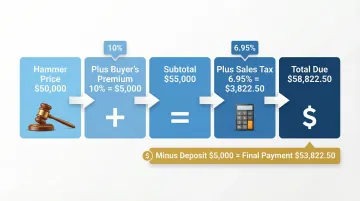
The complete formula: Final Payment = Hammer Price + Buyer's Premium + Sales Tax - Deposit Paid
Here's how this breaks down in practice:
- Hammer price: $50,000
- Buyer's premium (10%): $5,000
- Subtotal: $55,000
- Sales tax (6.95% in Utah): $3,822.50
- Total due: $58,822.50
If you paid a $5,000 deposit, your remaining balance is $53,822.50—not the $45,000 many buyers mistakenly expect.
Buyer's Premium: The Hidden Cost
Buyer's premiums typically range from 10-15% of the hammer price. This fee compensates the auction house for marketing, administration, and platform costs.
Some auctions charge higher percentages on lower amounts through tiered structures. For example, 10% on the first $2,000 and 2% on the remainder.
Mideast Equipment Auctions charges an 8% buyer's premium plus a 2% internet platform fee for online bidding, totaling 10%. This fee structure is transparent and consistent across all platforms including Proxibid, Equipment Facts, and Bidspotter.
Sales Tax Obligations
Auction houses are classified as retailers in most jurisdictions and must collect sales tax unless you provide valid exemption documentation.
Tax collection requirements vary significantly by state:
- Mideast Equipment Auctions collects 6.95% Utah sales tax on items picked up in or delivered to Utah
- Motor vehicle sales tax is not collected—buyers pay this directly to their state DMV
- International buyers may be exempt with proper export documentation
To claim tax exemptions, submit state-specific resale certificates before or immediately after winning:
Upload certificates to your buyer account for review, which typically takes 1-2 business days. Don't wait until after you win—delays in certificate approval mean you'll pay full tax upfront.
Financing Options for Auction Purchases
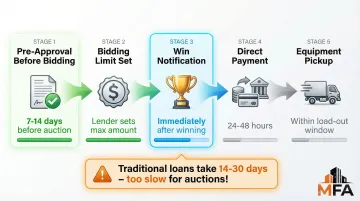
The biggest mistake buyers make is waiting until after they win to think about financing. Auction payment windows don't allow for loan applications—you need pre-approval before you bid.
Why Pre-Approval Is Non-Negotiable
Consider the timeline mismatch:
- Auction payment deadline: 2-7 days
- Traditional equipment loan approval: 7-14 days
- Bank loan approval without existing relationship: 14-30 days
Securing financing after winning is nearly impossible without prior groundwork.
How Equipment Financing Works for Auctions
Specialized equipment lenders offer approvals in as little as 24 hours, with promotional terms including deferred payments. The auction financing process works differently than traditional equipment loans:
- Pre-approval: Apply before bidding with financials and credit history
- Bidding limit: Lender sets your maximum purchase amount
- Winning notification: Notify lender immediately after winning
- Direct payment: Lender wires funds to auction house
- Collateral: Equipment serves as loan security
This streamlined process is designed specifically for auction timelines. Platforms that connect buyers with multiple competing lenders—rather than a single financing source—often deliver better rates. Mideast Equipment Auctions' financing network leverages relationships with multiple providers, allowing lenders to compete for your business based on your specific credit profile and equipment needs.
Required Documentation
Prepare these documents before applying:
Business buyers need:
- Last 2 years of business tax returns
- Current profit & loss statement
- Business bank statements (3-6 months)
- Business credit report authorization
- Equipment details (make, model, year, hours)
Individual buyers should provide:
- Personal tax returns (2 years)
- Personal financial statement
- Credit score authorization
- Down payment verification
Lenders work with various credit profiles, but having documentation ready accelerates approval. A quick application process that connects you with multiple lenders simultaneously improves your approval odds, as different lenders specialize in different credit scenarios and equipment types.
Common Payment Pitfalls and How to Avoid Them
Payment mistakes cost auction buyers thousands annually. The three pitfalls below account for 90% of post-auction disputes—and all are preventable.
Wire Transfer Fraud: A $2.8 Billion Problem
Fraudsters have perfected the art of intercepting auction communications and sending fake wire instructions that look completely legitimate.
How the scam works:
- Fraudster compromises the auction house's email or your email account
- You receive wire instructions that look identical to legitimate communications
- The routing/account numbers direct funds to the fraudster's account
- By the time you discover the fraud, the money is gone and untraceable
Protection protocol:
- Never rely solely on emailed wire instructions
- Call the auction house directly using a phone number from their official website (not from the email)
- Verify every digit of the routing and account numbers verbally
- Watch for subtle email address changes (mideastequip.com vs mideast-equip.com)
- Send a small test wire first for large transactions
While auction houses like Mideast Equipment Auctions maintain secure communication systems, buyer email security remains the most common vulnerability. Enable two-factor authentication and never access auction communications on public Wi-Fi.

Beyond fraud prevention, accurate budgeting prevents another costly mistake: underestimating your total investment.
Underestimating Total Costs
Budget for these often-overlooked expenses:
Beyond the hammer price:
- Buyer's premium: 10-15%
- Sales tax: 5-10% depending on state
- Payment processing fees: 3-4% for credit cards
- Transportation: $2-$15 per mile depending on equipment size
- Load-out assistance: $500-$2,000 if you need crane or forklift service
- Storage fees: $50-$200 per day if you miss the removal window
A $50,000 excavator can easily become a $65,000 total investment once all costs are included. Set your maximum bid at 75-80% of your true budget to account for these additions.
Once you've budgeted correctly, timeline management becomes your final critical consideration.
Missing Payment Deadlines
The most avoidable yet most common mistake: failing to initiate payment immediately.
Timeline traps:
- Wire transfers initiated after 2:00 PM may not process until next business day
- Weekend auctions mean Monday is day 1 of your payment window
- Bank holidays (Memorial Day, Labor Day) don't pause the auction clock
- International wires take 24-48 hours even with SWIFT GPI
Prevention strategy:
- Set phone and calendar reminders immediately after winning
- Have wire instructions pre-verified before you bid
- Know your bank's wire transfer cutoff times
- Build in 24-hour buffer—don't use your full payment window
- Initiate payment the same day you win, even if you have 3-7 days
Frequently Asked Questions
How long does a buyer have to pay after an industrial equipment auction?
Most auction houses require payment within 2-7 business days depending on the platform. Mideast Equipment Auctions requires full payment within 3 days of auction close, with no equipment release until funds clear.
What happens if I can't pay within the required timeframe?
You'll forfeit your deposit and face restrictions or bans from future auctions. Mideast Equipment Auctions considers equipment unpaid beyond 45 days as abandoned and reverts it to the seller.
Can I negotiate payment terms after winning the auction?
No. Auction terms are binding contracts established before bidding begins, with non-negotiable payment deadlines and accepted methods. The time to arrange payment terms is before you bid, not after you win.
Are payment plans available for large equipment purchases?
Traditional payment plans are not available for auction purchases due to tight timelines. However, pre-arranged financing accomplishes the same goal—secure pre-approval from lenders before bidding, and they'll pay the auction house directly while you repay the loan over time.
What payment method is fastest for releasing my equipment?
Wire transfer is the fastest option, typically clearing same-day if initiated before your bank's cutoff time (usually 2:00 PM), or next business day for later submissions. This beats cashier's checks (1-3 day holds) and company checks (3-5 day holds) significantly.
Do international buyers face different payment requirements?
Yes. International buyers must use wire transfers with proper SWIFT codes and provide export documentation including freight forwarder information and bills of lading. Mideast Equipment Auctions works with experienced freight forwarders to guide buyers through the documentation process.
Ready to bid with confidence? Understanding payment terms helps you plan your auction strategy effectively. Mideast Equipment Auctions offers transparent fee structures and multiple financing partnerships to help buyers navigate from winning bid to equipment delivery. Contact their specialists at +1 860-222-3393 or auctions@mideastequip.com to discuss payment options before your next auction.