The used construction equipment market is forecast to reach $174.28 billion by 2031, with auction platforms growing at 7.03% CAGR — making it more important than ever to understand how these transactions actually work before you register or consign.
This guide organizes the essential terminology into five categories: auction formats, bidding mechanics, financial terms, condition and inspection language, and post-sale logistics.
TLDR: Essential Heavy Machinery Auction Terms at a Glance
- Absolute Auction — Equipment sells to the highest bidder with no minimum price; sale is guaranteed
- Reserve Auction — A hidden minimum price must be met; if not, the item passes unsold
- Buyer's Premium — A percentage added to the hammer price, paid by the buyer to the auction house
- As-Is, Where-Is — No warranties; buyer accepts current condition and handles their own removal
- Hammer Price — The final accepted bid when the auctioneer calls "sold"
- Proxy Bidding — An automated system that bids on your behalf up to a pre-set maximum
Types of Heavy Equipment Auctions
Understanding the auction format before you register directly shapes your bidding strategy and price expectations. The rules governing when — and whether — a sale actually closes vary significantly by type.
Absolute (No-Reserve) Auctions
In an absolute auction, equipment sells to the highest bidder regardless of final price. No seller confirmation is required, and the sale is guaranteed to happen. Ritchie Bros. Auctioneers, one of the largest heavy equipment auction platforms in the world, operates on this unreserved model.
The advantage for buyers: you know you're competing for a real sale, not testing a seller's reserve. That certainty tends to drive stronger bidder participation and more competitive momentum.
Reserve Auctions
A reserve auction sets a confidential minimum price the seller will accept. If bids don't reach that threshold, the auctioneer passes the item unsold. Under UCC 2-328, all auctions are legally assumed to be with reserve unless explicitly advertised otherwise, so if a listing doesn't say "absolute" or "no reserve," assume a minimum exists.
IronPlanet uses this format: sellers set a hidden reserve, and they're only obligated to sell once bidding meets or exceeds it.
Online vs. Live (On-Site) Auctions
| Format | Key Characteristics |
|---|---|
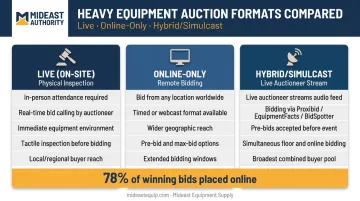
| Live (On-Site) | Physical inspection possible; real-time bid calling; immediate environment reading |
| Online-Only | Remote bidding; wider geographic reach; platform-based with timed or live webcast |
| Hybrid/Simulcast | Live auctioneer streaming alongside online bidding via platforms like Proxibid or EquipmentFacts |
Mideast Equipment Auctions runs a Live Virtual Auction format: a live auctioneer streams audio for each lot while all bidding takes place online through Proxibid, EquipmentFacts, and BidSpotter. Pre-bids can be placed before auction day, and buyers click "Enter Auction" to join the live webcast.
The shift to this model reflects a broader industry trend. During COVID, 78% of winning bids at Ritchie Bros. came through their website or app, confirming that hybrid and online formats are now the default, not the exception.
Specialty Auction Types
Three subcategories appear regularly in heavy equipment:
- Liquidation auctions sell assets quickly due to business closure or debt settlement; EquipmentWatch notes that Forced Liquidation Value reflects the compressed pricing these conditions create
- Bankruptcy auctions are court-ordered sales under 11 U.S.C. § 363, requiring a trustee, notice, and hearing before assets can be sold; bidding procedures and approval timelines distinguish these from standard consignments
- Retirement/fleet reduction auctions occur when an owner exits operations and sells off their fleet in a planned wind-down sale; Mideast Equipment Auctions has handled multiple retirement sales including the Hartland Building and Restoration Retirement Sale and the Deering Construction Retirement Auction
Retirement auctions often feature well-maintained single-owner equipment. Bankruptcy and liquidation auctions may see lower prices, but they also carry more due diligence risk around title and liens.
Bidding Terminology Every Buyer and Seller Must Know
Knowing how bids are structured keeps buyers from being caught off guard mid-auction and helps sellers set realistic floor expectations.
Hammer Price, Opening Bid, and Bid Increments
- Opening Bid — The starting price called by the auctioneer (also called the "initial bid" or "minimum bid" on platforms like Proxibid)
- Hammer Price — The final accepted bid at the moment the auctioneer calls "sold"; under UCC 2-328, the sale is legally complete at this point
- Bid Increment — The minimum amount each new bid must exceed the previous one; increments are set by the auction company and vary by price range
Bidding in irregular amounts — say, $26,500 rather than $26,000 — is a common tactic at threshold prices where competitors cluster at round numbers. Experienced buyers use it specifically to break ties at those congestion points.
Proxy Bidding and Absentee Bidding
Proxy bidding is the online equivalent of having someone bid for you. You enter your maximum bid in advance, and the platform automatically increments on your behalf — placing the smallest competitive bid needed to keep you in the lead, up to your ceiling. Proxibid, IronPlanet, and EquipmentFacts all operate this way.
Absentee bidding is the older, offline version: you leave a sealed maximum bid with the auction house before the event, and a representative bids on your behalf.
Both methods carry strategic risks worth knowing before you commit:
- Setting your maximum too low means losing the lot the moment a competitor exceeds your ceiling
- Revealing your ceiling too early in a live auction gives experienced bidders a target to push you against
- Proxy bids on competitive lots are often matched to the increment — your $50,000 ceiling may end at $50,100 if someone else bid $50,000
Shill Bidding and Reserve Confirmation
Shill bidding occurs when a seller or their agent places bids to artificially drive up the price. Under UCC 2-328, if an auctioneer knowingly accepts a seller's bid without prior notice that seller bidding was permitted, the buyer may void the sale or purchase at the last legitimate bid. The FTC classifies this as auction fraud.
"Subject to owner's confirmation" is language sometimes used in reserve auctions, indicating the seller must approve the winning bid before the sale is finalized. This is distinct from a standard reserve — it introduces additional seller discretion after the hammer falls.
Lot Numbers and Order of Sale
Each item in a heavy equipment auction is assigned a lot number in the catalog. The order of sale matters more than most buyers realize:
- Early lots may attract more attention before bidder fatigue sets in
- Later lots may benefit from competitors having exhausted their budgets
- Both fatigue and budget depletion compound as the auction runs longer
Identify your target lots and set firm maximum prices before the auction begins — adjusting strategy mid-event rarely ends well.
Financial Terms: Fees, Premiums, and Payment Structures
Auction costs go beyond the hammer price. Knowing every fee in advance is the only way to avoid budget surprises after the sale closes.
Buyer's Premium
The buyer's premium is a percentage of the hammer price charged on top of the final bid — paid by the buyer directly to the auction house. It's not negotiable after the hammer falls.
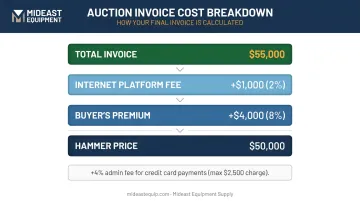
Mideast Equipment Auctions charges 8% buyers premium + 2% internet platform fee, totaling 10% added to the hammer price.
Quick example: if the hammer price is $50,000 and the buyer's premium is 10%, your total cost is $55,000 before taxes, payment fees, or removal costs.
Additional fee to note: credit card payments and "good company checks" incur an extra 4% administrative fee on the invoice total, with a maximum $2,500 credit card charge.
Seller's Commission
The seller's commission is the fee charged to the consignor as a percentage of the final sale price, agreed upon before the auction. As the National Auctioneers Association confirms, auctioneers are paid through seller commissions, fees, or both — negotiated in advance.
Both buyer's premium and seller's commission can apply in the same transaction. Each party should confirm their fee structure in writing before auction day.
Reserve Price and Upset Price
- Reserve price — The confidential minimum the seller will accept; if bidding doesn't reach it, the item is "passed" or "bought in"
- Upset price — Sometimes used interchangeably with reserve, though in bankruptcy proceedings it refers specifically to a late topping bid that reopens the sale after a court-approved auction
For standard UCC auctions, "reserve" is the operative term. "Upset price" is more commonly encountered in court-ordered bankruptcy sales.
Payment Terms and Accepted Methods
Mideast Equipment Auctions requires payment within 3 days of auction close. Accepted methods:
- Wire transfer
- Credit card (Visa, MasterCard, Discover, American Express)
- "Good Company Check" with a current Bank Letter of Guarantee
No equipment is released until payment clears in full. Items picked up in Utah are subject to UT State and Local Sales Tax of 6.95%. Sales tax rules vary by jurisdiction — confirm applicability before bidding on high-value items.
Financing is available for qualified buyers through Mideast Equipment Auctions' multi-lender platform. The minimum financed amount is $1,500, with a 60-second application process.
Condition and Inspection Terminology
Heavy machinery is almost universally sold "as-is, where-is." Understanding condition-related terms is the difference between a smart purchase and an expensive mistake.
As-Is, Where-Is
This phrase means the seller and auctioneer make no warranties about fitness, function, or condition. The buyer accepts the item exactly as it sits and is responsible for verifying condition before bidding and arranging removal after purchase.
Under UCC 2-316, "as is" and "with all faults" language legally disclaims implied warranties when it draws the buyer's attention to the exclusion. Once the hammer falls, there's no recourse for undiscovered mechanical problems unless fraud is proven.
Pre-auction inspection is the buyer's primary protection, and often the only one available.
Preview Period and Inspection Rights
Preview period is the designated window before the auction when registered bidders can physically examine equipment. Mideast Equipment Auctions' standard preview window is Thursday and Friday before the auction, 9am to 4pm. Inspection by appointment is also available — recommended for high-value purchases.
What to check during inspection:
- Engine hours on the meter
- Undercarriage wear (on tracked equipment)
- Hydraulic leaks or damaged cylinders
- Engine startup and idle behavior
- Maintenance records and service history

For online bidders, Mideast Equipment Auctions provides video walkarounds with audio of the engine running, photos covering all four sides and corners, and operating footage showing the machine performing its intended function. If you need more detail on a specific item, contact their team before the auction closes.
Condition Reports and Equipment Hours
A condition report is a formal document summarizing known defects, service history, and equipment condition, prepared either by the auction house or a third-party inspector. These reports reduce risk but don't eliminate it. Third-party reports typically exclude latent defects, load testing, and electrical systems.
Equipment hours are the engine hours recorded on the meter, functioning like mileage on a vehicle. Two benchmarks worth knowing:
- EquipmentWatch adjusts off-highway equipment valuations in 100-hour intervals
- Ritchie/Rouse 2024 data showed median dozer auction usage around 5,000–6,000 hours
High hours don't mean low value if maintenance records are strong and the machine runs well.
Logistics and Post-Auction Terminology
Winning the bid is step one. What follows — title transfer, removal deadlines, and export coordination — determines whether that win actually pays off.
Title, Lien, and Clear Title
- Title — The legal document proving ownership; the seller transfers this to the buyer at sale
- Lien — A legal claim against the equipment by a creditor (typically a lender who financed the original purchase)
- Clear title — Title free of encumbrances; under UCC 2-312, sellers provide an implied warranty that title is good and goods are free of unknown liens
In liquidation and bankruptcy auctions, lien searches are especially important — creditor claims can complicate or delay transfer. UCC financing statements are public records searchable through state offices. Ritchie Bros. states buyers receive a full refund if clear title cannot be conveyed.
Removal Period and Storage Fees
Mideast Equipment Auctions grants a 7-day removal period after the sale date. Loading is available Monday–Saturday, 8am–4pm, with limited Sunday hours at select locations.
Exceed the 7-day window and storage fees apply. Equipment left on site for more than 45 days is considered abandoned and reverts to the seller.
For international buyers, Mideast Equipment Supply coordinates with freight forwarding partners including Uni International and Hansen Shipping for export logistics — covering container loading, export documentation, and customs coordination for buyers across Australia, the Middle East, Far East, and Central America.
Consignment Agreement and Settlement
- Consignment agreement — The contract between seller and auction house covering commission rates, reserve prices, marketing commitments, and timelines; the seller retains ownership until sale and the auctioneer acts as agent
- Settlement — The post-auction process where the auction house distributes sale proceeds to sellers after deducting fees and confirming buyer payment
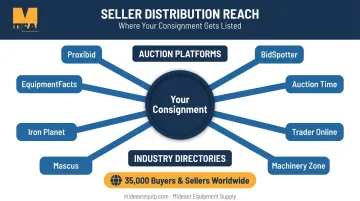
For sellers, broader exposure at settlement means more competitive final bids. Mideast Equipment Auctions reaches consignors' equipment to a weekly list of 35,000 buyers and sellers worldwide through:
- Auction platforms: Proxibid, EquipmentFacts, BidSpotter, and Auction Time
- Industry directories: Iron Planet, Mascus, Trader Online, and Machinery Zone
- Automated CRM feeds pushing listings directly to multiple marketing agencies
Frequently Asked Questions
What are some common auction terms?
The most essential terms are: absolute auction, reserve auction, buyer's premium, hammer price, lot, as-is/where-is, proxy bidding, and consignment. Each section of this guide covers these in full — use the headers to jump directly to any term.
What are the 4 types of auction?
The four primary formats in heavy equipment auctions are absolute (no-reserve), reserve, online, and live (on-site). Liquidation and bankruptcy auctions are subcategories that typically fall within reserve or court-ordered formats, each with distinct procedures and pricing dynamics.
What does "as-is, where-is" mean at a heavy equipment auction?
It means the equipment is sold in its existing condition with no seller warranties of any kind. The buyer is responsible for verifying condition during the preview period and for arranging removal from the auction site after purchase.
What is a buyer's premium and how much is it?
The buyer's premium is a percentage fee added to the hammer price, paid by the buyer to the auction house. Mideast Equipment Auctions charges 8% + 2% internet platform fee (10% total). Always factor this into your maximum bid before the auction starts.
Can I inspect equipment before bidding?
Yes. Most auctions include a preview period for physical inspection. At Mideast Equipment Auctions, previews are typically Thursday and Friday before the auction, 9am–4pm, with appointments available. Online auctions provide photos, video walkarounds, and condition documentation for remote buyers.
How does proxy bidding work in online heavy equipment auctions?
You enter your maximum bid in advance, and the platform automatically increments on your behalf, placing only the lowest competitive bid needed to keep you in the lead. You pay no more than competition requires, up to your ceiling.