Introduction
Industrial equipment auctions give buyers access to excavators, dozers, semi trucks, compressors, generators, and processing machinery at prices well below dealer retail — but only when approached with real preparation. Miss a cracked frame rail or skip a title check, and that "deal" turns into a six-figure repair bill before the machine ever turns a profit.
That risk is baked into how auctions work legally. Under UCC Section 2-316, language like "as is" or "with all faults" excludes implied warranties entirely — meaning you carry full responsibility for assessing condition, verifying specs, and calculating costs before you bid.
This guide walks through each stage of that process — from understanding auction formats and inspecting equipment to calculating true acquisition cost and avoiding the missteps that consistently catch underprepared buyers.
Key Takeaways
- Auction sales are final and "as-is" — inspection and research are non-negotiable
- Know the full cost stack before bidding: hammer price + buyer's premium + transport + repairs
- Preview the equipment in person or hire a local inspector for high-value lots
- Set a hard maximum bid before the auction opens and treat it as non-negotiable
- Plan removal logistics before you win — missing pickup deadlines triggers fees or forfeiture
Why Industrial Equipment Ends Up at Auction
Understanding where auction inventory comes from helps buyers evaluate risk and opportunity more accurately. Equipment at auction isn't inferior by default. It arrives through several well-defined channels.
The Main Supply Sources
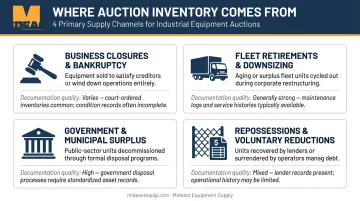
- Business closures and bankruptcy liquidations: Court-ordered sales prioritize debt recovery speed over maximum return — which can mean real value for prepared buyers. IndustrialBid has listed production equipment directly "By Order of the US Bankruptcy Court."
- Fleet retirements and contractor downsizing: Companies like Seneca Excavating have sold entire fleets through retirement dispersals. Mideast Equipment Auctions has run similar events, including a Deering Construction Retirement Auction and an H-K End of Year Surplus sale.
- Government and municipal surplus: The GSA sells federal property — including heavy machinery and vehicles — through GSA Auctions. RB Global's GovPlanet handles military and government equipment under DLA contracts.
- Repossessions and voluntary downsizing: Equipment from financing defaults or strategic fleet reductions by contractors and agricultural operations.
What This Means for Buyers
Each source carries different documentation. Here's what to expect:
- Government surplus: Title documentation typically included (GSA Form 27A, SF 97-1 for vehicles)
- Bankruptcy liquidations: Court records available, but service history is often sparse
- Contractor retirements: Usually the richest documentation — prior owners serviced the equipment themselves
The American Society of Appraisers distinguishes between "forced liquidation value" and "orderly liquidation value." Knowing which type you're looking at tells you whether a low price reflects genuine market value or simply distressed circumstances.
Types of Industrial Equipment Auctions: Know What You're Entering
The Three Core Formats
| Format | How It Works | Best For |
|---|---|---|
| Live/Virtual Auction | Real-time auctioneer, competitive bidding, fast-paced | Quick decisions, high-energy lots |
| Online Timed Auction | Lots open for days with a set closing deadline | Multi-department approvals, remote buyers |
| Sealed Bid | Single confidential offer submitted by deadline | Strategic pricing, competitive discretion |
Most major platforms now blend formats. Mideast Equipment Auctions runs live virtual auctions — bidders can leave pre-bids in advance, then join a live webcast on auction day where a real auctioneer calls each lot. There's no on-site bidding; everything happens through the platform. They also run timed auctions through their own platform for lots suited to that format.
Matching Format to Your Procurement Process
- Online timed auctions are the right call when a purchase needs sign-off from finance, operations, or management — a multi-day window lets you run numbers and gather approvals without missing the lot
- Live auctions move fast; they work best when you've already inspected the equipment, know your ceiling, and can commit without a committee
- Sealed bids give an edge to buyers with solid market knowledge — you submit your number once, privately, so competitors can't respond to your position
To reach buyers across both formats, Mideast Equipment Auctions lists on Proxibid, Equipmentfacts, and BidSpotter. Subscribers to their weekly email list — over 35,000 active buyers and sellers — get early access to upcoming auction catalogs, giving you a head start on building your watchlist before lots go public.
How to Prepare Before Placing a Bid
Research Fair Market Value First
Don't walk into any auction without a defensible number. Use multiple reference points:
- RitchieSpecs — A database of 15,900+ equipment specifications for current and historical models
- IronPlanet appraisals — Proprietary database of used equipment sales data
- Recent comparable auction results — What did similar machines actually sell for in the last 90 days?
- Dealer retail prices — Your ceiling relative to the market
The goal is to establish your maximum bid before you log in or show up.
Study the Catalog and Terms
Auction catalogs are published online before the sale date. Review make, model, year, condition notes, known defects, and any appraisal reports. Flag lots with missing information as higher risk.
Key terms to confirm before bidding:
- Buyer's premium percentage (Mideast Equipment Auctions charges 8%, plus a 2% internet platform fee for online bidding)
- Accepted payment methods and any surcharges (credit card and company check payments at Mideast carry an additional 4% administrative fee, with a $2,500 credit card maximum)
- Payment deadline (Mideast requires full payment within 3 days of auction close)
- Removal window (Mideast enforces a 7-day pickup window; Mideast considers equipment abandoned after 45 days)
Once you've confirmed the terms, logistics are the next variable to lock down before you bid.
Plan Logistics Before Winning
Heavy equipment requires flatbeds, riggers, cranes, or specialized carriers — get freight quotes before bidding, not after. Key logistics to arrange in advance:
- International shipping — Mideast works with Uni International and Hanson Shipping; use code "MIDEAST" for dealer pricing
- Export documentation — CBP requires export paperwork for used self-propelled vehicles at least 72 hours before export
- Domestic transport — Confirm flatbed or specialized carrier availability and costs for your location
With logistics covered, the final step is confirming you're bidding through a trustworthy platform.
Verify the Auction House
Check for:
- State auctioneer licensing (requirements vary by state — Massachusetts requires a $10,000 surety bond; Pennsylvania has its own board)
- Platform affiliations (Proxibid, IronPlanet, BidSpotter are established indicators)
- Clear physical address and contact information
- Transparent payment and dispute terms
Red flags: untraceable payment requirements, no preview access, no verifiable history of completed auctions.
Inspecting Equipment at an Industrial Auction
What to Look for on Visual Inspection
Walk the machine systematically:
- Structural condition — Check frame, boom, stick, and blade welds for cracks. Rust lines can reveal where bare metal is exposed beneath surface corrosion
- Fluid leaks — Look beneath the machine for oil, hydraulic fluid, or coolant pooling
- Hoses, belts, chains, electrical wiring, and track or tire condition all indicate how hard the machine has been run
- Hour meter vs. wear correlation — Equipment World notes that scratches and wear patterns sometimes suggest harder use than hour meters indicate
Operational Checks
If the auction house permits power-on testing — and Mideast Equipment Auctions generally does during preview days — use it:
- Start the machine and listen for knocking, grinding, or squealing
- Operate all controls: levers, switches, hydraulic cylinders
- Raise and lower attachments to test hydraulic response
- Verify all gauges and displays function correctly
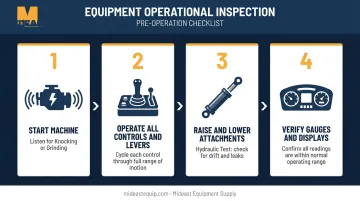
Mideast's own inspection process requires sellers to have operators demonstrate machines through their full range of motion. That's worth keeping in mind as a benchmark: a thorough preview should cover the same ground.
When You Can't Inspect in Person
Not every buyer can get to the auction site before bidding. For remote situations, your main options are:
- Review the high-resolution photo set and any video walkthroughs in the catalog
- Request additional photos of specific components directly from the auction coordinator
- Hire a local third-party inspector or equipment broker near the auction site
Ritchie Bros. performs 100,000+ equipment inspections annually, and IronPlanet's IronClad reports cover visible condition and functional tests. Both are useful for remote screening, though neither substitutes for in-person inspection on high-value lots. Each service explicitly excludes latent defects that require dismantling to find.
Red Flags That Warrant Walking Away
- Fresh paint on structural components, particularly over welds or repaired areas
- Hour meter readings inconsistent with actual wear levels
- Missing or altered serial number plates
- Incomplete or sluggish hydraulic response during testing
- Seller or auctioneer unwilling to answer specific mechanical questions
Calculating Total Cost and Setting Your Bidding Strategy
The Full Cost Stack
The hammer price is just the starting point. Before you bid, calculate:
Winning bid
- Buyer's premium (Mideast: 8% + 2% internet fee = 10% for online bidding)
- Payment surcharges (4% for credit card/company check at Mideast)
- Applicable taxes
- Transportation and rigging fees
- Estimated repair or refurbishment costs = True acquisition cost
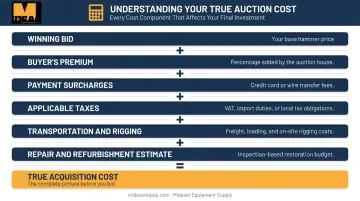
Only compare this final number against fair market value to determine whether the deal holds up.
Set Your Ceiling Before the Auction Opens
Research from Harvard's Program on Negotiation describes the "winner's curse" : the tendency of winning bidders to overpay for uncertain-value assets in competitive environments.
Live auctions amplify this through competitive arousal. The faster the pace and the more active the bidding, the easier it is to exceed your rational ceiling.
Write down your maximum before the auction opens and treat it as non-negotiable. Walking away from a lot that exceeds your number is always the right call.
Proxy Bidding and Anti-Sniping Rules
For online timed auctions, proxy bidding tools let the platform bid incrementally on your behalf up to your maximum without revealing that number to competitors. Mideast recommends setting your proxy bid at least 24 hours before auction close.
Anti-sniping (auto-extend) rules vary by platform — BidSpotter's default extension is 10 minutes when a bid is placed near closing, not 5 minutes. Proxibid has similar functionality. Check each auction's specific rules before the close approaches.
Financing for High-Value Lots
Financing is available for auction equipment purchases, which lets buyers preserve working capital. Mideast Equipment Auctions works with Universal Finance Company and the APPROVE platform, which connects buyers with competing lender offers through a 60-second application process (minimum financed amount: $1,500). Getting pre-approved before auction day means you can bid confidently when the right lot comes up.
Common Mistakes Buyers Make at Equipment Auctions
Skipping the Preview
Catalog descriptions and photos are starting points — not guarantees. Buyers who skip inspection frequently discover compatibility issues, missing attachments, or undisclosed damage only after paying. GSA terms explicitly note that buyers who don't inspect waive inspection rights and bear risk for gross omissions.
Mideast's own terms state that bidders bidding off-site "understand and acknowledge that they may not be able to inspect an item as well as if they examined it in person." That acknowledgment matters — it shifts all discovery risk to you.
Underestimating Removal Costs and Deadlines
Many buyers win equipment then face penalty fees because they didn't arrange transport in time. Removal deadlines are strict across most auction platforms. Mideast enforces a 7-day removal window, with storage fees kicking in after that and forfeiture after 45 days. IronPlanet begins charging storage from day 9 and may relocate equipment after 15 calendar days.
Heavy equipment often requires crane removal, permits, or environmental compliance steps — none of which can be arranged quickly. Secure your transport and logistics plan before bidding, not after you've won.
Ignoring Voltage, Sizing, and Compatibility Specs
For generators, compressors, and processing equipment, the wrong electrical configuration renders a machine useless. Before bidding on any power generation or processing equipment, confirm:
- Voltage (single-phase vs. three-phase)
- Frequency (60 Hz for North America, 50 Hz for most international markets)
- Phase configuration compatibility with your facility
- Load rating relative to your application
- Any proprietary software or missing components
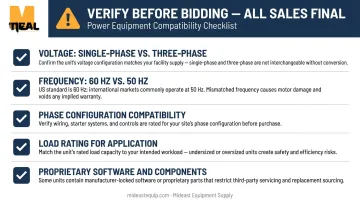
A machine with the wrong voltage or missing proprietary controls can be impossible to retrofit. Since all sales are final, verifying specs before you bid is the only protection you have.
Frequently Asked Questions
What types of machinery are auctioned?
Industrial auctions cover excavators, bulldozers, cranes, forklifts, compressors, generators, CNC machines, semi trucks, trailers, and agricultural machinery. Mideast Equipment Auctions focuses on heavy construction equipment and trucks — Caterpillar/Komatsu excavators, crawler dozers, and Kenworth/Peterbilt semis sourced from contractor retirements, fleet upgrades, and business closures.
How do I check if an auction is legitimate?
Verify state auctioneer licensing, platform listings on Proxibid, IronPlanet, or BidSpotter, a physical address, verifiable contact information, and a history of completed auctions. Any house requesting payment via untraceable wire transfer or refusing preview access is a red flag.
What are the different types of auctions?
Live/virtual auctions feature a real-time auctioneer with competitive bidding. Online timed auctions run for days with a set closing deadline. Sealed bid auctions accept one confidential offer per buyer. Many modern platforms combine formats — Mideast runs live virtual events on Proxibid, Equipmentfacts, and BidSpotter alongside separate timed auction formats.
What is the auto-extend rule in online timed auctions?
Auto-extend (sometimes called anti-sniping) automatically extends the bidding deadline when a new bid is placed near closing, which prevents last-second sniping. The window is platform-specific: BidSpotter defaults to 10 minutes, not 5. Always confirm terms before the close approaches.
Can international buyers participate in industrial equipment auctions?
Yes. International buyers should factor in export documentation, CBP submission (at least 72 hours before export), customs clearance, container shipping, and import duties. Mideast Equipment Auctions regularly facilitates international purchases across Australia, the Middle East, Far East, and Central America through freight partners Uni International and Hanson Shipping.
What is a buyer's premium and how does it affect my total cost?
A buyer's premium is a fee added on top of the hammer price. Mideast Equipment Auctions charges 8%, plus a 2% internet platform fee for online purchases (10% total). Factor this into your maximum bid before the auction opens to avoid exceeding your real budget.