 You Can't Ignore](https://file-host.link/website/mideastequip-m6tvc9/assets/blog-images/8431cc5c-3cb6-4c32-a761-fdbfaf5ef056/1771589176091883_74745b55f78e4210973aba13f07ce419/360.webp)
Introduction
Industrial equipment auctions have become a strategic buying option for construction companies, contractors, and dealers under constant pressure to maximize capital efficiency while accessing quality machinery.
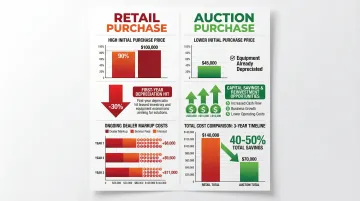
With construction equipment losing 20-30% of its value in the first year alone, the traditional retail model increasingly forces buyers to absorb depreciation costs that auctions help them avoid entirely.
Auctions offer more than just liquidation. They deliver measurable cost savings, unprecedented equipment access, and operational flexibility that directly impact profitability.
This article breaks down the five practical benefits of industrial equipment auctions that matter most to both buyers seeking value and sellers maximizing asset returns.
Key Takeaways
- Auctions deliver 30-70% cost savings by avoiding retail markups and first-year depreciation
- Access diverse inventory including rare, obsolete, and specialized machinery unavailable through dealers
- Complete transactions in 2-4 weeks versus months of negotiation
- Transparent competitive bidding establishes true market value for all parties
- Professional auctioneers handle logistics, paperwork, and payment security from bid to delivery
What Are Industrial Equipment Auctions
Industrial equipment auctions are competitive bidding events—conducted online, via webcast, or on-site—where construction, manufacturing, and transportation machinery sell to the highest bidder. Auctions create time-limited marketplaces where multiple buyers compete simultaneously, eliminating the extended negotiations typical of dealer sales.
These auctions serve specific business scenarios:
- Company liquidations requiring rapid asset conversion
- Surplus equipment sales following fleet upgrades
- Strategic asset monetization for construction and industrial operators
Major platforms like Ritchie Bros. and IronPlanet aggregate inventory from hundreds of sellers, creating centralized marketplaces that attract thousands of bidders to single events.
Key Benefits of Industrial Equipment Auctions
Traditional equipment dealers often lock buyers into high markups and limited inventory. Construction companies struggle with inflexible pricing, while contractors face lengthy procurement timelines that delay projects.
Industrial equipment auctions solve these problems directly. They create competitive bidding environments that drive down costs, open access to diverse equipment inventories, and accelerate transaction timelines from weeks to days.
The five benefits below show how auctions address the most expensive pain points in heavy equipment procurement:
- Cost savings through competitive bidding vs. fixed dealer pricing
- Equipment variety from multiple sellers in one location
- Transaction speed that shortens acquisition cycles
- Transparent pricing that eliminates negotiation uncertainty
- Risk reduction through inspection periods and verified listings
Whether you're acquiring excavators for a highway project or liquidating a fleet of aging dump trucks, understanding these advantages helps you make smarter procurement and disposal decisions.
Benefit 1: Significant Cost Savings
Industrial equipment at auction typically sells for 30-70% below retail prices, allowing buyers to acquire quality machinery at a fraction of new equipment costs. This dramatic price difference comes from the auction format itself, which eliminates retail markups, dealer margins, and new equipment premiums while sellers accept market-driven pricing to move assets quickly.
Why This Benefit Matters
The most compelling financial advantage is avoiding the biggest depreciation hit. According to EquipmentWatch data, construction equipment loses 20-30% of its value within the first 12 months of ownership.
Buyers purchasing 1-2 year old machines at auction effectively save this entire depreciation margin while retaining most of the asset's useful life.
Cost savings free up capital for other operational priorities:
- Additional equipment purchases to expand fleet capacity
- Workforce investment in skilled operators or project managers
- Project expansion into new markets or service lines
- Working capital reserves for seasonal fluctuations
This pricing advantage becomes even more pronounced during market shifts. When retail prices disconnect from actual demand, auctions serve as a market correction mechanism—historical data shows that when retail prices exceeded auction values by more than 120%, buyers shifted decisively to auctions.
KPIs Impacted
- Capital expenditure per equipment unit
- ROI on equipment investment
- Cash flow availability for operations
- Effective depreciation rates
- Total cost of ownership
When This Benefit Matters Most
- Startups and small businesses operating with limited capital budgets
- Companies expanding fleets without major capital outlays
- Contractors on tight margins needing equipment for specific projects
- Businesses replacing aging equipment without absorbing new equipment premiums
Benefit 2: Access to Wide Equipment Selection
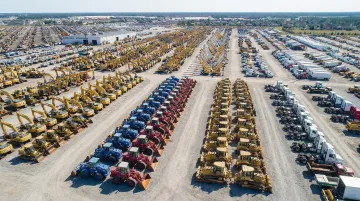
Auctions bring together equipment from multiple sellers, creating diverse inventory that includes current models, older reliable units, specialized machinery, and hard-to-find equipment.
This concentration of supply gives buyers comparison options that would require visiting dozens of individual dealers to match.
Why This Benefit Matters
A single major auction event can feature extraordinary inventory depth. Take Ritchie Bros.' Orlando 2023 auction, which attracted 22,000+ bidders competing for 13,000+ items, including:
- 500+ excavators across multiple brands and sizes
- 430+ truck tractors for transportation fleets
- 230+ wheel loaders for material handling
- 200+ dozers for earthmoving applications
This variety allows buyers to:
- Compare equipment side-by-side across brands, capacities, and conditions
- Find exact specifications matching project requirements without compromise
- Source backup units or replacement parts from older discontinued models
- Access international inventory beyond local or regional availability
Beyond standard construction equipment, auctions also feature niche industrial assets like 50-ton shop presses and 125-ton solid tire press machines that typical construction equipment dealers don't stock. Inventory spans all major manufacturers—Caterpillar, John Deere, Komatsu, Volvo, and Bobcat—allowing fleet standardization or brand-specific preferences without visiting multiple dealerships.
KPIs Impacted
- Equipment availability for active projects
- Procurement timeline from need identification to acquisition
- Project readiness and start date certainty
- Equipment utilization rates across fleet
- Downtime caused by equipment unavailability
When This Benefit Matters Most
- Companies seeking older models to maintain fleet consistency and simplify maintenance
- Businesses needing specialized equipment for niche applications or unique project requirements
- International buyers seeking equipment configurations unavailable in local markets
- Contractors sourcing backup units to minimize downtime risk on critical projects
Benefit 3: Speed and Efficiency
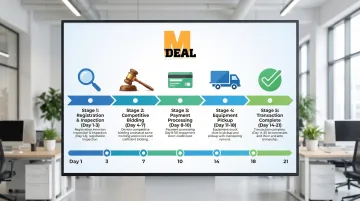
Auction transactions typically complete within 2-4 weeks from listing to equipment transfer, compared to months of negotiation in traditional private sales. This compressed timeline stems from the defined auction structure: registration → bidding → closing → payment → pickup, which creates urgency and eliminates prolonged back-and-forth negotiations.
Why This Benefit Matters
The standardized process enforces strict deadlines that benefit both parties.
Buyers must submit full payment within 3 business days of auction closing, with wire transfers or credit cards (up to $50,000 limits) processing immediately. Equipment must be removed within 8 business days of payment, with buyers coordinating transport during defined pickup windows. Storage fees apply for delayed removal, incentivizing prompt action.
This speed creates tangible advantages across your operation:
- Buyers needing equipment urgently deploy assets on active projects within weeks
- Sellers converting idle assets free up capital tied in depreciating machinery
- Holding costs drop as you eliminate storage fees, insurance expenses, and maintenance
- Capital turnover accelerates, allowing reinvestment in new inventory or business operations
These operational improvements translate to measurable metrics: shorter equipment acquisition timelines, fewer project delays, reduced storage costs, faster capital turnover rates, and higher equipment utilization percentages.
The speed advantage matters most when you're facing urgent project needs requiring immediate equipment deployment, managing business liquidations that need fast asset conversion, dealing with warehouse space constraints requiring rapid inventory clearance, or operating as a seasonal contractor needing equipment for specific project windows.
Benefit 4: Competitive Pricing Through Bidding
The competitive bidding environment creates transparent, market-driven pricing where multiple buyers push values to true fair market levels.
This open competition eliminates price uncertainty for sellers while giving buyers confidence they're paying competitive rates.
Why This Benefit Matters
Competitive bidding can drive specialized asset prices 10-20% higher than private sale expectations, as multiple motivated buyers compete simultaneously.
For Buyers:
- Visible competition confirms pricing reflects genuine market demand
- Public auction results provide benchmark data for future purchases
- Detailed inspection reports reduce uncertainty about equipment condition
- The price you see is the price you pay—no hidden negotiations
For Sellers:
- Multiple bidders compete to establish true market value
- Avoid lowball offers from dealers seeking wholesale margins
- List equipment when demand peaks for best returns
- Transparent pricing demonstrates fair value to stakeholders
Industry data backs this up. The Sandhills Equipment Value Index tracks the spread between asking prices and auction values. The EVI spread for used combines reached 36% in early 2025, showing the significant markup buyers avoid through auction channels.
KPIs Impacted
- Price competitiveness versus market benchmarks
- Market value realization for asset sales
- Buyer confidence levels in purchase decisions
- Seller return on assets
- Pricing transparency metrics
When This Benefit Matters Most
- High-value equipment sales where market pricing is uncertain or volatile
- Sellers wanting maximum returns during favorable market conditions
- Buyers seeking pricing assurance to justify capital expenditure approvals
- Fleet liquidations requiring transparent valuation for financial reporting
Benefit 5: Professional Mediation and Risk Mitigation
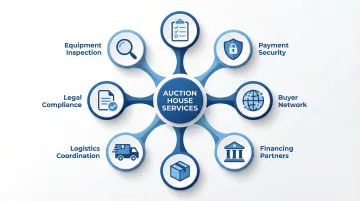
Professional auctioneers handle all transaction aspects: equipment inspection, documentation, marketing, bidder vetting, payment processing, and logistics coordination.
This full-service approach reduces risks that typically affect private equipment sales, including payment defaults, misrepresentation disputes, and documentation errors.
Why This Benefit Matters
Experienced auction houses provide structured frameworks that protect both parties:
Risk Mitigation Features:
| Feature | Protection Mechanism | Benefit |
|---|---|---|
| Condition Verification | IronClad Assurance inspection reports | Buyers can dispute if equipment differs materially from description |
| Payment Security | Escrow-style client accounts | Funds held until transaction conditions are met |
| Binding Bids | Non-retractable bid commitments | Eliminates "tire kickers" disrupting sales |
| Default Penalties | Buyer default fees and exclusions | Ensures high transaction success rates |
Beyond risk protection, auction houses add value through:
- Industry networks connecting sellers with qualified buyers globally
- Financing partnerships offering pre-approved equipment loans
- Logistics coordination with freight forwarders for domestic and international shipping
- Legal compliance expertise for proper documentation in cross-border transactions
These capabilities translate into real-world advantages. Mideast Equipment Auctions maintains a weekly email list reaching 35,000 qualified buyers, connecting sellers with active markets globally. The company's experience in international transactions—from export documentation to freight forwarding—handles complex sales that would overwhelm sellers managing private transactions independently.
KPIs Impacted
- Transaction success rates (completed sales vs. listings)
- Payment default rates
- Legal dispute frequency and resolution time
- Administrative time investment for sales management
- Logistics coordination efficiency
When This Benefit Matters Most
- Complex multi-equipment sales or complete facility liquidations
- International transactions requiring export documentation and freight coordination
- Sellers lacking internal resources for equipment marketing and sales management
- High-value transactions where professional mediation reduces risk exposure
What Happens When Auctions Are Not Utilized
Contractors and equipment dealers who bypass auctions face measurable financial and operational penalties. The costs extend far beyond the sticker price.
Financial penalties hit first:
- Paying full retail prices means absorbing the 20-30% first-year depreciation that auction buyers avoid
- Accepting lowball dealer trade-in offers that don't reflect true market value
- Missing market timing opportunities when auction demand would drive prices higher
Operational limitations create project delays:
- Limited equipment access forces compromises on specifications or project delays
- Settling for suboptimal equipment choices when specific models aren't locally available
- Prolonged private sale negotiations lock capital in idle, depreciating assets
Hidden costs accumulate quickly:
- Extended storage fees and insurance for unsold equipment
- Maintenance expenses for idle machinery awaiting buyers
- Opportunity costs of capital that could be deployed in active projects or new inventory
These compounding costs explain why experienced dealers and contractors view auctions as strategic acquisition and liquidation channels. The format's transparency and competitive pricing directly eliminate these penalties, converting potential losses into measurable gains.
How to Get the Most Value from Industrial Equipment Auctions
Maximizing auction benefits requires preparation and strategic approach for both buyers and sellers:
Research Reputable Auction Houses
Look for auctioneers who offer:
- Strong industry reputation and proven track records in your equipment category
- Extensive buyer networks ensuring competitive bidding
- Transparent terms and conditions with clear dispute resolution processes
- Multi-channel marketing reach (online platforms, email lists, industry networks)
For Buyers
Pre-Auction Preparation:
- Inspect equipment through in-person visits or detailed condition reports
- Review auction terms including buyer's premium, payment deadlines, and removal requirements
- Get financing pre-approved to establish bidding power
- Research comparable sales to set maximum bid limits
During Bidding:
- Set maximum bids based on equipment value plus transport costs
- Factor in any refurbishment or repair needs you found during inspection
- Avoid emotional bidding that exceeds predetermined budgets
Post-Auction:
- Process payment within required timeframes (typically 3 business days)
- Coordinate logistics for equipment removal within deadline windows
- Document equipment condition upon pickup for records
For Sellers
Preparation:
- Work with auctioneers offering comprehensive services including equipment appraisal and strategic timing recommendations
- Provide detailed photos, accurate descriptions, and maintenance records to minimize post-sale disputes
- Consider minor refurbishments (cleaning, window repair) that can increase final sale prices
Marketing:
- Leverage auctioneers' multi-channel marketing including email campaigns, online platforms, and industry networks
- Time auctions to coincide with peak demand periods for your equipment category
- Ensure listings include complete specifications and transparent condition disclosures
Logistics:
- Clarify equipment location and access requirements for buyer pickup
- Coordinate with auction house on post-sale logistics support
- Maintain clear communication with winning bidders through the auction house
Mideast Equipment Auctions provides comprehensive support throughout this process, with a 35,000-strong email list reaching serious buyers worldwide and financing options through multiple lenders to help qualified buyers secure equipment quickly.
Frequently Asked Questions
What are the key benefits of industrial equipment auctions, including e-auctions?
Industrial equipment auctions offer 30-70% cost savings compared to retail pricing, access to diverse inventory including rare machinery, and fast 2-4 week transaction timelines. The competitive bidding ensures transparent pricing while auctioneers handle logistics and documentation.
How do industrial equipment auctions work?
Equipment is listed with detailed descriptions, photos, and condition reports. Buyers register, inspect items (in-person or remotely), then bid competitively online or on-site. The highest bidder wins, with payment processed within 3 business days and equipment transferred within 8 business days.
What types of equipment are commonly sold at industrial auctions?
Common categories include construction equipment (excavators, loaders, bulldozers, graders), manufacturing machinery (CNC machines, lathes, presses), transportation equipment (truck tractors, trailers), and specialized industrial tools. Auctions also feature niche assets like heavy-duty shop presses and specialized material handling equipment unavailable through typical dealer channels.
How can I ensure I'm getting quality equipment at auction?
Conduct in-person inspections when possible, or review detailed condition reports and maintenance records. Ask auctioneers specific questions about equipment history, hour meter readings, and known issues. Work with reputable auction houses that thoroughly vet listings and provide buyer protection.
What should I prepare before participating in an industrial equipment auction?
Register early to establish bidding credentials, research market values for target equipment to set budget limits, and secure financing or budget approval in advance. Understand auction terms including buyer's premium, payment deadlines, and removal requirements. Plan logistics for equipment transportation and have freight coordination resources ready.
Are there financing options available for equipment purchased at auction?
Many auction houses partner with equipment financing lenders offering pre-approved credit lines. Financing options typically provide up to 100% financing with $0 down and flexible 60-72 month terms, with pre-approval valid for multiple auctions and deferred payment options available.